
The Epstein Saga (File)
Power, Secrecy, and the Files That Won’t Stay Hidden

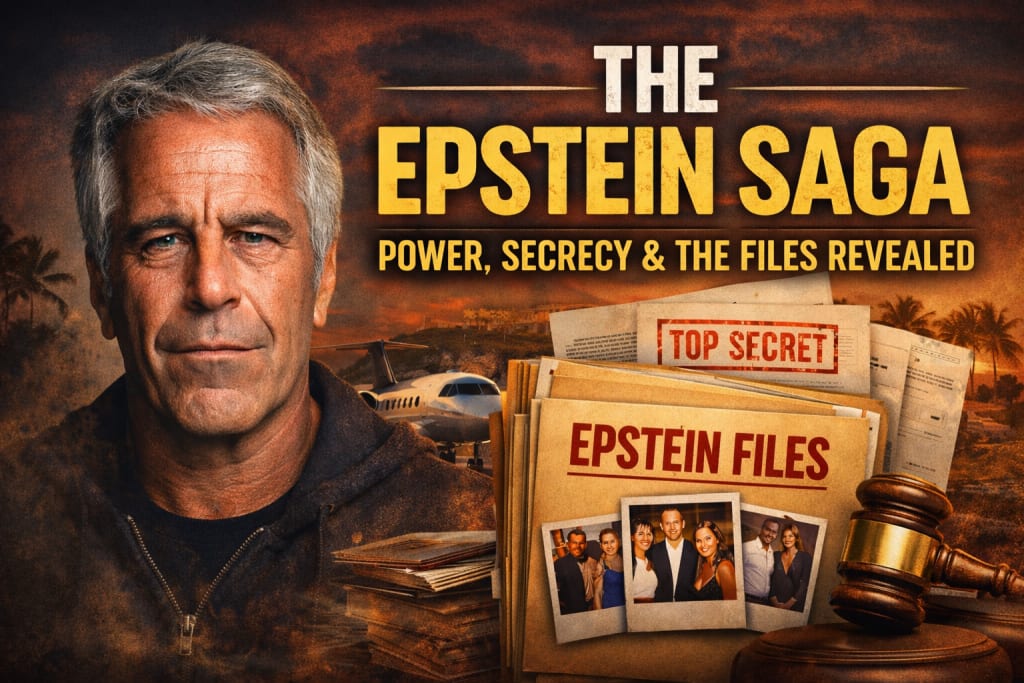
For years, the name Jeffrey Epstein floated quietly through elite social circles. He was known as a wealthy financier, a man who entertained billionaires, politicians, academics, and celebrities at lavish properties across the globe. To the public, he appeared mysterious but successful. Behind the scenes, however, a far darker story was unfolding — one that would eventually shake governments, expose legal failures, and lead to the release of what the world now calls the Epstein files.
This is the story of who Jeffrey Epstein was, what he did, and why new revelations continue to surface years after his death.
A Man Who Moved Among the Powerful
Born in Brooklyn in 1953, Epstein did not come from wealth. Yet by the late 1970s and early 1980s, he had positioned himself within the world of high finance. He worked briefly as a teacher before moving into investment banking and later creating his own financial management firm. He claimed to manage money for extremely wealthy clients, though details about his business operations were often vague.
What was clear, however, was his growing list of influential acquaintances. He was regularly seen with prominent figures in politics, technology, academia, and royalty. His homes in New York, Florida, New Mexico, Paris, and his private island in the Caribbean became symbols of both luxury and exclusivity.
But while the world saw privilege and prestige, survivors were living with trauma.
The Hidden Crimes
Over time, allegations began to emerge from young women and girls who said Epstein had sexually abused them when they were minors. Many described similar patterns: they were approached with offers of money, work, or help with their future, only to be drawn into situations of exploitation.
Investigations revealed that Epstein had created a system in which victims were often encouraged to recruit other girls, expanding the cycle of abuse. The crimes were not isolated incidents but part of a disturbing pattern that continued for years.
In 2008, Epstein faced charges in Florida related to the solicitation of minors. Yet the outcome stunned many observers. He secured a highly controversial plea deal that allowed him to serve just 13 months in a county jail with work-release privileges. The agreement prevented federal charges and granted immunity to potential co-conspirators. Critics later described this deal as a major failure of the justice system.
Arrest, Jail, and a Death That Sparked Questions
In July 2019, federal prosecutors in New York arrested Epstein again, this time on charges of sex trafficking minors. The case quickly gained national and international attention. Survivors felt that, at last, accountability might come.
But before the trial could begin, Epstein was found dead in his Manhattan jail cell on August 10, 2019. Authorities ruled his death a suicide. The circumstances surrounding his death — including reported security failures and broken cameras — fueled widespread suspicion and countless theories, many of which persist today.
His death did not end the story. In many ways, it intensified it.
Ghislaine Maxwell and the Expanding Investigation
Epstein’s longtime associate, Ghislaine Maxwell, was later arrested and convicted for her role in helping him recruit and groom underage girls. Her conviction confirmed that Epstein did not act alone. It also strengthened demands for the release of investigative materials that could reveal how such abuse went on for so long and who may have known about it.
Public pressure mounted. Survivors, journalists, and lawmakers all asked the same question: what information was sitting inside government files that the public had never seen?
The Push for Transparency
Years of legal battles and freedom-of-information requests followed. Eventually, lawmakers passed legislation requiring the Department of Justice to release large portions of its records related to the Epstein investigation, while still protecting the identities of victims.
These documents, collectively known as the Epstein files, include flight logs, emails, financial records, interview notes, photographs, and internal investigative reports. The scale of the archive is enormous — millions of pages and thousands of pieces of media collected over years.
When the first waves of documents were released, they sparked immediate global interest.
What the Newly Released Files Reveal
The recent releases have not delivered a single explosive secret. Instead, they paint a broader, more detailed picture of Epstein’s world.
Some files show how frequently Epstein traveled between his properties and who accompanied him on certain trips. Others reveal how investigators struggled with incomplete records, reluctant witnesses, and complex financial structures. In some cases, documents appear with heavy redactions, while in others, redactions were reportedly flawed, unintentionally revealing sensitive details.
Photographs and correspondence demonstrate how deeply Epstein had embedded himself into elite networks. These materials have prompted fresh scrutiny over the nature of his relationships, though appearing in a document or photo does not necessarily imply wrongdoing.
One important takeaway from official reviews is that investigators did not find proof of a formal “client list” or a structured trafficking network involving prominent individuals, despite years of speculation. This finding has challenged many public assumptions while still leaving room for unanswered questions.
International Ripple Effects
The files have also created political and legal consequences beyond the United States. In several countries, public figures have faced renewed scrutiny due to past associations with Epstein. Some have stepped down from positions, while others are under investigation for financial or legal ties that were not previously known.
The documents have also drawn attention to Epstein’s properties, especially his New Mexico ranch and Caribbean island, where multiple survivors say abuse occurred. These locations are now central to understanding the full scope of what happened.
Why the Story Still Matters
Jeffrey Epstein is no longer alive, yet his case continues to affect legal systems, political careers, and public trust. For survivors, the release of these files is not about curiosity — it is about acknowledgment and accountability. For the public, it raises serious questions about how someone with so much power avoided full justice for so long.
The ongoing document releases suggest that the story is not finished. Government agencies are still reviewing material, and advocacy groups continue to demand greater transparency.
A Legacy of Questions
At its core, the Epstein saga is about more than one man’s crimes. It is about how wealth, influence, and secrecy can protect wrongdoing for years. It is about legal failures that allowed abuse to continue. And it is about the long struggle for truth by those who refused to be silenced.
The Epstein files are not just records from the past. They are a reminder that justice can be delayed, but the search for truth does not disappear.
About the Creator
Active USA
Motivation, News, technology
Keep reading
More stories from Active USA and writers in Criminal and other communities.
Microsoft Alerts Businesses and Governments to Critical Server Software Attack.
In July 2025, Microsoft issued a high-priority security alert warning businesses, government agencies, and IT administrators worldwide about a newly discovered and active attack campaign targeting Microsoft server software. The company revealed that a sophisticated hacking group is exploiting previously unknown vulnerabilities in Microsoft Exchange Server and Microsoft SQL Server to gain unauthorized access to corporate and government networks.
By Active USA 7 months ago in Criminal
The Race for Resources: The Final Frontier of Power
The Race for Resources: The Final Frontier of Power As the struggle for influence intensifies, the world is entering a new era of resource competition that will define the next century. While the previous chapters of this story focused on cyber security and political interference, the next major shift is happening on the ground—and under the ice. The "Race for Resources" is no longer just about oil and gas; it is about the rare materials needed for the next generation of technology and the strategic routes that connect the East and the West. As nations like China expand their reach through massive investment projects, the Western world is waking up to a new reality: if you do not own the supply chain, you do not own your future.
By Wings of Time 6 days ago in Criminal
The Angry Man in Your House
"If you grow up with an angry man in your house, there will always be an angry man in your house" This statement has caused plenty of controversy online, people say its a statement that blames victims while also undermining those who break traumatic cycles to form health relationships... but if I'm honest now that I'm in my 30s it makes more sense to me than ever, and I'd argue that its not just about fathers and uncles.
By S. A. Crawforda day ago in Humans




Comments
There are no comments for this story
Be the first to respond and start the conversation.