
The Future of Mass Media
Paradigm Change at the End of Information Order

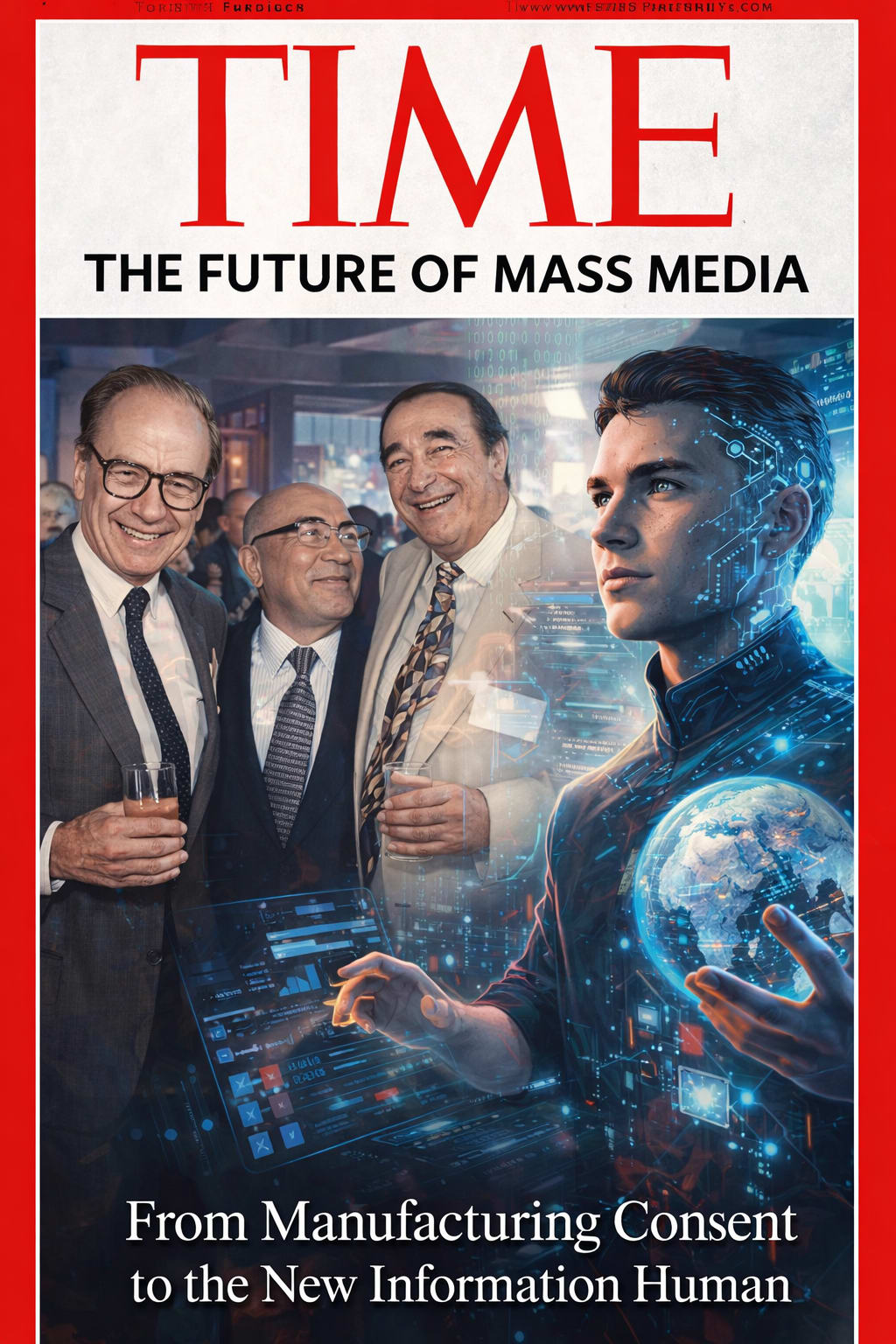
The Future of Mass Media, Paradigm Change at the End of Information Order
Peter Ayolov, Sofia University "St. Kliment Ohridski", 2026
Abstract
This article examines the future of mass media at the point where the twentieth-century information order reaches structural exhaustion and a new paradigm of mass communication becomes unavoidable. Revisiting the critical legacy of UNESCO’s New World Information and Communication Order, Denis McQuail’s paradigm shift thesis, and the political economy critiques articulated in Inventing Reality and Manufacturing Consent, the article argues that these models described a media system oriented toward stabilising power through manufactured consensus. Drawing on The Economic Policy of Online Media: Manufacture of Dissent, it develops the claim that contemporary digital media no longer primarily manufactures consent but systematically produces, manages, and monetises dissent through platform architectures, algorithmic amplification, and attention economies. The article situates this transformation within broader technological changes, including artificial intelligence, instant translation, permanent archiving, and global connectivity, which undermine secrecy and force power systems into unprecedented exposure to the past. Against this background, the article asks whether a new form of consent is possible by 2088—one century after Manufacturing Consent—under conditions of radical informational transparency. It concludes that the future of mass media is inseparable from the emergence of a new anthropological figure, the New Information Human, for whom knowledge replaces belief and verification replaces narrative loyalty, marking a shift from mass persuasion toward individual responsibility as the foundation of any future information order.
Keywords
mass media; paradigm shift; manufacture of dissent; manufacture of consent; information order; propaganda; intentional media; artificial intelligence and journalism; global media systems; New Information Human; Chomsky
Introduction: The Dead End of Mass Media
Debates about the future of mass media have long oscillated between technological optimism and political anxiety. Since the late twentieth century, media theory has repeatedly returned to the problem of consent, power, and information control, most notably in projects such as UNESCO’s New World Information and Communication Order , Denis McQuail’s reformulation of the normative foundations of mass communication, and the critical political economy articulated in works like Inventing Reality (1986) by Parenti and Manufacturing Consent (1988) by Herman and Chomsky. These interventions emerged from a specific historical moment: the Cold War, the consolidation of broadcast media, and the rise of transnational information asymmetries. Yet their central concern—the production of shared reality through media power—has not diminished. It has intensified.
UNESCO’s New World Information and Communication Order was effectively suppressed in the late Cold War period through coordinated political and financial pressure, most visibly by the withdrawal of funding and membership by major Western states, which framed the project as a threat to press freedom while protecting existing global information asymmetries. Introduced too early for the technological conditions of its time, NWICO may appear less utopian in 2026, when global digital infrastructures, instant translation, and transnational media flows have created the material conditions for a genuinely plural and more symmetrical information order to be reconsidered. McQuail’s proposal for a new paradigm of mass communication remained largely confined to academic debate and was not taken up by policy-makers or media institutions, advancing only slowly as its implications challenged entrenched professional and economic interests. This delayed reception is unsurprising in light of Thomas Kuhn’s theory of paradigm change, articulated in The Structure of Scientific Revolutions, which explains why new paradigms typically gain recognition only after prolonged resistance—making McQuail’s ideas appear strikingly contemporary precisely now.
After the publication of Manufacturing Consent and Inventing Reality, and through their gradual assimilation within academic circles of media and propaganda research, it became increasingly clear that the propaganda model did not merely manufacture consent but actively invented reality, functioning in a manner structurally analogous to the early propaganda institutions of the Catholic Church from which the term itself originates. This recognition carried an implicit temporal insight: that such a model, once fully understood, could not remain stable indefinitely and would eventually exhaust its own legitimacy, a transition anticipated in Denis McQuail’s reflections on the emergence of a new paradigm of mass communication. That moment arrived with Manufacture of Dissent (2023), which marks the theoretical shift from consent-oriented propaganda to a new paradigm in which dissent itself becomes the primary object of systemic production, management, and economic exploitation in the twenty-first century.
The Economic Policy of Online Media: Manufacture of Dissent (2023) rereads the late-twentieth-century critique of media power articulated in Manufacturing Consent and Inventing Reality by shifting the analytical focus from ideological control to economic incentives, platform architectures, and attention markets. It argues that in the digital environment power no longer primarily manufactures consent, but systematically produces, monetises, and stabilises dissent as a renewable resource. The book advances the hypothesis that the emerging paradigm of mass communication in the twenty-first century is defined not by unified propaganda but by the infrastructural management of permanent disagreement as a condition of political and economic order. This article revisits those late twentieth-century frameworks in light of contemporary transformations in global communication and develops a forward-looking question: what is the future of mass media once it becomes truly global, multilingual, instantaneous, and structurally unavoidable across all political regimes? Not Western liberal mass media alone, but a planetary media system encompassing democracies, hybrid regimes, authoritarian states, corporate platforms, criminal networks, financial infrastructures, and informal communicative orders. The question is not whether mass media will survive, but what kind of consent—or dissent—it will organise by the year 2088, exactly one century after the publication of Manufacturing Consent. At the core of classical mass-media theory lies a political axiom older than modern media itself: the consent of the governed is the foundation of all political systems. Consent presupposes shared information, shared temporal reference points, and a minimal agreement about how collective life functions. When information is systematically hidden, distorted, or segmented, consent becomes fragile. Historically, such fragility has eventually produced legitimacy crises and the collapse or transformation of power systems. The late twentieth-century critique of propaganda assumed that secrecy, asymmetry, and narrative control could be sustained. The twenty-first century increasingly suggests otherwise. The article The Future of Mass Media, Paradigm Change at the End of Information Order argues that the future of mass media cannot be separated from the future of the state and of power itself. Drawing on Thomas Hobbes’s image of Leviathan, the modern state appears as a monster constructed from consent—an artificial unity sustained through law, fear, and shared symbolic order. Yet Hobbes also named its shadow: Behemoth, the monster of dissent, fragmentation, and civil war. In the contemporary condition, this civil war is increasingly non-kinetic and informational: a cold civil war conducted online, where ideological nations coexist within the same territorial state. Mass media no longer merely mediates power; it becomes the terrain on which Leviathan and Behemoth struggle continuously. New communication technologies intensify this tension. Instant translation, permanent archiving, algorithmic retrieval, and near-universal access to historical records push power systems out of the shadows of secrecy. This exposure extends beyond governments to intelligence services, financial institutions, criminal organisations, familial networks, and informal elites. The defining resource of the coming century is not energy or territory, but information—specifically information about the past. All information is retrospective; it stabilises memory, assigns responsibility, and constructs continuity. Power, therefore, increasingly depends on controlling temporal narratives rather than merely present events.
This temporal dimension reopens the question famously dramatised in 1984: ‘Who controls the past controls the future; who controls the present controls the past.’ The standard reading casts Winston Smith as a victim of totalitarian manipulation. Yet a closer reading reveals something more unsettling. Winston is a privileged Party member whose job is to rewrite history, generate slogans, and fabricate propaganda. He is not merely oppressed by Big Brother; he is one of its operational functions. Likewise, O’Brien authors the very text of the regime’s greatest enemy. Opposition and domination are co-produced. This is not a flaw in the system but its operating logic—a logic recognisable today in what can be described as kayfabe politics: the staged antagonism of heroes and villains, dissenters and rulers, whose conflict sustains the spectacle of power. If this mechanism is now widely understood, the future problem is no longer ignorance but knowledge. Archives are open. Old newspapers expose old lies. Slogans repeat with mechanical predictability. The past increasingly reveals itself as a loop rather than a linear progression. In such a condition, the emerging subject is not Orwell’s manipulated victim but a new figure: the informed individual who knows too much. After Fukuyama’s ‘end of history’ and Nietzsche’s ‘last man’, a different anthropological type appears—the human who knows everything and therefore mistrusts everything. This raises the central question of this article: can a future global media system generate consent under conditions of radical informational transparency? Is a relatively ‘light’ power system possible—one that operates with reduced secrecy, fewer hidden agendas, and diminished narrative manipulation? Or does the exposure of the past inevitably accelerate Behemoth, producing perpetual dissent, ideological fragmentation, and permanent informational civil war? The future of mass media, this article contends, is inseparable from this dilemma. It is not a question of freedom versus control, but of whether shared reality itself remains governable in an age where the past is no longer easily rewritten, yet endlessly reinterpreted. The future of mass media, therefore, is ultimately the future of history—who writes it, who reads it, and whether knowing it grants power, paralysis, or a new, unstable form of collective consent.
From Information Order to Information Dystopia: Rethinking Global Media Power
The idea of a New World Information and Communication Order emerged in the late twentieth century as a normative response to global asymmetries in communication power. Articulated most clearly through UNESCO debates and the MacBride Commission, NWICO proposed a future in which communication would no longer function as a unidirectional system of domination but as a plural, participatory, and egalitarian infrastructure supporting global understanding. Four decades later, the historical irony is difficult to ignore. What materialised was not a democratic world information order but its inverse: a global system of communication that is formally abundant yet structurally unequal, technically interconnected yet politically fragmented, and increasingly governed by private monopolies rather than public norms. The New World Information Order did not disappear; it returned as dystopia. Contemporary digital media infrastructures enable an unprecedented mapping of global communication flows. Large-scale archiving, algorithmic analytics, and platform integration produce a comprehensive cartography of who speaks, who is heard, and who remains invisible. This cartography reveals not horizontality but hierarchy. Information power is concentrated in a small number of transnational actors who control platforms, infrastructures, standards, and visibility itself. Communication remains global in reach but asymmetrical in structure. In this sense, it is no longer metaphorical to speak of a new information totalitarianism: a system in which control does not operate primarily through censorship or overt repression, but through ownership, design, and algorithmic prioritisation. At the theoretical level, communication can still be understood through two opposing models. The first conceives communication as transmission: orders, commands, narratives, and interpretations flowing from centre to periphery. This model stabilises hierarchy, reproduces inequality, and sustains existing power arrangements. The second conceives communication as interaction: reciprocal exchange among informed participants who share access, agency, and voice. This latter model promises trust, creativity, and democratic coordination. NWICO was an attempt to institutionalise this second model at a planetary scale. Its failure, and the historical trajectory that followed, form the background of the present dystopian condition.
The MacBride Commission’s 1980 report, Many Voices, One World, diagnosed communication inequality as a structural obstacle to social development and democratic participation. It identified media concentration, information monopolies, and the centralisation of communicative power as sources of global imbalance. Access to information and the capacity to communicate, the report argued, were not luxuries but prerequisites for human development. Without them, individuals and communities were condemned to passivity, dependency, and political invisibility. The report’s warnings were prescient. It anticipated that emerging communication technologies could either deepen inequality through technocratic centralisation or enable decentralised participation and pluralism. The decisive variable was governance. One of the Commission’s most striking contributions was its anticipation of a globally networked communication infrastructure—effectively a prefiguration of the internet. Yet this technological foresight was coupled with an ethical warning. Networks could become servants of human communication or masters of social organisation. The humanisation of communication was therefore central to the NWICO vision: transforming anonymous mass audiences into interconnected individuals, and passive consumers into active citizens. The report also recognised the absence of independent communication systems for international organisations themselves. Without such systems, global institutions remained dependent on private or nationally biased media to mediate their relationship with the world’s public. NWICO thus aimed to create the conditions for an international public opinion grounded in shared information, dialogue, and mutual recognition rather than elite-manufactured narratives.
The concept of international public opinion remains unresolved. Public opinion presupposes informed participants capable of deliberation, disagreement, and consensus-building. Despite global connectivity, no stable international public opinion has emerged around issues such as climate change, pandemics, or war. This absence is not merely cultural but structural. States and corporations that benefit from informational asymmetry have little incentive to support egalitarian global media arrangements. Divide-and-rule logics persist, now reinforced by platform segmentation and algorithmic personalisation. While social networks technically enable multidirectional communication, the dominance of platform monopolies and the absence of independent global media institutions undermine the egalitarian public sphere envisioned by the MacBride Commission. The political response to NWICO illustrates the limits of normative reform under conditions of asymmetric power. The MacBride proposals implied a redistribution of communicative authority and directly challenged Western media dominance. In the early 1980s, these implications provoked a decisive backlash. The United States and later the United Kingdom withdrew from UNESCO, effectively freezing NWICO discussions and signalling that reform of the global information order would not be tolerated where it threatened established economic and geopolitical interests. Communication, as the Commission understood, is foundational to both financial and military power. Control over information infrastructures underwrites legitimacy, coordination, and authority. Any attempt to democratise this control was therefore perceived as a systemic threat.
In the decades that followed, the abandoned normative horizon of NWICO was replaced by marketisation. What has been described as the “Murdochisation” of global communication names a broader transformation: the commercialisation, concentration, and ideological narrowing of media systems worldwide. Public service ideals gave way to profit-driven models in which media primarily serve private interests. Disagreement and conflict became commodities. Polarisation, outrage, and identity segmentation proved effective for securing attention and revenue. In this environment, trust eroded and publics fragmented into mutually hostile interpretative communities. The MacBride vision of many voices in a shared global conversation receded as communication became a mechanism for managing division rather than fostering dialogue. Contemporary debates over net neutrality and digital inequality represent a technical continuation of these earlier conflicts. The principle that carriers should not discriminate among content echoes the MacBride Commission’s insistence on non-discriminatory access and the dangers of monopolistic control. The erosion of net neutrality, combined with the consolidation of platform power, threatens to entrench a new global hierarchy of information. Access becomes stratified, visibility becomes purchasable, and participation becomes conditional. Abundant information coexists with structural exclusion. What emerges from this historical trajectory is a paradox. The New World Information Order was conceived as a project of emancipation but returns today as a dystopian mirror. Information flows are global yet unequal; communication is instantaneous yet fragmented; publics are connected yet divided. The failure of NWICO did not eliminate the problem it sought to address. It merely displaced it into a more complex and opaque configuration. The dystopia of the present lies not in the absence of information but in its concentration, monetisation, and strategic manipulation. Yet the legacy of NWICO remains analytically indispensable. It reminds media research that communication systems are normative structures, not neutral technologies. They embody choices about equality, participation, and power. The early promise of the internet—a decentralised, cooperative, and horizontal communication environment—has not entirely vanished. Scholars, journalists, and citizens continue to use digital tools to expose abuses and experiment with alternative publics. Whether these practices can scale beyond isolated resistance depends on a renewed engagement with the foundational questions posed by the MacBride Commission: who owns communication infrastructures, who governs them, and in whose interests they operate. Without addressing these questions, each new communication technology will tend to reproduce the same asymmetries that the New World Information Order sought, unsuccessfully, to overcome.
Time for a Paradigm Shift: Rethinking Mass Communication
The contemporary crisis of mass communication is not primarily a technological problem but a paradigmatic one. The emergence of the manufacture-of-dissent model in online media is a consequence of deep structural transformations in global communication that have not yet been fully recognised or theorised. Communication systems inherited from the twentieth century continue to operate according to assumptions that no longer correspond to the realities of digital networks, platform economies, and algorithmically mediated publics. This mismatch between paradigm and practice has become one of the central sources of political instability, social fragmentation, and democratic dysfunction in the twenty-first century.
The classical paradigm of mass communication was built on a hierarchical architecture: information flows from a limited number of centralised producers to a large number of dispersed recipients. Filtering, gatekeeping, and agenda-setting functioned at the source, and the audience was imagined as a relatively homogeneous mass whose attitudes and behaviours could be shaped through exposure to common messages. This model proved historically powerful because it aligned with the organisational needs of states, advertisers, and large media institutions. It also provided the conceptual foundation for propaganda research and for theories explaining how consent could be manufactured within democratic systems. Yet this paradigm is now in visible decline. Denis McQuail’s late reflections on paradigm change in communication theory articulated a growing unease with the absence of a shared theoretical framework capable of accounting for contemporary communication dynamics. McQuail observed that communication research had become increasingly fragmented, closely tied to political and commercial interests, and dominated by empirical studies designed to serve specific institutional demands rather than theoretical coherence. At the same time, the apparent stability of the media system created the illusion that no fundamental change was required. Media industries continued to thrive on sensationalism and consumption; political actors used communication to shape beliefs on a global scale; audiences appeared entertained and engaged; and academic output expanded steadily. On the surface, the system worked. Beneath this surface, however, a transformation was already underway. Digital networks introduced a radically different logic of communication—one that could no longer be reduced to transmission. The Internet does not primarily function as a channel for moving information efficiently from sender to receiver; it functions as a space in which human groups form, dissolve, and reorganise themselves. Communication online is inseparable from identity, belonging, and conflict. Information circulates not to persuade a unified mass but to bind communities together and distinguish them from others. Under these conditions, communication effects are no longer predictable, universal, or linear. They are contextual, group-specific, and often antagonistic.
The old paradigm assumed that individuals could be reached directly, bypassing culture, ideology, family, religion, and local social structures. Messages were expected to overwhelm traditional filters and produce conformity. Media power was understood primarily as the capacity to shape beliefs through content. This assumption now appears inadequate. Online communication does not dissolve social structures; it multiplies them. Individuals do not receive messages in isolation but interpret them within dense networks of affiliation and opposition. The result is not consensus but persistent disagreement, polarisation, and symbolic conflict. This shift does not eliminate propaganda; it transforms it. In the classical model, propaganda aimed at unifying the audience by manufacturing consent. In the emerging paradigm, power increasingly operates by manufacturing dissent—by dividing audiences into antagonistic groups whose conflicts can be managed, monetised, and politically exploited. The strategic objective is no longer agreement but controllable disagreement. The audience is no longer imagined as a mass but as a collection of segmented communities whose internal cohesion is strengthened through opposition to others. Research on media effects has begun to reflect this transformation. Contemporary studies move away from grand claims about omnipotent media influence and focus instead on differentiated effects within specific groups and contexts. The audience is no longer treated as passive or uniform but as active, interpretive, and constantly monitored. Digital technologies enable detailed tracking of behaviour, preferences, and interactions, allowing unprecedented precision in communication strategies. At the same time, the free circulation of information online revives the ritual view of communication as the creation of shared meaning within communities. Media become spaces for interaction rather than mere transmitters of messages. This development creates a paradox. On the one hand, the Internet undermines the traditional power of mass media by exposing audiences to multiple perspectives and enabling direct communication. On the other hand, it enables new forms of manipulation that are more subtle, personalised, and embedded in social relations. Trust shifts away from institutions and towards peers, influencers, and charismatic figures. Mass media increasingly reinforce existing beliefs rather than changing minds, while polarisation becomes a structural feature of public life.
The concept of the audience undergoes a corresponding transformation. The homogeneous mass audience remains attractive for advertisers and propagandists because it simplifies strategy and measurement. In practice, however, audiences increasingly resemble what Roland Burkart describes as dispersive audiences: loosely connected individuals who share opinions or interests without forming genuine communities. Such audiences generate what can be called non-public opinion—aggregates of similar views lacking the dense social ties necessary for deliberation and collective responsibility. These formations resemble swarms rather than publics. Communication becomes continuous, automatic, and ritualised, while genuine interpersonal exchange diminishes. This condition challenges the very idea of mass communication. If communication presupposes reciprocity and community, then much of what passes for mass communication today risks becoming a simulation: endless publication without dialogue, commentary without encounter. The effects of communication under these conditions cannot be captured by mechanistic models or reduced to exposure metrics. They depend on how people use media within their social worlds, how information interacts with values, loyalties, and lived experience. The need for a paradigm shift therefore arises not from theoretical fashion but from empirical necessity. Communication understood solely as information transfer can no longer account for the organised division of societies, the persistence of conflict, and the strategic production of dissent. The old model continues to serve powerful actors in advertising, politics, and platform capitalism, which explains its inertia. Audiences themselves do not necessarily demand change, as the system provides entertainment, identity, and belonging. But for communication research, the costs of conceptual stagnation are growing. A new paradigm must treat communication as a social ritual through which communities are formed, maintained, and opposed. It must analyse how dissent is organised, stabilised, and exploited rather than assuming that consensus is the default or desired outcome. The Internet has made a new information order technically possible, but without a corresponding theoretical shift, this possibility risks being absorbed into existing structures of domination. The question is no longer whether a paradigm shift is needed, but whether communication theory can recognise that its time has already arrived.
Reality, Consent, and Dissent: From Manufactured Consensus to Monetised Conflict
The critical tradition inaugurated in the late twentieth century by Michael Parenti and by Edward Herman and Noam Chomsky established a powerful framework for understanding how modern media systems shape reality, delimit political imagination, and stabilise power. Yet the distance between that historical moment and the present digital environment is no longer merely technological; it is paradigmatic. Comparing Inventing Reality, Manufacturing Consent, and The Economic Policy of Online Media: Manufacture of Dissent reveals not simply different emphases, but a fundamental shift in how power relates to reality, consent, and dissent itself. Both Parenti and Herman–Chomsky begin from a shared diagnosis: media reality is not neutral, objective, or spontaneous. News is produced within structural constraints that align it with the interests of political and economic elites. What appears as balance or professionalism is in fact the outcome of systemic filtering that narrows the spectrum of acceptable discourse and marginalises radical alternatives. Media thus functions as a stabilising force, reproducing the status quo by shaping what can be said, who can speak, and which interpretations appear legitimate.
The difference between the two late-twentieth-century models lies in emphasis rather than opposition. Herman and Chomsky formalise media power through the Propaganda Model, identifying five structural filters—ownership, advertising, sourcing, flak, and ideology—that operate largely without conspiracy or direct coercion. Their focus is institutional and procedural: journalists behave as propagandists not because they are instructed to do so, but because the system rewards conformity and penalises deviation. Parenti’s approach is more explicitly political and class-oriented. For him, media does not merely filter reality; it actively invents it, constructing narratives that justify capitalist exploitation, imperial intervention, and social inequality. Where Herman and Chomsky analyse structure, Parenti foregrounds ideology and class struggle. Despite these differences, both models presuppose the same strategic objective of power: consensus. Media is designed to unify the public, to produce a stable ideological environment in which fundamental assumptions about capitalism, foreign policy, and social hierarchy remain unchallenged. Dissent is dangerous precisely because it threatens unity. It must therefore be excluded, marginalised, or rendered invisible. The public, whether described as a “bewildered herd” or as passive conformists, is imagined as something to be managed, calmed, and aligned. This assumption no longer holds in the digital media environment. Manufacture of Dissent departs from its predecessors not by rejecting their insights, but by historicising them. It argues that the classical propaganda model described a specific media ecology: centralised, one-to-many, slow, and institutionally gatekept. In that environment, consensus was profitable and politically functional. In the contemporary attention economy, however, consensus has lost its economic value. Fragmentation, conflict, and emotional escalation generate more engagement, more data, and more revenue than stability ever did.
The new media system therefore does not suppress dissent; it produces it. Algorithms amplify outrage because anger travels faster than agreement. Platforms segment publics into hostile camps because polarisation maximises attention. Political conflict becomes performative, repetitive, and structurally inconclusive. Instead of silencing opposition, the system invites everyone to speak—loudly, constantly, and against one another. Dissent is no longer a threat to power; it is its raw material. This marks a decisive shift in the relationship between reality and propaganda. In Parenti’s model, reality is invented to appear coherent and inevitable. In Herman and Chomsky’s model, reality is filtered to appear reasonable and centrist. In Ayolov’s model, reality is deliberately destabilised. What emerges is not a shared worldview but a sequence of managed moral dramas—predictable cycles of outrage that never challenge the underlying platform infrastructures or ownership structures. Power no longer requires belief; it requires participation. Users become players in staged conflicts whose outcomes are irrelevant as long as engagement continues. The role of the public changes accordingly. The passive audience of twentieth-century mass media becomes an active but fragmented participant in digital conflict. Individuals experience themselves as autonomous, expressive, and politically engaged, even as their interactions are shaped by algorithmic incentives they neither see nor control. The result is what can be described as decorative democracy: democratic forms without deliberative substance, participation without collective agency, and visibility without power.
Seen together, the three books form a chronological sequence that tracks the evolution of propaganda from exclusion, through filtering, to amplification. In the 1980s, the problem was silence—radical ideas kept out of the news. Today, the problem is noise—everything is visible, but nothing coheres. The classical fear was manipulation through scarcity of information; the contemporary danger is control through excess, speed, and emotional saturation. This transformation explains why a new model is required. Applying the old paradigm of manufactured consent to the digital environment obscures more than it reveals. The system no longer aims to make people agree; it aims to keep them permanently divided, morally activated, and economically exploitable. Reality itself becomes unstable, not because truth has vanished, but because it is drowned in performative conflict. Understanding contemporary media power therefore requires a shift from analysing how consent is produced to examining how dissent is organised, circulated, and monetised. Without this shift, media theory risks mistaking the symptoms of the present for the mechanisms of the past.
Intentional Media and the Scripted Public Sphere
Published by PressReader, 2026: The Year of Intentional Media forecasts a major shift in digital news consumption away from click-driven, attention-chasing formats toward content that readers choose because it fits their daily routines, supports understanding, and builds trust. The report predicts that in 2026 audiences will increasingly seek calm, purposeful media experiences shaped by AI-assisted delivery and design features that prioritise relevance, clarity and utility over sensationalism. By 2026, the media system enters a phase that can no longer be adequately described through the logic of attention capture alone. After more than a decade dominated by clicks, alerts, outrage cycles, and continuous visibility, digital publishing encounters a structural limit: audiences are no longer merely distracted but cognitively exhausted. What emerges in response is not indifference to information, but selectivity. This transition is increasingly described as the rise of intentional media—a mode of communication defined less by volume and velocity than by fit, relevance, and experiential coherence.
Intentional media refers to content that people actively choose because it integrates meaningfully into their daily lives. It is media designed to support focus, understanding, learning, routine, and reflection rather than to provoke compulsive engagement. Instead of asking how to seize attention, intentional media asks how to deserve it. This shift is not cosmetic; it marks a reorientation of value in the media economy, from agitation to utility, from shock to service, from perpetual urgency to contextual relevance. Seen through the lens of The Media Scenario, Scriptwriting for Journalists (2026), intentional media represents a structural convergence between journalism and scenario logic. The book argues that modern media no longer merely reports events but scripts reality: it organises time, roles, expectations, and emotional trajectories in ways comparable to dramatic structures. In this sense, intentional media is not anti-narrative; it is post-chaotic narrative. It replaces the improvised dramaturgy of outrage with designed scenarios that respect the limits of human attention and the rhythms of everyday life. Drawing on narrative theory and communication studies, it argues that contemporary media must be approached as authored scenarios integrating roles, settings, conflicts, and resolutions, thereby providing journalists the conceptual tools to craft information environments that support coherent public life rather than fragmented attention.
Three tendencies define this shift. First is what can be called lifestyle gravity. Audiences increasingly return not to breaking news but to content that anchors routine: puzzles, hobbies, wellness, cooking, practical guides, and service journalism framed explicitly around ‘what this means for me’. This does not signal the disappearance of political or economic news, but a reordering of entry points. Hard news becomes something people consult when needed, while everyday formats become the loyalty engines that sustain long-term relationships. From a scenario perspective, these formats function as recurring acts rather than climactic events—they stabilise the narrative environment in which exceptional events are later interpreted.
Second is the rise of ambient news. Artificial intelligence accelerates the transformation of journalism from a fixed product into a contextual layer. News is no longer encountered primarily through front pages or feeds, but through briefings, summaries, audio explainers, graphs, alerts, and conversational queries that adapt to time, place, mood, and cognitive availability. The same journalistic core is transformed into multiple narrative forms depending on the moment of use. This aligns directly with the media-scenario argument that meaning is not inherent in content alone, but emerges from its placement within lived temporal sequences. AI becomes not the author of journalism, but the stage machinery that adapts the script to the situation.
Third is the redefinition of trust as a product rather than an abstract value. In an environment saturated with synthetic content and automated text, trust is no longer communicated implicitly through institutional authority. It must be performed through tone, labeling, transparency, and design. Calmness becomes a signal of credibility; clarity becomes an ethical choice. Distinctions between reporting, analysis, opinion, and synthesis are made visible rather than assumed. Provenance, corrections, and explanations of method move from footnotes to interfaces. From the perspective of media scenario theory, this represents a shift from hidden scripting to acknowledged dramaturgy: the audience is no longer treated as a passive viewer but as a conscious participant who must understand how the narrative is constructed. Intentional media thus responds directly to the pathologies of the manufacture-of-dissent phase. Where the previous model monetised anger, polarisation, and moral escalation, intentional media seeks to lower emotional volatility without abandoning significance. It does not depoliticise reality, but it refuses to stage every issue as an existential confrontation. In scenario terms, it replaces permanent crisis mode with differentiated narrative registers: moments of urgency coexist with moments of explanation, routine, and pause.
This also clarifies why intentional media is not a retreat from journalism but a reformulation of its social role. Journalism becomes less a machine for producing headlines and more an infrastructure for sense-making. The key question is no longer ‘What happened?’ but ‘Where does this belong in my understanding of the world?’ That question is inherently scenographic: it concerns sequence, proportion, relevance, and consequence. In this sense, intentional media is inseparable from the future of mass communication as a whole. As AI mediates access, as audiences enter news through assistants rather than feeds, and as trust migrates from institutions to experiences, media increasingly functions as a designed environment rather than a stream of messages. *The Media Scenario* provides a conceptual framework for understanding this shift: mass media becomes a system of scripted situations that organise public life, not by commanding belief, but by shaping the conditions under which meaning is formed. Entering the year of intentional media therefore means entering a phase where responsibility moves upstream—from moderation after the fact to design before publication. The central challenge is no longer speed or scale, but intentionality itself: how narratives are framed, how emotions are calibrated, how audiences are positioned, and how time is structured. The publishers and platforms that succeed in 2026 will be those that understand media not as noise to be amplified, but as scenarios to be carefully written into the fabric of everyday life.
What Is the Future of Mass Media: From Mass Communication to Intentional Media
Published by the Reuters Institute for the Study of Journalism, How will AI reshape the news in 2026? brings together forecasts from seventeen leading editors, journalists, and media strategists working across major international news organisations. Drawing on their practical and strategic experience, the report offers a comparative, forward-looking assessment of how generative AI is transforming news production, distribution, verification, and audience relations at a global scale. By 2026, the future of mass media no longer appears as an abstract horizon but as an observable transition already underway. What is emerging is not simply a technological upgrade of journalism but a structural reorientation of how information is produced, distributed, verified, and consumed. The dominant tendency can be described as a shift from passive mass consumption toward what industry actors increasingly call an “answer economy” and “intentional media.” While these terms originate in commercial forecasting rather than critical theory, they nonetheless reveal a deeper paradigm change that aligns closely with the arguments developed in this article.
The classical mass-media model assumed that audiences encountered information by browsing a front page, watching a scheduled broadcast, or consuming linear narratives shaped by editorial hierarchies. That logic is now dissolving. Audiences increasingly access news through AI-mediated interfaces that fragment, reassemble, summarise, and contextualise information according to situational needs. Instead of asking “What happened today?”, users increasingly ask “What does this mean for me?”, “How does this affect my work, my health, my community?” Media consumption becomes query-based, situational, and task-oriented rather than ritualistic or habitual. This transition signals the rise of the answer economy. In this model, journalism no longer appears primarily as finished articles but as modular knowledge units embedded within AI-driven conversational systems. Context replaces chronology; relevance replaces prominence. There is no front page, no fixed order, and no stable hierarchy of importance. Information is accessed through interaction rather than exposure. This transformation weakens the symbolic authority of media brands while strengthening the role of systems that can translate verified information into personalised, actionable responses. From the perspective of power and propaganda, this development is ambivalent. On the one hand, it accelerates the erosion of the old consent-manufacturing paradigm. Centralised narrative control becomes increasingly difficult when information is constantly recomposed by AI systems beyond the direct control of publishers. On the other hand, it introduces new forms of mediation that are less visible, more opaque, and more dependent on infrastructural gatekeepers. The struggle shifts from controlling content to controlling interfaces, training data, citations, and verification layers. This environment gives rise to what is increasingly described as intentional media. Unlike the outrage-driven dynamics of the attention economy, intentional media promises calmness, utility, and integration into everyday life. Content is designed not to provoke emotional escalation but to support routines, decisions, and understanding. Service journalism, explanatory formats, puzzles, and personalised briefings replace the endless production of scandal and conflict. In part, this shift is a response to news fatigue and to the visible exhaustion produced by the manufacture of dissent. Continuous outrage, once profitable, now threatens to alienate audiences and undermine trust altogether.
Trust thus becomes a central commodity. In a media environment saturated with synthetic content, deepfakes, and automated misinformation, verification emerges as a product in its own right. The value of journalism increasingly lies not in speed but in proof. Digital chains of custody, provenance standards, and authentication tools become critical infrastructures of credibility. The question “Is this real?” precedes the question “Is this important?”. Verification displaces breaking news as the primary marker of journalistic authority. At the same time, mass media is becoming immersive and participatory in new ways. Virtual and augmented reality promise forms of experiential journalism that place audiences inside events rather than observing them from a distance. Younger audiences, in particular, resist passive consumption and seek creative participation: remixing narratives, co-producing content, and engaging through social platforms, newsletters, and virtual environments. AI-generated presenters and virtual personalities extend this logic further, offering continuous interaction without human limits, while raising profound questions about authenticity, affect, and representation. Economically, the future of mass media points toward fragmentation rather than consolidation. Advertising alone no longer sustains journalism. Micromonetisation, subscriptions, niche communities, and hyperlocal models gain importance. While global platforms dominate scale, local and specialised media rediscover value by offering forms of knowledge that algorithms struggle to replicate: trust, proximity, and social embeddedness. In this sense, the crisis of mass media coincides with a partial revival of non-mass communication. Inside newsrooms, AI accelerates a structural transformation already in progress. Task-level automation gives way to agentic systems capable of coordinating complex workflows: research, investigation, verification, updating, and distribution. Journalism becomes less about producing singular texts and more about managing living knowledge systems. The newsroom increasingly resembles an infrastructure rather than a factory. This requires new skills, new ethics, and new forms of institutional responsibility. It also intensifies the asymmetry between organisations that can invest in AI infrastructure and those that cannot. Crucially, these developments do not resolve the central problem identified earlier; they reconfigure it. The old paradigm failed because it assumed a mass audience and pursued consensus through filtering. The intermediate digital phase monetised dissent through polarisation. The emerging phase risks replacing both with algorithmic mediation that is calmer, more useful, and more efficient—but also more invisible. Intentional media may reduce noise, but it may also further individualise reality, dissolving shared temporal and symbolic reference points.
The future of mass media, therefore, cannot be understood as a simple progression toward better technology or healthier communication. It represents a new stage in the relationship between reality, power, and knowledge. As journalism becomes a layer inside AI systems, the question shifts from who controls the message to who controls the system that answers questions. The danger is no longer mass manipulation through propaganda slogans, nor permanent mobilisation through outrage, but the quiet delegation of judgement to opaque infrastructures. This is why the question of the future of mass media is inseparable from the question of paradigm change. Communication theory must move beyond models centred on transmission, persuasion, or even conflict. It must confront a reality in which media operates as an adaptive interface between individuals, machines, and institutional power. Whether this new configuration will mitigate or entrench the manufacture of dissent remains open. What is clear is that mass media, as it was historically understood, is no longer the dominant form. What replaces it will shape not only how people know the world, but how they decide, trust, and act within it.
Conclusion: After Consent: Toward the New Information Human
The future of mass media will not be decided by technology alone, but by whether global societies can reinvent consent under conditions of radical informational transparency. By 2088—one century after *Manufacturing Consent*—the decisive question will no longer be how consent is manufactured, but whether a new form of consent can emerge at all in an environment where the past is permanently accessible, endlessly comparable, and resistant to narrative closure. This future points toward what may be called a new consent: not consensus imposed through propaganda, nor dissent monetised through conflict, but a fragile, provisional agreement grounded in shared verification, open archives, and the explicit acknowledgement of uncertainty. In this horizon appears a new anthropological figure: the New Information Human. Unlike the Winston Smith of 1984, this subject does not secretly rewrite history in the service of power, nor produce the speeches of Big Brother while imagining resistance as a private fantasy. The Winston of 2084 is neither victim nor functionary, but a knowing participant in an informational order where manipulation is recognisable, repetition is visible, and historical lies are searchable. This figure no longer believes in absolute narratives, yet is not paralysed by cynicism. Power can no longer rely on ignorance, silence, or controlled memory; it must operate in the open, under continuous retrospective scrutiny.
The paradox of the coming media order is therefore clear. Total transparency does not automatically produce truth, justice, or harmony. It can just as easily generate paralysis, permanent dissent, and epistemic exhaustion. Yet secrecy as a systemic principle becomes increasingly unsustainable. In this tension lies the future of mass media and of the state itself. Leviathan, the monster of consent, can no longer rule through hidden scripts alone; Behemoth, the monster of dissent, can no longer be indefinitely exploited without eroding the foundations of collective life. Between them emerges a narrow path: a lighter, more exposed form of power that governs not by pretending to control the past, but by negotiating openly with it. The end of the information order does not mean the end of media, nor the end of consent. It signals the end of naive belief in stable narratives and the beginning of a more precarious, reflexive condition in which knowing replaces believing as the primary civic burden. Whether this condition leads to renewed democratic coordination or to endless informational civil war remains undecided. What is certain is that mass media in the twenty-first century will no longer merely tell societies what to think, nor simply provoke them to fight. Its ultimate task will be to sustain the possibility of shared reality itself—under conditions where history remembers everything, and forgetting is no longer an option.
In the wake of renewed public scrutiny over Noam Chomsky’s documented contacts with Jeffrey Epstein, including meetings reported from Epstein’s calendar and subsequent reporting on released correspondence, the old countercultural posture is harder to sustain as an external critique untouched by the circuits of prestige, access, and complicity. What looks, in retrospect, like ‘radical’ media criticism can also function as a stabilising ritual inside the system it condemns: a licensed dissent that confirms the rules of the stage, even when it names the stage machinery. In Kuhnian terms, paradigm shifts rarely arrive because an old paradigm is refuted in a seminar; they arrive because the institutions, careers, and reputations that anchor the old normal science slowly lose their monopoly on what counts as serious explanation. The uncomfortable implication is not that a single thinker ‘caused’ delay, but that a field can become dependent on a canonical vocabulary that keeps revisiting the twentieth-century architecture of consent while missing the twenty-first-century infrastructure of dissent. If 2088 is imagined as the century-mark of Manufacturing Consent, the question becomes whether a new consent can emerge without the old theatrical division of heroes and villains—without a Winston who earns privilege by rewriting the past for the regime, and without an O’Brien who scripts the enemy to keep the plot alive. The only durable exit from manufactured reality is not mass enlightenment but the slow multiplication of what might be called the new information human: a person trained to verify, to remember, to trace provenance, and to refuse the emotional dramaturgy of kayfabe—so that, this time, the world follows the human rather than the spectacle.
‘The transfer of allegiance from paradigm to paradigm is a conversion experience that cannot be forced.’
-Thomas Kuhn
Bibliography
International Commission for the Study of Communication Problems (1980) Many Voices, One World: Towards a New, More Just and More Efficient World Information and Communication Order. Paris: UNESCO.
McQuail, D. (1983) Mass Communication Theory: An Introduction. London: Sage.
Parenti, M. (1986) Inventing Reality: The Politics of News Media. New York: St. Martin’s Press.
Chomsky, N. and Herman, E.S. (1988) Manufacturing Consent: The Political Economy of the Mass Media. New York: Pantheon Books.
Ayolov, P. (2023) The Economic Policy of Online Media: Manufacture of Dissent. Abingdon: Routledge.
Digital Planet 2017. Fletcher School, Tufts University. Available at: [http://sites.tufts.edu/digitalplanet/dei17/](http://sites.tufts.edu/digitalplanet/dei17/) (accessed 16 June 2020).
Federal Communications Commission (2015) ‘Protecting and Promoting the Open Internet’. Federal Register. Available at: [https://www.federalregister.gov/documents/2015/04/13/2015-07841/protecting-and-promoting-the-open-internet](https://www.federalregister.gov/documents/2015/04/13/2015-07841/protecting-and-promoting-the-open-internet) (accessed 16 June 2020).
Federal Communications Commission (2017) ‘FCC Proposes Ending Utility-Style Regulation of the Internet: First Step Toward Restoring Internet Freedom, Promoting Investment, Innovation & Choice’. Available at: [https://www.fcc.gov/document/fcc-proposes-ending-utility-style-regulation-internet](https://www.fcc.gov/document/fcc-proposes-ending-utility-style-regulation-internet) (accessed 16 June 2020).
Gwertzman, B. (1983) ‘U.S. Is Quitting UNESCO, Affirms Backing For U.N.’, New York Times, 30 December.
MacBride, S. et al. (1980) Many Voices, One World: Communication and Society Today and Tomorrow. Paris: UNESCO. Available at: [http://unesdoc.unesco.org/images/0004/000400/040066eb.pdf](http://unesdoc.unesco.org/images/0004/000400/040066eb.pdf) (accessed 16 June 2020).
Thussu, D. K. (2005) ‘From MacBride to Murdoch: The Marketisation of Global Communication’, Javnost – The Public, 12(3), pp. 47–60.
McQuail, Denis (2013). “Reflections on Paradigm Change in Communication Theory and Research.” International Journal of Communication, 7, 216–229.
Burkart, Roland (2002). Kommunikationswissenschaft: Grundlagen und Problemfelder; Umrisse einer interdisziplinären Sozialwissenschaft. Böhlau.
Reuters Institute for the Study of Journalism. (2026). How will AI reshape the news in 2026? Forecasts by 17 experts from around the world. [online] Available at: https://reutersinstitute.politics.ox.ac.uk/news/how-will-ai-reshape-news-2026-forecasts-17-experts-around-world.
PressReader Business. (2026). 2026: The Year of Intentional Media - PressReader Business. [online] Available at: https://about.pressreader.com/2026-year-of-intentional-media/ [Accessed 5 Feb. 2026].
Ayolov, P. (2026) The Media Scenario, Scriptwriting for Journalists. Sofia: Sofia University Press.
Ayolov, P. (2026) The Media Scenario, Scriptwriting for Journalists. Sofia: Sofia University Press.
Ayolov, P. (2026). Noam Chomsky and the End of Counterculture: Performing Dissent and ‘Sunsteinization’. [online] Philarchive.org. Available at: https://philarchive.org/rec/AYONCA [Accessed 5 Feb. 2026].
About the Creator
Peter Ayolov
Peter Ayolov’s key contribution to media theory is the development of the "Propaganda 2.0" or the "manufacture of dissent" model, which he details in his 2024 book, The Economic Policy of Online Media: Manufacture of Dissent.
Keep reading
More stories from Peter Ayolov and writers in Critique and other communities.
Chasing Shadows: Why “More” Doesn’t Mean Happier
Last year, the World Happiness Report highlighted a striking pattern: even in developed countries where people spend substantial amounts on non-essential goods, higher consumption beyond basic needs does not significantly increase life satisfaction. Imagine Jane, a young professional scrolling through her social media feed: her friends flaunt new cars, exotic vacations, and the latest gadgets, making her feel inadequate despite owning everything she once dreamed of. This scene is far from unusual. Every advertisement, post, and billboard seems to whisper: “You need more.” Yet, the irony of modern life is stark: despite unprecedented access to wealth and goods, many of us feel lonelier, more anxious, and less fulfilled than ever. The promise of happiness through consumption is, in reality, an illusion that leaves us running in circles, chasing temporary pleasures that fade almost as soon as we acquire them.
By Rachid Zidine6 days ago in Critique
Lil Wayne Complains About Yet Another Grammys Snub
Hang it up, sir. You're a legend in this game, but you played like Jordan on the Wizards with this last album. I actually like most of the songs including “Cotton Candy.” But it’s time to retire, homie. You’ve achieved great critical and commercial feats during your tenure in this rap sludge.
By Skyler Saunders6 days ago in Critique




Comments
There are no comments for this story
Be the first to respond and start the conversation.