
A Mind-Bending Exploration of Black Hole Cosmology
Are We Living Inside a Black Hole?

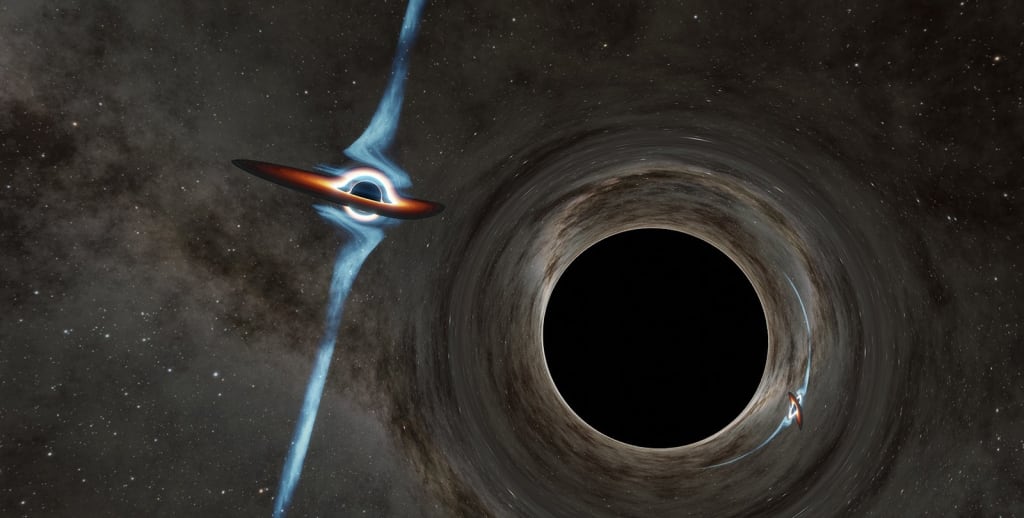
Imagine looking up at the night sky, marveling at the vast expanse of stars, galaxies, and cosmic wonders, only to learn that everything you see, including the universe itself, might be nestled inside a colossal black hole. This seemingly science-fiction idea, known as Black Hole Cosmology, is a captivating theory proposed by scientists seeking to unravel the mysteries of existence. Could our universe be one of many in a multiverse of black holes? Let’s dive into this mind-boggling concept.
The Singularity Connection
To understand the premise, we must revisit the origin of the universe: the Big Bang. Scientists believe that 13.8 billion years ago, everything—space, time, matter—originated from a singularity, an infinitely dense point where the laws of physics as we know them cease to function.
Interestingly, singularities are not exclusive to the Big Bang. They also exist at the heart of black holes, regions of space where gravity is so intense that nothing, not even light, can escape. At their core lies a singularity, a point of infinite density where all the matter sucked into the black hole is compressed.
This similarity raises a tantalizing question: Could the universe’s Big Bang have been the singularity inside a black hole?
Black Holes as Cosmic Wombs
The idea that our universe might be a black hole stems from striking coincidences in physics. For instance, the event horizon of a black hole—the point of no return for matter and light—mirrors the cosmological event horizon of our universe, which marks the furthest observable limit. Both concepts deal with regions beyond which information cannot escape, effectively isolating them from external observation.
If our universe resides within a black hole, it could mean that black holes are not mere cosmic vacuum cleaners but rather gateways to new universes. Matter falling into a black hole in a "parent universe" might emerge as a Big Bang in a new universe, creating a self-replicating multiverse of black holes.
Multiverses and the Infinite Stack
Taking this idea further, some scientists propose that the multiverse itself could resemble a cosmic nesting doll. Each universe may contain countless black holes, each leading to a new universe. These child universes could have distinct physical laws, much like variations on a theme.
Conversely, our universe might be a mere speck within a larger black hole of a parent universe. This infinite stack of universes could continue indefinitely, challenging our understanding of space, time, and reality.
The Einstein-Cartan Twist
Theoretical frameworks like the Einstein-Cartan Theory add more depth to this concept. Instead of collapsing into an infinitely small point, matter inside a black hole might form a wormhole, also known as an Einstein-Rosen Bridge, connecting two distinct regions of space-time.
On one side of this bridge lies the black hole in a parent universe, and on the other, a white hole—hypothetical regions that expel matter instead of pulling it in. This could theoretically allow the creation of a brand-new universe.
Recycling Universes: The Big Bounce
Another fascinating aspect of Black Hole Cosmology is the Big Bounce hypothesis. This theory suggests that our universe is not the first of its kind but the result of a previous universe that collapsed into a singularity before rebounding into a new state of expansion.
Instead of a singular Big Bang marking the birth of everything, the cosmos might undergo endless cycles of collapse and rebirth, much like a cosmic heartbeat.
Speculation Meets Science
While these theories are captivating, they remain speculative. The mathematical elegance of Black Hole Cosmology is tantalizing, but we lack empirical evidence to confirm or refute it. For now, these ideas exist at the intersection of science and philosophy, inviting us to ponder the nature of existence and our place in the cosmos.
The Final Frontier of Imagination
Whether or not we live inside a black hole, the theory underscores the boundless curiosity driving human exploration. As we peer deeper into the universe, we not only seek to understand its origins but also grapple with the possibility that reality might be far stranger than we ever imagined.
Perhaps, in some distant future, our descendants will find answers to these cosmic riddles—or perhaps they’ll discover that the more we know, the greater the mysteries become. Either way, the journey of discovery is as infinite as the universe itself—or the black hole that might contain it.
About the Creator
Keep reading
More stories from Georgia M. and writers in Earth and other communities.
The Ghost of an Ancient World Found Under Antarctica
Antarctica, the frozen continent at the bottom of the globe, is often associated with penguins, endless snow, and bone-chilling cold. Yet, beneath its thick ice sheet lies a hidden world—a "ghost world"—that offers tantalizing glimpses into an ancient past.
By Georgia M.about a year ago in Earth
No, North Carolina Wild Horses Were Not Wrapped in Insulation
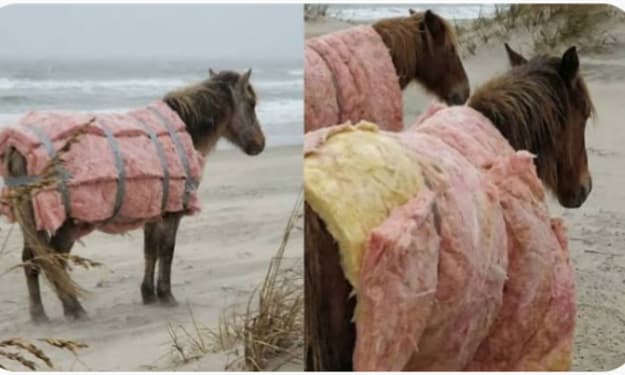
You might have seen some shocking images circulating online: wild horses on a North Carolina beach supposedly wrapped in pink insulation by volunteers trying to “help” them survive the winter. The photos went viral, sparking outrage, concern, and a flurry of social media shares.
By Sajida Sikandar2 days ago in Earth
Storm Leonardo Triggers Mass Evacuations Across Spain and Portugal
Storm Leonardo has unleashed severe weather across parts of Spain and Portugal, forcing authorities to evacuate more than 11,000 residents as flooding, powerful winds, and widespread disruption threaten public safety. Emergency services in both countries remain on high alert, warning that risks persist even as conditions show signs of gradual improvement.
By Adil Ali Khan3 days ago in Earth



Comments
There are no comments for this story
Be the first to respond and start the conversation.