


Chipmunks are one of the most domestic, non-domesticated animals in Canada. With their small size and interesting stripes, they are more cherished and friendly than common black or grey squirrels. These physical traits may have helped chipmunks endear themselves to humans and after receiving gifts of food, they began to expect these treats, and embrace the urban setting rather than be fearful of it.
On the day when I took these pictures, I was hanging out with a friend from my creative writing class. We had one month left until we would graduate high school and go off to universities far away from Ottawa, Ontario.
We met up at a nearby nature conservation centre. We walked up the hill to the little, tended garden and sat on a bench under the shade of a large tree. We began to notice a chipmunk running up to our feet, looking at us expectantly. Out of pure chance I had brought a bag of mixed nuts as a snack. I broke them apart and gave some to my friend. We put our open palms on the ground and held out the broken pieces of nuts to the chipmunk. The chipmunk politely walked closer, balanced its paws on my fingertips and stuffed its cheek pockets with bits of the nuts. The chipmunk ran away, with ballooning cheeks, to dig a winter cellar and fill with its new bounty. Soon after, it came back and picked up more nuts from my friend’s hand and ran away, again, cheeks full to bursting. This back and forth continued until my bag was empty. The results of this experiment were simple: the key to taking quality chipmunk photographs is to bring them snacks! The chipmunk was so bold, I was able to take many close up pictures, showing off its tiny features and stripy back. Chipmunks have an interesting colouration, with both black and white stripes and light-tipped grey and brown fur. These details are more noticeable after looking at photographs.
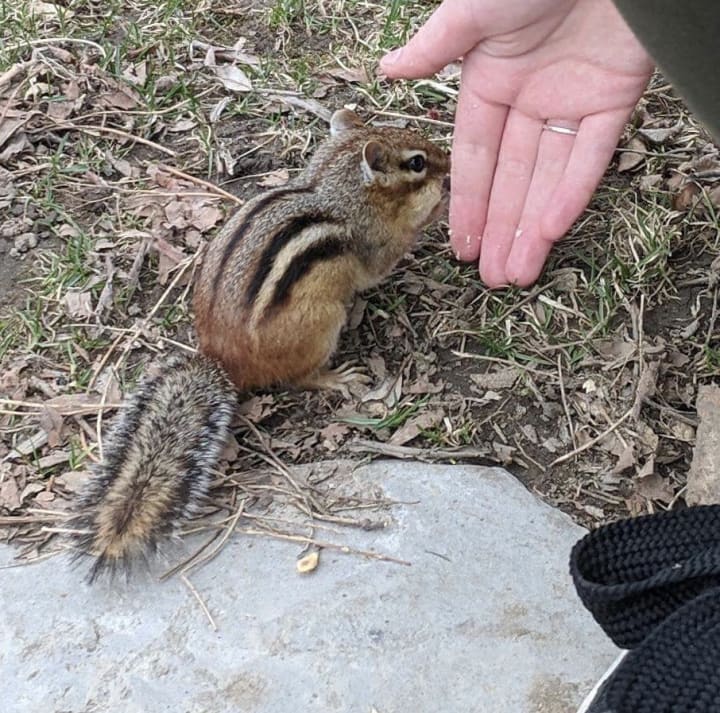
This is not the only experience I have had feeding and photographing chipmunks. Last summer, at my parents house, their backyard compost became overrun with chipmunks. This culminated in a loud, domestic fight, during which time a sound, similar to if a class of preschoolers were each squeezing a squeaky toy, erupted from the compost bin. Then, eight chipmunks leapt from the bin and ran in different directions. One ran to hide in the gutter of our basement window. I checked to see if it was alright, and it had a bloody dot in place where one of its whiskers had been. I took some photographs of the hiding chipmunk, and was inspired to use it as a base for some illustrations I did in a zine I made shortly after.


My mother, however, was not pleased with the chipmunks last year. Soon after, they dug deep holes in the garden, eating her tulip and daffodil bulbs.
In conclusion, I do not know what the consequences of the increased domestic habits of urban chipmunks will be. Perhaps someday chipmunks will become a common house pet, like gerbils or hamsters, although it is no longer legal to acquire domestic chipmunks in the UK. I enjoy crouching in a wooded park, holding a handful of crushed almonds, and waiting for the chipmunk's trusting approach. When they are close enough, I admire their quick movements, their tiny fingers and ears. I take photographs to brag to my friends and family later. I like to imagine the chipmunk's excitement to find food to store in the ground, in preparation for the long Canadian, winter. As with feeding any wild animal, however, one must be careful not to overfeed them, as the high calorie content in nuts is bad for their diet, and variety is always best.
Sources:
https://www.canadadocks.ca/the-safe-way-to-feed-chipmunks#:~:text=Chipmunks%20love%20shelled%2C%20unsalted%20peanuts,peanuts%20that%20you%20feed%20them.
https://www.rspca.org.uk/adviceandwelfare/pets/rodents/chipmunks
About the Creator
The Jinn Fled
This short story was narrated by my grandson Taimoor, who is thirteen years old. He heard it from the family of his friend Zain Ali. Zain Ali’s mother, Nusrat Bibi, loves Taimoor like her own son. She is a pious, well-mannered, kind-hearted, and refined woman.
By Sudais Zakwan7 days ago in Earth
Dead and Wearing Green
She was wearing that green dress when I first saw her, five years ago to the day. Flowing meadow fabric draped over long legs, thick auburn hair flowing down her back. That smile. Of course, she is still beautiful now. But now she is no longer alive.
By Karen Cave6 days ago in Fiction



Comments
There are no comments for this story
Be the first to respond and start the conversation.