
Into the Clouds: Conquering Mount Everest
Where Earth Touches the Sky and Legends Are Born

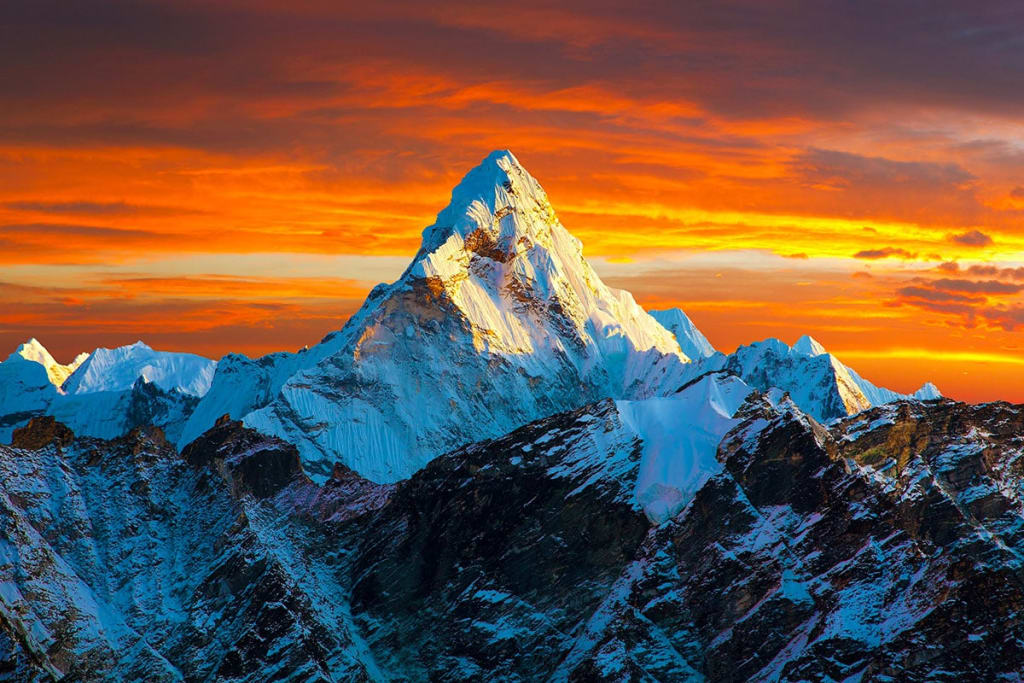
The wind howled like a wild beast, tearing through the fabric of the tents and whistling across the icy ridges. Above 26,000 feet, in the heart of the “Death Zone,” air was thin, frost clung to eyelashes, and every breath felt borrowed. Yet, amidst the unforgiving cold and near-vertical cliffs, a figure pressed forward—Aryan Malik, a 29-year-old mountaineer from Pakistan, chasing a dream carved into the sky.
For Aryan, climbing Mount Everest wasn’t just about reaching the summit. It was about fulfilling a promise he made to his late father—a retired army officer who used to show him pictures of the Himalayas and say, “Son, one day, you’ll touch the sky.”
Growing up in the small town of Hunza, Aryan was fascinated by mountains. His childhood was shaped by tales of Tenzing Norgay and Edmund Hillary, the first to summit Everest in 1953. Aryan read every book, studied every trail, and trained relentlessly on the snowy slopes of the Karakoram. When he finally got the opportunity to join an international expedition to Everest, he knew it was the moment he had been preparing for his entire life.
The journey began at Lukla, a small airport nestled dangerously between hills, known as one of the most treacherous airstrips in the world. From there, the team of 12 climbers trekked to Base Camp, a buzzing community of colorful tents, supplies, and anticipation. Aryan met climbers from across the globe—men and women from Japan, France, Nepal, and the U.S.—each with their own reasons for risking everything to climb Earth’s highest peak.
Base Camp was both sanctuary and challenge. The days were filled with training, gear checks, and acclimatization climbs to higher camps and back. Nights were cold and restless, with oxygen dropping and dreams haunted by avalanches. Still, Aryan remained focused. He had carried a photo of his father, now creased and weathered, tucked in his jacket. He whispered to it every night: “We’ll reach the top together.”
After nearly four weeks, the expedition began its push through Camp I, a maze of icefalls and ladders creaking over bottomless crevasses. The Khumbu Icefall was a terrifying obstacle—massive blocks of ice that shifted unpredictably. Climbers crossed narrow ladders strapped over gaping chasms with trembling feet and unwavering faith.
Aryan’s strength, both physical and mental, shone through. He helped others with their gear, offered encouragement during storms, and even made tea during rest stops. One fellow climber, Maria from Argentina, told him, “You climb with your heart, Aryan. That’s rare.”
By the time they reached Camp IV, the edge of the Death Zone, only six climbers remained. Altitude sickness, frostbite, and fear had turned others back. Aryan’s oxygen tank hissed steadily beside him, but he refused to show weakness. The final climb to the summit would begin at midnight—a tradition followed to avoid afternoon avalanches and allow descent during daylight.
At 12:04 AM, under a sky blanketed with stars, Aryan stepped into history. The ascent was brutal. The cold bit into his bones, and the wind screamed in protest. Every step was a war. At the infamous Hillary Step, a narrow, exposed rock face near the summit, Aryan’s glove slipped. For a moment, he dangled by his harness, staring at the abyss below. But with sheer will and a helping hand from his Sherpa guide, Dorje, he pulled himself back.
At 6:27 AM, with the sun rising above a sea of clouds, Aryan took his final step. He stood atop Mount Everest—29,032 feet above sea level.
The world fell silent.
Tears froze on his cheeks as he pulled out his father’s photograph, held it to the wind, and whispered, “We did it, Baba. We touched the sky.”
He planted both the Pakistani flag and a white flag with a mountain sketch—a tribute to climbers everywhere who had tried and failed, lived and lost. Aryan knew he wasn’t alone on that summit. He carried with him the weight of dreams, sacrifice, and stories from around the world.
The descent was no less dangerous, but Aryan returned safely to Base Camp, greeted by cheers and tears. His story spread quickly—of a small-town boy who climbed the highest point on Earth with the spirit of his father and the courage of legends.
Years later, Aryan would speak to schools, sharing the message that Everest isn’t just a mountain—it’s a symbol. A reminder that no dream is too high, no path too steep, and no heart too small to reach the clouds.
And so, the mountain stood, tall and timeless, whispering its eternal challenge into the winds:
“Come find me, brave soul. Come chase the sky.”
About the Creator
Mati Henry
Storyteller. Dream weaver. Truth seeker. I write to explore worlds both real and imagined—capturing emotion, sparking thought, and inspiring change. Follow me for stories that stay with you long after the last word.
Keep reading
More stories from Mati Henry and writers in Earth and other communities.
The Final Hour: Countdown to Doomsday
The sun rose over a quiet Earth, but it brought no warmth. A strange silence had spread across the planet. No birds sang. No waves crashed. The winds had stilled as if the world itself was holding its breath. It was the morning of December 21, 2094—the day humanity had long feared, the day scientists had come to call Doomsday.
By Mati Henry 9 months ago in Earth
Laura Dern Names Adam Sandler as Her Favorite On-Screen Kissing Partner
In a recent interview that has fans buzzing, Oscar-winning actress Laura Dern revealed that her favorite on-screen kissing partner is none other than Adam Sandler. Known for her impressive body of work across drama and comedy, Dern’s revelation adds a playful, humanizing touch to the glitz of Hollywood life.
By Aarif Lashari5 days ago in Earth




Comments
There are no comments for this story
Be the first to respond and start the conversation.