
James Webb Space Telescope Spotted a “Cosmic Jellyfish” 8.5 Billion Years Away That Shouldn’t Exist So Early in the Universe
A mysterious galaxy formation challenges modern understanding of the early universe
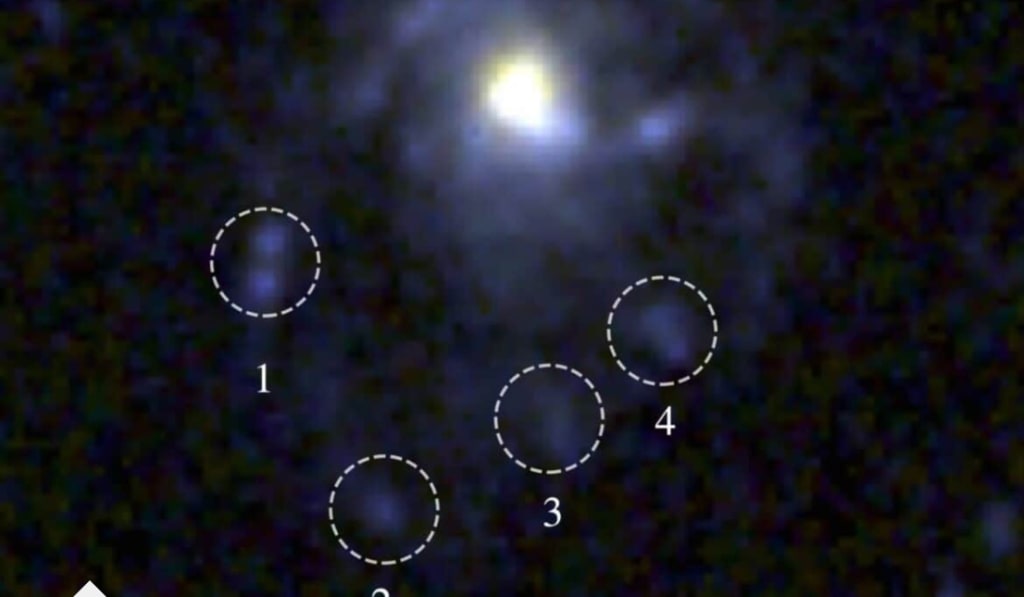
The universe is full of surprises, but sometimes discoveries force scientists to rethink their understanding of cosmic evolution. Recently, the James Webb Space Telescope detected a mysterious structure known as a “cosmic jellyfish” galaxy located about 8.5 billion light-years away.
What makes this discovery astonishing is the age of the structure. According to current astronomical theories, such complex galaxy formations were not expected to exist so early in the universe’s history.
This finding has created excitement among astrophysicists because it challenges models of galaxy formation and cosmic development.
🌠 What Is the “Cosmic Jellyfish”?
The term “cosmic jellyfish” is used to describe a galaxy with long trailing structures that resemble the tentacles of a jellyfish.
These tentacle-like features are actually streams of gas and stars pulled outward by strong gravitational or environmental forces.
Scientists believe that this shape usually forms when galaxies interact with dense cosmic environments. The structure often indicates that the galaxy is experiencing intense gravitational pressure.
However, discovering such a structure 8.5 billion years in the past raises important scientific questions.
🧠 Why Shouldn’t It Exist So Early?
Current cosmological theories suggest that galaxy structures take billions of years to evolve.
The early universe was mostly filled with:
Hot plasma clouds
Simple hydrogen and helium structures
Young, unstable galaxies
Complex morphologies like the jellyfish pattern were expected to appear much later.
The discovery implies that galaxy evolution might have happened faster than scientists predicted.
Some researchers now believe that early cosmic environments may have been more dynamic than previously thought.
🌌 Role of Gravitational Forces
Astronomers are studying whether gravitational interactions caused the jellyfish-like appearance.
Possible mechanisms include:
Galaxy collisions or near collisions
Strong intergalactic medium pressure
Rapid star formation bursts
Dark matter gravitational effects
The movement of gas and stars forming the “tentacles” suggests external cosmic forces shaping the galaxy.
🌟 Importance of Infrared Observation
The discovery was made possible because the NASA-led James Webb telescope uses advanced infrared technology.
Infrared observation is crucial because early universe light is highly redshifted due to cosmic expansion.
Without this technology, such distant structures would remain invisible.
🔬 Impact on Modern Cosmology
This discovery could influence several areas of astrophysics.
1. Galaxy Formation Models
Scientists may need to revise timelines of galaxy maturation.
2. Early Universe Dynamics
The finding suggests that matter distribution might have been more complex than previously believed.
3. Dark Matter Research
Some experts are exploring whether dark matter gravitational effects played a role in shaping the structure.
🌍 Comparison With Nearby Jellyfish Galaxies
Jellyfish-type galaxies are usually observed in dense galaxy clusters in the relatively modern universe.
The newly detected structure is much older than typical examples.
This age difference is why the discovery is considered extraordinary.
✨ Scientific Debate
Not all scientists agree on the interpretation.
Some researchers argue that the structure may be:
A temporary formation stage
A projection effect from viewing angle
Or an unusual but natural early universe event
Further observations are required before drawing final conclusions.
🚀 Future Observations
Astronomers plan to continue monitoring the region.
Upcoming studies will focus on:
Spectral analysis of gas composition
Star formation rate measurement
Gravitational field mapping
These studies may help determine whether the structure is stable or evolving.
🌙 Why This Discovery Matters
The cosmic jellyfish galaxy is more than just a beautiful space structure. It represents a puzzle for modern science.
If such complex galaxies existed 8.5 billion years ago, it means the universe may have developed structure faster than expected.
This could reshape understanding of cosmic history, galaxy birth, and large-scale universal evolution.
⭐ Conclusion
The detection of a cosmic jellyfish galaxy by the James Webb Space Telescope is one of the most fascinating astronomical discoveries of recent years.
By revealing a structure that theoretically should not exist so early in cosmic history, the observation challenges established models of universe formation.
As technology improves, humanity may uncover even more mysterious structures hidden in the deep universe. Each discovery brings scientists closer to understanding how the cosmos truly evolved.
About the Creator
Unofficial Challenge: What would you do if you were rich?
I love the kind of work I get to do in my career, but as I job search and browse apartments again due to another understaffed and unsustainable work environment that I did not intend to get into, my daydreams of better days consistently lean into the same question: What would I do if I didn't have to worry about my basic needs being met?
By Kay Husnick5 days ago in Writers




Comments
There are no comments for this story
Be the first to respond and start the conversation.