
"The Megaraptor of Patagonia: Unearthing a Feathered Dinosaur"
"The discovery of a new species in Chile challenges the current understanding of dinosaur evolution"

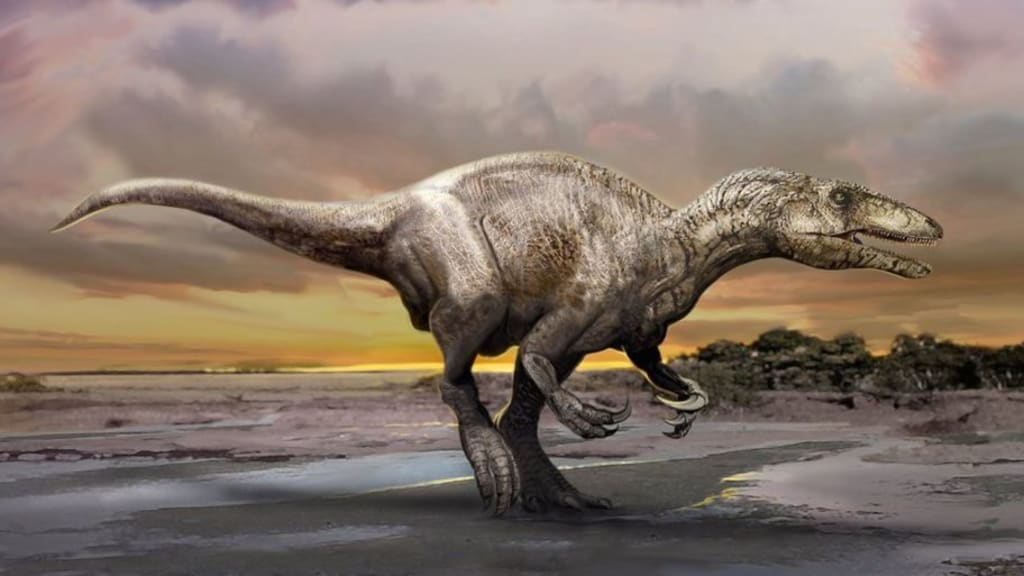
In the rugged wilderness of Patagonia, Chile, a team of paleontologists made a discovery that would change the way we think about dinosaurs. Buried deep within the earth, they uncovered the fossilized remains of a new species of dinosaur that they named Megaraptor. This dinosaur was unlike any other found before, and its discovery would challenge the current understanding of dinosaur evolution and provide insight into the lost world of the Late Cretaceous.
The Megaraptor, which lived around 85 million years ago, was a large and powerful predator that stood about 10 meters long and 4 meters tall. Its most striking feature was its giant, sickle-shaped claw, which it used to hunt and kill its prey. But what truly set the Megaraptor apart from other dinosaurs was the presence of feathers.
The discovery of feathered dinosaurs was not entirely new, but the Megaraptor represented the first known example of a large, predatory dinosaur with feathers. This challenged the traditional belief that only small, bird-like dinosaurs had feathers, and suggested that feathers were much more widespread among dinosaurs than previously thought.
As the team of paleontologists delved deeper into their discovery, they began to uncover a wealth of information about the lost world of the Megaraptor. Through careful study of the fossils, they were able to reconstruct the environment in which the Megaraptor lived. They discovered that the Patagonia region, where the fossils were found, was once a lush, tropical paradise teeming with life. The Megaraptor roamed the forests and swamps, hunting the other dinosaurs that lived there.
Further analysis of the fossils also revealed that the Megaraptor was not alone in its ecosystem. The team found evidence of other feathered dinosaurs, as well as crocodile-like reptiles and giant insects. This made it clear that the Megaraptor was not only a unique dinosaur but a part of a diverse and complex ecosystem.
As the team continued to study the Megaraptor, they also began to unravel its place in the grand scheme of dinosaur evolution. Analysis of the Megaraptor's DNA revealed that it was a member of the raptor family, which also included the Velociraptor and the Deinonychus. However, it was also found to be more closely related to other theropod dinosaurs than to birds, suggesting that birds did not evolve directly from raptors like the Megaraptor.
This discovery provided new insight into the evolution of dinosaurs and birds and raised many questions about the relationships between different dinosaur groups. Some scientists argued that the presence of feathers on the Megaraptor meant that it was closely related to birds, while others argued that the feathers were simply an adaptation for insulation or courtship. The debate continues to this day, as discoveries and research provide new perspectives and evidence.
The discovery of the Megaraptor also shed new light on the history of Patagonia itself. During the Late Cretaceous, Patagonia was part of a land bridge between Antarctica and South America, and the presence of the Megaraptor and other tropical creatures in the region suggests that the climate was much warmer than it is today.
This discovery also highlighted the importance of Patagonia as a paleontological site. The unique combination of geological formations and preservation conditions in the region make it a prime location for finding. The Megaraptor remains on display in the National Museum of Natural History in Santiago, Chile, where it continues to fascinate and inspire visitors from all over the world. The story of this feathered dinosaur from Patagonia serves as a reminder of the incredible diversity and complexity of life on Earth, and the ongoing quest to uncover its secrets.
About the Creator
Nivas
If you find this piece interesting, please consider leaving a ❤️, or even a tip. Your support means a lot to me as a writer! connect with me for exciting stories.
Cypro Banker Adversaries: How Cyber Threats Are Challenging Banks and Financial Systems
In the digital age, the banking sector has become a prime target for cyber adversaries — groups and individuals seeking to exploit vulnerabilities for financial gain, espionage, or disruption. Cypriot banks, despite their reputation as a stable financial hub, are not immune to these threats. The term “Cypro banker adversaries” captures the growing spectrum of cyber attacks, ranging from ransomware and malware campaigns to complex state-linked operations targeting banks in Cyprus and beyond.
By Ayesha Lashari5 days ago in Earth
The Arctic is Breaking Down: Why This Rare February Signal Has Meteorologists On Edge
As the calendar turns through February, something unsettling is happening 30,000 feet above the North Pole. High-altitude sensors and satellite data are flashing "code red" signals that haven't been seen in decades. Meteorologists are sounding the alarm on an unusually early Arctic breakdown—a massive disruption of the atmosphere that could flip the script on the rest of our winter.
By Adil Ali Khan7 days ago in Earth
from death into life
Young Aldin of Wiloh had never contemplated death. It was almost strange — so many around him had the tendency to obsess over it, to clamor and claw almost desperately at their own perceptions of the end to know death as much as they could: when it would come, why it would come, where it would take them when it did.
By angela hepworth8 days ago in Fiction




Comments
There are no comments for this story
Be the first to respond and start the conversation.