
Cloud Seeding: Engineering Rainfall in a Thirsty World
Unveiling the Science, Successes, and Skepticism Behind Weather Modification

Introduction
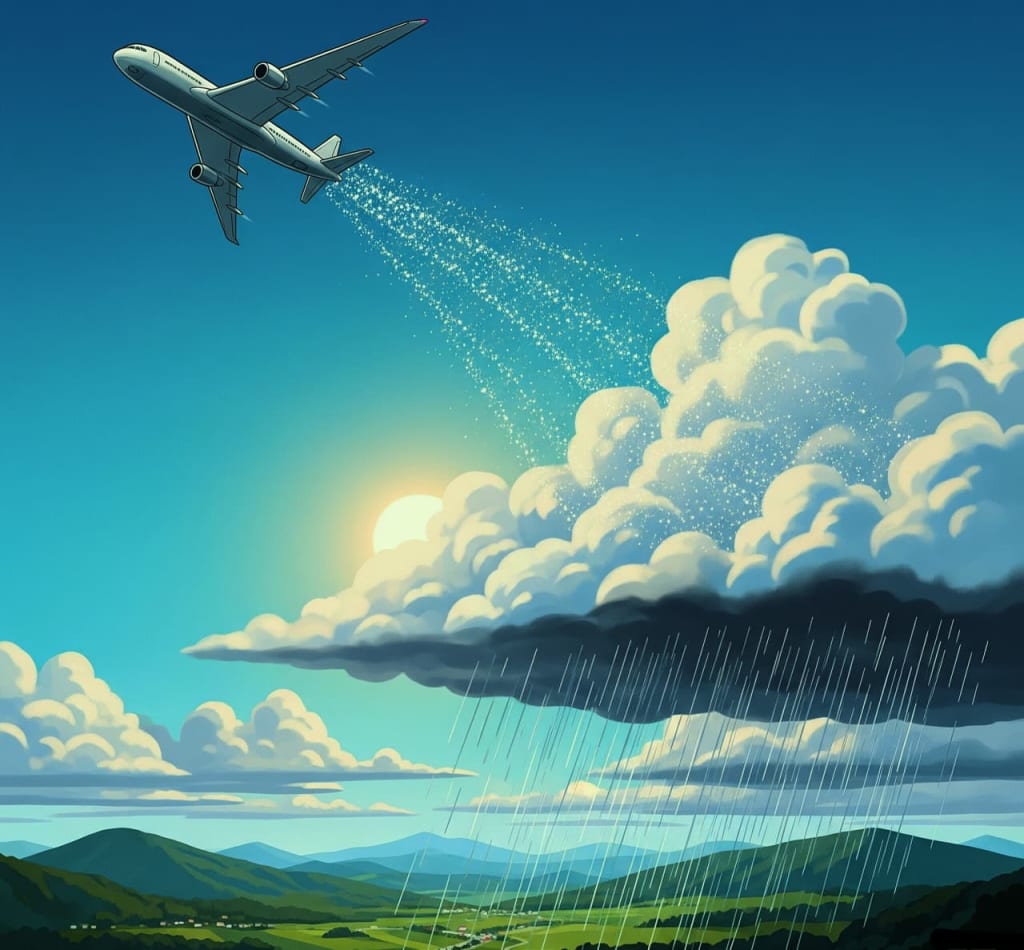
In today’s world, where climate change worsens droughts and billions face water shortages, people are searching for new ways to secure fresh water. One solution that sounds almost like science fiction is cloud seeding a process where scientists try to “help” clouds produce more rain or snow. This method has been around for decades and is used to increase rainfall, reduce hail damage, and even clear fog. As water demand keeps rising, it’s important to understand what cloud seeding really is, how it works, and what challenges it brings.
The Origins of Cloud Seeding
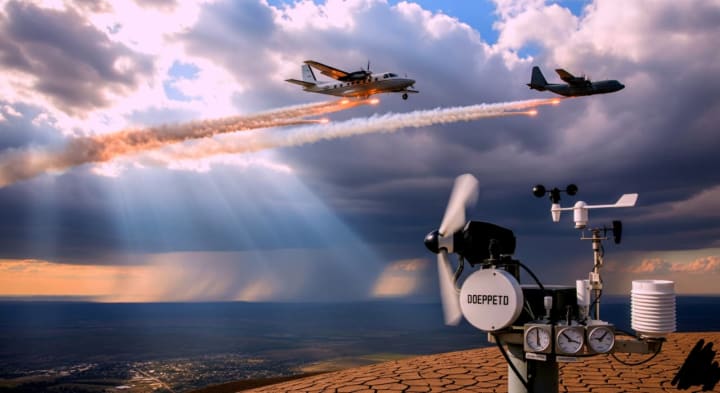
Cloud seeding began in the mid-20th century. In 1946, American scientist Vincent Schaefer discovered that dropping dry ice into supercooled clouds could trigger snowfall. Soon after, his colleague Bernard Vonnegut found that silver iodide worked just as well because its structure was similar to ice crystals.

The first real test happened on November 13, 1946, when Schaefer flew over Massachusetts and released crushed dry ice into the sky. To everyone’s amazement, snow began to fall. By the 1950s, commercial and government projects started around the world. Not all uses were peaceful. During the Vietnam War, the U.S. military carried out Operation Popeye (1967-1972), a project that tried to extend the monsoon season to disrupt enemy supply lines. This raised ethical questions about using weather as a weapon. Other projects, like the U.S. Skywater Program (1964-1988) and trials in Australia’s Snowy Mountains, pushed the science further.
How Does Cloud Seeding Work?
Clouds are made of tiny water droplets, many of which remain liquid even below freezing temperatures. Cloud seeding adds particles such as silver iodide, potassium iodide, or salt that act like “seeds” for ice or water droplets to form around.
Once droplets freeze or grow larger, they become heavy enough to fall as snow or rain. There are different methods to deliver these particles:
-Aircraft release flares or dry ice into the cloud.
-Ground-based generators burn silver iodide and send it up with the wind.
-Modern techniques use drones, lasers, or even electric charges to encourage droplet formation.
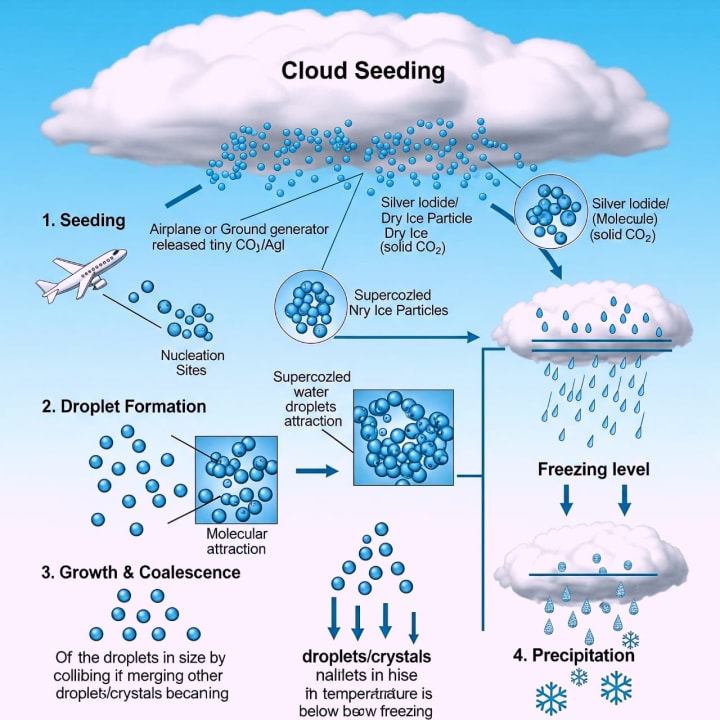
Some methods, like hygroscopic seeding, use salts to make bigger raindrops in warmer clouds. The goal is not to create new clouds but to make existing ones release more water.
Where Is Cloud Seeding Used?
Cloud seeding is practiced around the world, especially in regions struggling with water shortages:
United States: States like California and Wyoming use it to increase snow in the mountains, which later feeds rivers and reservoirs. Reports show a 3-10% increase in snowfall in the Sierra Nevada since 1969.
China: Runs the largest program, using cloud seeding to fight drought. In 2009, it even created an early snowfall in Beijing.
United Arab Emirates: Uses drones to seed clouds, claiming rainfall increases of up to 35%.
South Asia: India and Pakistan have tested it during monsoon seasons and pollution crises. In 2023, Pakistan worked with the UAE to bring rain to polluted skies.
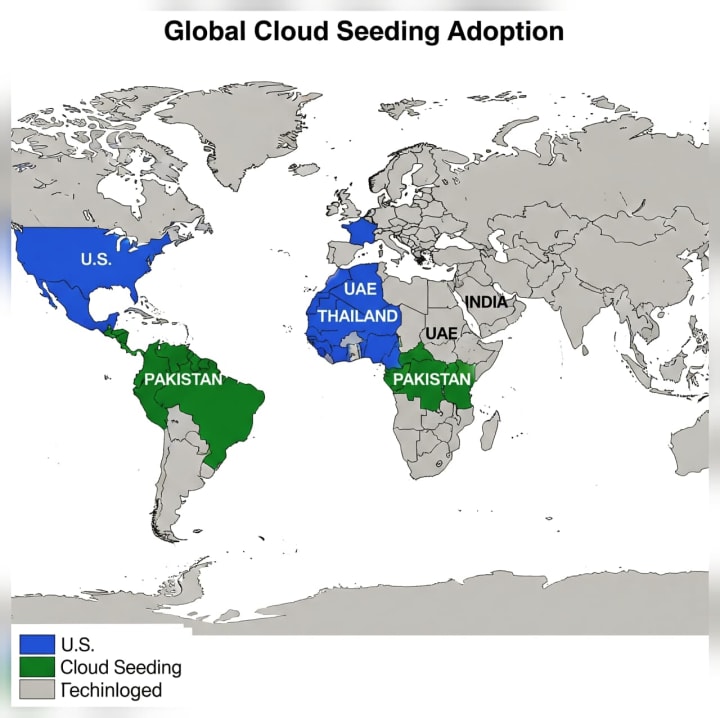
Thailand: Has been running the Royal Rainmaking Project since 1955, spending millions annually to help farmers.
Does It Really Work?
Scientists say cloud seeding can increase rainfall by 5-20%, depending on conditions. The American Meteorological Society supports it as effective when done properly. However, it’s not a guaranteed solution success depends on the type of clouds, timing, and weather conditions.
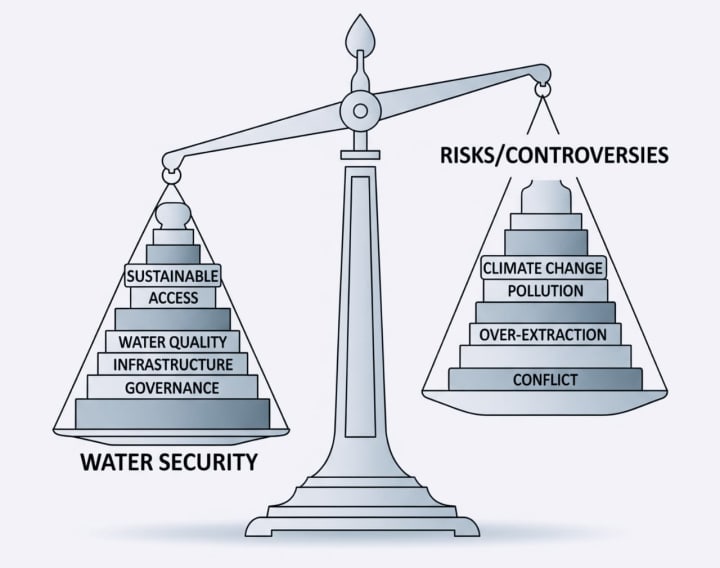
The Concerns and Controversies
Like any technology, cloud seeding comes with debates and doubts.
Environmental impact: Silver iodide could harm ecosystems, but most studies show the amounts used are too small to cause serious damage.
Rain theft: Some worry that making rain in one place steals it from another, sparking legal and political disputes.
Costs and results: Israel stopped its program in 2021, saying it wasn’t worth the expense.
Ethics: Past military uses raise questions about whether weather should ever be manipulated for conflict.
The Future of Cloud Seeding
As technology advances, drones, artificial intelligence, and eco-friendly seeding materials may make cloud seeding more effective and safer. It could become an important tool for water security in a warming world. But cloud seeding is not a magic fix. It must be studied carefully, regulated internationally, and used responsibly. Done wisely, it may help us cope with water shortages. Done recklessly, it could create more problems than it solves.
About the Creator
Muzamil khan
🔬✨ I simplify science & tech, turning complex ideas into engaging reads. 📚 Sometimes, I weave short stories that spark curiosity & imagination. 🚀💡 Facts meet creativity here!
Keep reading
More stories from Muzamil khan and writers in Education and other communities.
The September 2025 Blood Moon: Longest Lunar Eclipse in Years
What Is a Blood Moon? On the night of September 7–8, 2025, people across the world will get to witness a breathtaking event a total lunar eclipse, also called a Blood Moon. This happens when the Earth moves directly between the Sun and the Moon, casting its shadow on the Moon’s surface.
By Muzamil khan6 months ago in Education
Wings of Wonder: Tracing the Evolutionary Brilliance of Butterflies
Butterflies are among nature’s most enchanting creations, admired for their delicate forms and radiant colors. Their gentle flight and fleeting presence often evoke a sense of calm and wonder, yet their existence is rooted in a long history of adaptation and survival. Far from being fragile ornaments of the natural world, butterflies are products of powerful evolutionary forces that have shaped them into highly specialized organisms.
By Akito Kawahara4 days ago in Education
The Devil's Triangle
The sails ruffled in the breeze as we cruised along. The Sea Breeze was a mid-size catamaran that sailed out of Royal Naval Dockyard in Bermuda. We had booked this trip weeks in advance and were now looking at our Captain, Spike and two boat hands. Paddy and Wilson seemed like nice guys, joking around with the passengers and telling us some stories about Bermuda that only locals would know. Their island accents sounded almost British but they were pleasant to listen to.
By Barbara Gode Wiles5 days ago in Fiction



Comments
There are no comments for this story
Be the first to respond and start the conversation.