
The Warehouse of Young Minds: Why We Store Children Instead of Growing Them
We Built Schools That Resemble Factories and Storage Units—And Then Wonder Why Graduates Don't Know How to Think
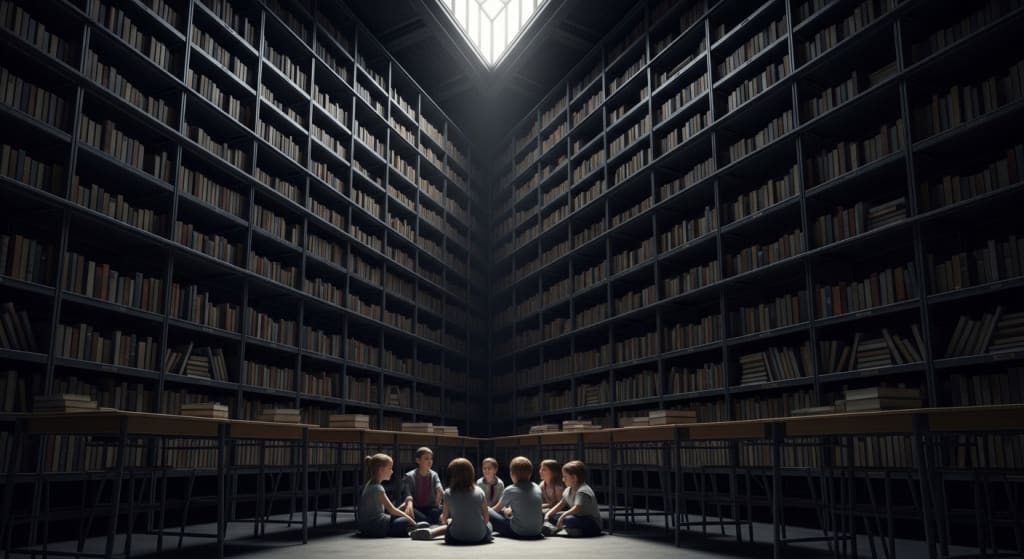
We have built schools that look like warehouses because we think of children as products to be stored. Row after row of desks, identical and interchangeable. Bells that signal when to move, when to stop, when to eat, when to think. Curriculum delivered in standardized units, measured by standardized tests, sorted into standardized categories. The message is subtle but absolute: you are one of many, your individuality is inconvenient, your curiosity is irrelevant. The goal is not to grow you but to process you, to move you through the system efficiently, to deliver you to the next stage of storage with the minimum of disruption.
This is not what education was meant to be. The word itself comes from Latin roots meaning "to lead out"—to draw forth what is within, to cultivate the unique potential of each human being. But we have inverted this meaning. We now practice in-ducation: the pouring in of information, the filling of empty vessels, the standardization of minds. We treat children as containers to be filled rather than gardens to be tended. And then we wonder why so many emerge from this process without knowing who they are, what they care about, or how to think for themselves.
The warehouse model serves purposes beyond education. It sorts children into categories that will follow them forever—advanced and remedial, college-bound and vocational, successful and failed. It provides custodial care while parents work. It offers measurable data to justify funding and political careers. It employs millions of adults trained in the same system, who struggle to imagine alternatives. But it does not serve children. It does not nurture their minds, their hearts, their spirits. It processes them, and in the processing, it loses them.
Consider what happens to a child who does not fit the warehouse model. The child who learns differently, who thinks in images rather than words, who needs to move to concentrate, who asks questions that are not in the lesson plan, who sees connections the curriculum does not make. This child is not seen as different; they are seen as deficient. They are labeled, medicated, remediated, removed. The system pathologizes the very diversity of mind that the world most needs. It insists that every child fit the same mold, and when they cannot, it breaks them rather than bending.
The tragedy is compounded by what we know about human development. Children are not blank slates or empty vessels. They arrive in the world already wired for curiosity, already driven to explore, already capable of profound learning when conditions are right. The conditions that support this learning are not rows of desks and standardized curricula. They are safety, relationship, choice, relevance, and time. They are environments where questions are welcomed more than answers, where failure is information not judgment, where each child's unique path is honored rather than corrected. We know this. We have known it for decades. And we continue to build warehouses.
The alternative exists. It is not theoretical. It is being practiced in thousands of schools around the world, often quietly, often against the grain of policy and funding. These schools look different. There are no bells. There are no rows of desks. Children move freely, work at their own pace, pursue projects that matter to them. Teachers act as guides rather than lecturers, helping students navigate their own learning rather than delivering standardized content. Assessment is narrative and individualized, focused on growth rather than comparison. These schools are not chaotic; they are carefully structured to support the natural processes of human learning. And they work. Their graduates are not just knowledgeable but curious, not just skilled but adaptable, not just successful but fulfilled.
The resistance to this model is not about effectiveness. The evidence is clear that student-centered, project-based, individualized approaches produce better outcomes on every measure—academic achievement, critical thinking, creativity, emotional health, long-term success. The resistance is about control. The warehouse model is easy to manage, easy to measure, easy to defend. It requires no trust in teachers, no trust in children, no trust in the messy, unpredictable process of genuine learning. It replaces trust with procedures, relationships with rules, growth with grades. It is the path of least resistance, and it leads nowhere worth going.
What would it take to change? It would take a revolution in how we see children. Not as future workers to be trained but as whole human beings to be nurtured. Not as empty vessels to be filled but as seeds containing everything they need to grow, given the right conditions. Not as products to be sorted but as people to be known. This revolution would require us to abandon the industrial model that has shaped schooling for a century. It would require us to trust teachers as professionals, to trust children as learners, to trust the process of discovery over the efficiency of delivery. It would require courage, imagination, and the willingness to be wrong about things we have believed for a very long time.
The warehouse of young minds is vast. It contains millions of children, each one unique, each one precious, each one slowly being processed into something less than they might have been. The shelves are stacked with knowledge they will forget as soon as the test is over. The bells dictate the rhythm of days they will not remember. The labels they receive will follow them forever, shaping what they believe about themselves, what they dare to attempt, what they become.
But it does not have to be this way. The children are still there, underneath the processing, still curious, still capable, still waiting to be seen. The teachers are still there, many of them, fighting the system every day to protect the humanity of their students. The knowledge of how to do better is still there, accumulated over decades of research and practice. The only thing missing is the will to change.
The warehouse will not transform itself. It is too entrenched, too funded, too comfortable for those who run it. Change will come only from outside—from parents who demand something better, from communities who build alternatives, from a public that finally recognizes that the purpose of education is not economic productivity but human flourishing. Change will come when we decide that children are more than products, that learning is more than processing, that schools should be gardens, not warehouses.
The small group of children sitting on the floor, their backs against the shelves, trying to have a conversation—they are the hope. They are still connected to their own humanity, still reaching for each other, still learning in the only way that really matters: together, curiously, alive. The warehouse surrounds them, but it has not yet consumed them. There is still time to build something different, something worthy of their potential, something that will grow them rather than store them.
The narrow beam of sunlight illuminates nothing but dust motes. But it could illuminate so much more. It could fall on children engaged in work that matters, on teachers who know their students deeply, on learning that looks like life because it is life. The light is there, waiting. The question is whether we will finally have the wisdom to let it in.
About the Creator
HAADI
Dark Side Of Our Society
The Enduring Melody: Why Jazz Remains a Timeless Art Form
Jazz has a unique place in music history. Its rhythms, improvisation, and emotion have influenced countless genres and generations of musicians. Even today, jazz continues to captivate listeners around the world. Its ability to evolve while retaining its core identity is part of what makes jazz a timeless art form.
By Michael O'Sullivan Hampton6 days ago in Education
How to Avoid Scams in Online Transcription Work
The growing popularity of remote work has made online transcription an attractive option for people who want to earn income from home. With flexible schedules and low entry barriers, transcription work appeals to students, freelancers, stay-at-home parents, and professionals looking for additional income. However, the increasing demand for transcription services has also created opportunities for scammers who target beginners unfamiliar with how legitimate transcription jobs operate. Understanding how to recognize and avoid scams is essential for building a safe and sustainable transcription career.
By Mahesh Kumar6 days ago in Education



Comments
There are no comments for this story
Be the first to respond and start the conversation.