
The Wonders of Our Solar System: A Cosmic Journey
Exploring the Structure, Dynamics, and Future of Our Celestial Neighborhood
I. Introduction:
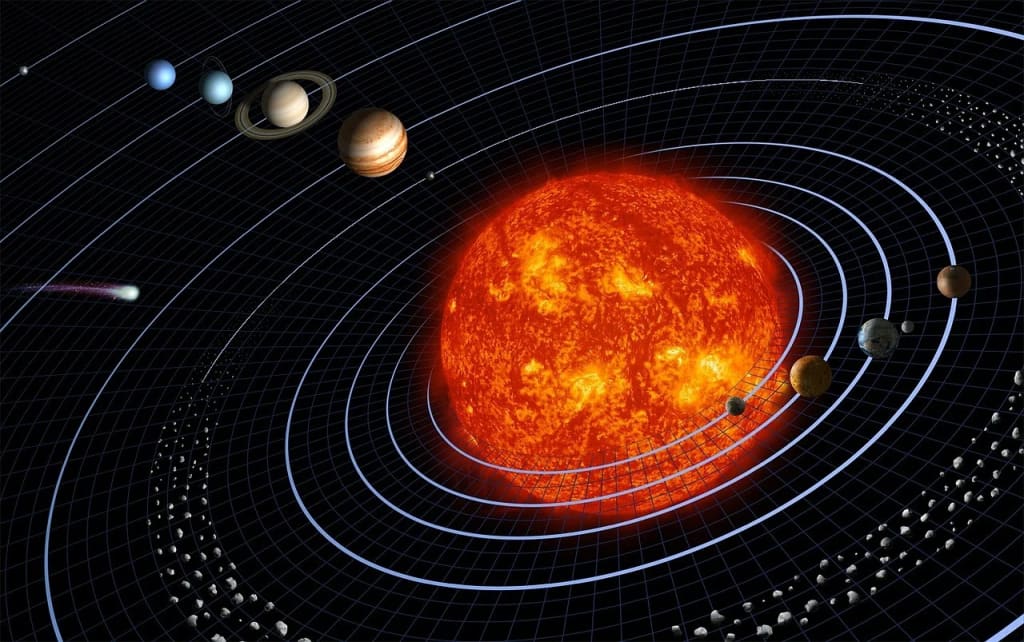
The solar system is a vast and fascinating expanse of celestial bodies that orbit around our star, the Sun. It is a complex system comprising eight major planets, their moons, dwarf planets, asteroids, comets, and other celestial phenomena. Understanding our solar system not only satisfies human curiosity but also provides insights into the origins of life on Earth and the dynamics of planetary systems.
II. Structure of the Solar System:
A. The Sun:
At the heart of our solar system lies the Sun, a nearly perfect sphere of hot plasma that accounts for about 99.86% of the total mass of the solar system. The Sun's immense gravitational force holds the entire system together, influencing the orbits of all planets and other celestial objects. It emits energy in the form of light and heat, which is essential for life on Earth.
B. The Planets:
The solar system consists of eight recognized planets, which are divided into two categories: terrestrial (inner) planets and gas giants (outer) planets.
1. Terrestrial Planets:
- Mercury: The closest planet to the Sun, known for its extreme temperatures and lack of atmosphere.
- Venus:Often called Earth's "sister planet," it has a thick atmosphere and is the hottest planet in our solar system.
- Earth: The only known planet to support life, with a diverse climate and abundant water.
- Mars: Known as the "Red Planet," it has surface features both similar to both Earth and the Moon.
2. Gas Giants:
- Jupiter: The largest planet in our solar system, famous for its Great Red Spot and numerous moons.
- Saturn: Known for its stunning ring system made up of ice particles and rocky debris.
- Uranus: An ice giant with a unique tilt that causes extreme seasonal variations.
- Neptune: The farthest planet from the Sun, known for its deep blue color and strong winds.
C. Dwarf Planets:
In addition to the main planets, there are several recognized dwarf planets in our solar system. The most famous is Pluto, which was reclassified from a planet to a dwarf planet in 2006. Other notable dwarf planets include Eris, Haumea, and Makemake.
III. Other Celestial Bodies:
A. Moons:
Many planets in our solar system are accompanied by moons—natural satellites that orbit them. For example:
- Earth's Moon:The only natural satellite of Earth, influencing tides and stabilizing its axial tilt.
- Jupiter's Moons: Includes Ganymede, the largest moon in the solar system, and Europa, which may harbor subsurface oceans.
B. Asteroids and Comets:
Asteroids are primarily found in the asteroid belt between Mars and Jupiter; they are rocky remnants from the early solar system. Comets, on the other hand, originate from the Kuiper Belt or Oort Cloud and are composed of ice and dust. When they approach the Sun, they develop glowing comas and tails due to sublimation.
IV. Formation and Evolution:
The solar system formed approximately 4.6 billion years ago from a rotating disk of gas and dust known as the solar nebula. As gravity pulled material together, it formed the Sun at its center while remaining material coalesced into planets, moons, asteroids, and comets. This process continues to shape our solar neighborhood as new celestial bodies emerge.
V. Unique Features:
Our solar system is located in one of the spiral arms of the Milky Way galaxy, approximately 26,000 light-years from its center. Compared to other known solar systems discovered by astronomers using advanced telescopes like Kepler and TESS (Transiting Exoplanet Survey Satellite), our solar system has a relatively stable configuration with no known rogue planets.
VI. Conclusion:
The solar system is not just an arrangement of celestial bodies; it is a dynamic environment that has evolved over billions of years. Understanding its structure and components enhances our knowledge about life on Earth and informs future exploration endeavors beyond our planet. As technology advances, we continue to uncover mysteries about our cosmic neighborhood, inspiring generations to look up at the stars with wonder and curiosity.
About the Creator
Why Technology Is Driving Innovation Across the United Kingdom?
The United Kingdom has long been recognized as a center for innovation, finance, and research. In recent years, technology has become one of the most influential forces shaping its economic and social landscape. From software development and fintech to artificial intelligence and cybersecurity, digital advancements are transforming industries across the country.
By deepanshu Thakur2 days ago in Education
Mastering Poker: The Smart Way to Build a Pro Career
Poker is more than a card game. It is a game of skill, math, and mindset. Many players dream of going pro, but only a few succeed. Mastering poker takes time, effort, and smart planning. If you want to turn your passion into a career, you need a clear path. This guide will show you how to build strong skills and move toward professional play.
By Micah Raskin7 days ago in Education




Comments
There are no comments for this story
Be the first to respond and start the conversation.