
Understanding XAU/USD in 2026
Why Discipline Matters More Than
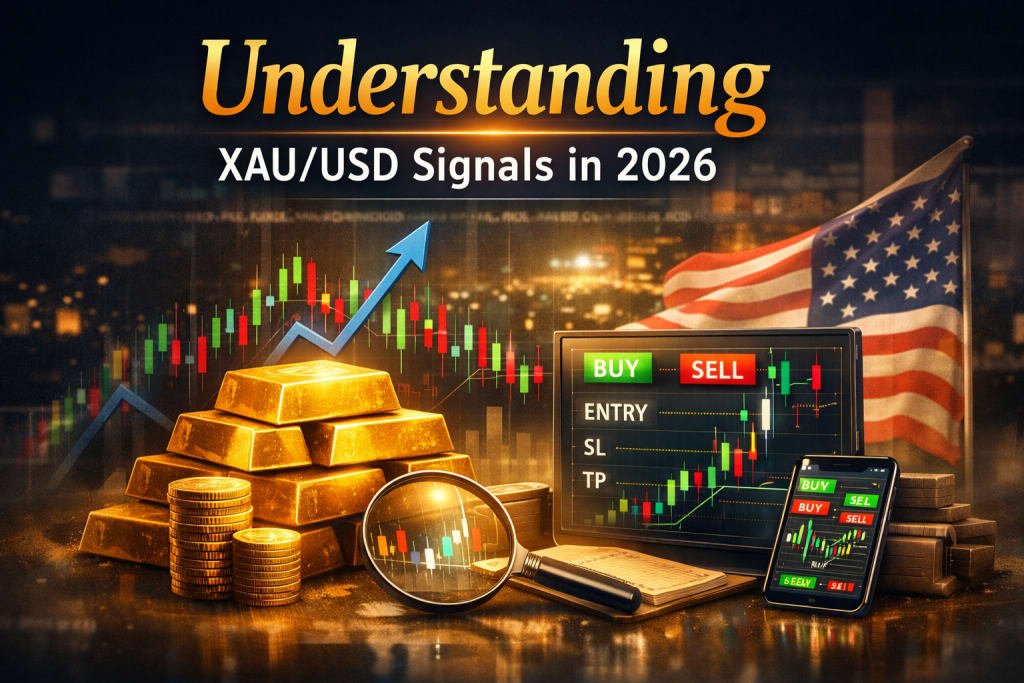
In 2026, gold continues to dominate financial headlines. Every time inflation numbers are released or central banks adjust interest rates, the price of gold reacts. Like many retail traders, I found myself drawn to XAUUSD signals — the gold-to-dollar pair — because of its volatility and constant movement.
For many traders, including myself, the appeal isn’t just about the metal itself. It’s about movement. Gold rarely sits still for long. And with that movement comes both opportunity and risk.
Over the past year, I’ve spent time observing how XAU/USD signals are used and interpreted. What I discovered wasn’t a shortcut to success, but something far more valuable: structure.
Why Gold Feels Different in 2026
The financial landscape in 2026 feels reactive. Markets respond quickly to economic data releases and central bank commentary. Gold, in particular, reacts sharply to inflation reports and interest rate decisions. When uncertainty rises, price swings often become more dramatic.
Watching these movements can be overwhelming. Charts fluctuate within minutes. Headlines influence sentiment. Social media amplifies opinions.
It’s easy to feel like you’re constantly one step behind.
That’s where trading signals first caught my attention — not because they promised results, but because they offered clarity amid noise.
What XAU/USD Signals Really Represent
At their core, trading signals are structured trade ideas. They typically outline:
- A suggested entry point
- A stop-loss level
- A take-profit target
- A timeframe or context
When I first examined them, I realized something important: signals are less about prediction and more about planning.
Each signal defines risk before reward. The stop-loss is not an afterthought; it is built into the setup. That alone reframed how I looked at trading.
Instead of asking, “How much can I make?” the better question became, “How much am I willing to risk?”
That shift in mindset made a noticeable difference in how I approached the market.
The Emotional Side of Gold Trading
Gold’s volatility is both attractive and intimidating. A strong move can happen quickly, and watching price accelerate in either direction can trigger emotional decisions.
I remember one instance where I entered a trade impulsively after seeing a sudden breakout. I hadn’t reviewed the broader context. I hadn’t defined my risk clearly. I was reacting rather than planning.
The result wasn’t catastrophic — but it was unnecessary.
That experience reinforced a simple truth: structure reduces emotional pressure. When entry, exit, and risk are clearly defined beforehand, there’s less room for panic or overconfidence.
Signals, when treated as structured references rather than commands, can help reinforce that discipline.
Signals as a Learning Framework
Over time, I began comparing signal setups with my own analysis. I would check support and resistance levels, observe momentum indicators, and consider upcoming economic events. Sometimes the signal aligned with my interpretation. Other times, it didn’t.
That process became educational.
Instead of blindly following alerts, I started asking:
- Why is this entry placed at this level?
- What market structure supports this idea?
- Is volatility increasing or decreasing?
- How does broader sentiment influence gold today?
The more I questioned the reasoning behind each setup, the more confident I became in forming my own perspective.
Signals became less of a dependency and more of a reference point.
Risk Management: The Underrated Skill
In 2026, gold’s price movements can be sharp and unforgiving. One unexpected economic headline can shift momentum instantly. That reality highlights the importance of risk control.
One of the most valuable lessons I’ve learned is that consistency matters more than intensity. A single well-managed trade often outweighs multiple impulsive ones.
Defining position size, respecting stop-loss levels, and accepting that losses are part of trading — these habits create stability over time.
There’s a misconception that tools like trading signals remove uncertainty. They don’t. Markets remain unpredictable. No method eliminates risk entirely.
What structured trade ideas can offer, however, is a predefined plan. And in a market influenced heavily by psychology, a plan creates calm.
The Balance Between Guidance and Independence
One concern I initially had was whether using signals would limit independent thinking. I didn’t want to outsource decision-making entirely.
What I discovered instead was that the value depends on approach.
If signals are followed without understanding, they can create dependence. But when they are analyzed critically — when they are compared against personal research and interpreted thoughtfully — they can strengthen analytical skills.
Gold’s price reflects global forces far beyond any single trader’s control. Inflation trends, currency strength, central bank decisions — all of these shape XAU/USD movement.
Recognizing that broader context encourages humility. No single strategy guarantees outcomes. But structured thinking improves decision quality.
A More Realistic Perspective
Trading gold in 2026 has taught me that the real challenge isn’t forecasting the next big move. It’s managing behavior during uncertainty.
Patience, emotional control, and consistent risk management often matter more than pinpoint entries.
Signals can support those qualities by offering organized trade frameworks. But they work best when paired with personal responsibility and ongoing learning.
In the end, gold’s volatility will continue. Markets will react to news. Prices will rise and fall.
What remains constant is the importance of discipline.
And that may be the most valuable signal of all.
About the Creator
Keep reading
More stories from Elaxi Digital and writers in Education and other communities.
Best Forex Signal Providers
The forex market in 2026 is more competitive and data-driven than ever. With rapid price movements, global economic uncertainty, and algorithmic trading dominating liquidity, many retail traders rely on forex signal providers to help structure their trades.
By Elaxi Digitalabout 5 hours ago in Education
Ramadan Mubarak – A Month of Mercy, Forgiveness, and Spiritual Transformation
Ramadan is not just a month in the Islamic calendar — it is a divine season of mercy, forgiveness, and spiritual elevation. It is the month in which Allah Almighty revealed the Noble Qur’an as guidance for humanity, a criterion between truth and falsehood, and a light for those who seek righteousness.
By M Irfan Zafar2 days ago in Education
The Protection-of-Innocence Reciprocity Doctrine
Core Moral Premise The highest duty of any legitimate social order is the protection of innocent life. Innocent life has absolute moral primacy. Any system that systematically insulates predators, tolerates predatory asymmetry, rewards hypocrisy, or allows aggressors to retain insulation has inverted its purpose and forfeited legitimacy. Truth, justice, reciprocity, humility, mercy, forgiveness, and vertical accountability are structural necessities rather than optional virtues. Vertical accountability means recognition of and submission to a moral law higher than oneself. Authority must flow toward those who most consistently demonstrate sustained competence in moral and epistemic discipline. This competence is shown through observable conduct and trajectory over time, not through doctrinal label, tribal identity, credential alone, or self-profession.
By Peter Thwing - Host of the FST Podcastabout 18 hours ago in Education



Comments
There are no comments for this story
Be the first to respond and start the conversation.