

I picked a cuticle as I trudged down 154th street. I’d made this walk every Tuesday since I was old enough to take the subway on my own, but this was the first time I’d come on a Friday. It felt blasphemous.
Aunt Tabby died on Monday.
I had arrived early for our Tuesday meeting and stood in the hallway, aware that I was four minutes early. The four minutes ticked past, but the familiar five clicks of ritual chain-sliding did not come. At one minute past the door remained closed. I checked my phone. It was old enough that the apps crashed more often than not, but the clock had yet to fail me. I didn’t think it failed me now. The floor creaked as I shifted from foot to foot. At two minutes after five, I did something I’d never once done in my nearly 40 years of visiting Aunt Tabby: I knocked on the door.
There was no answer.
I turned the handle and popped a shoulder into the door to push through the familiar sticking spot in the jamb. The chain ripped easily off the wall. So much for ritual security.
Aunt Tabby was slumped forward in her chair, her neck in its perennially craned position, one boot on and one boot in her lap. The coroner couldn’t say exactly what time the aneurysm had taken her, but based on her boots, I would bet the complete contents of my checking account that it had been 3:02 pm.
Not that $1.35 would be much of a loss if I was wrong.
Before her illness, Aunt Tabby had been secretary for a large bank branch and proudly used her first year’s salary to pay cash for this apartment, in what had been a particularly seedy part of town.
“Why don’t you get a loan and find somewhere more respectable?” my mother had lamented, but Aunt Tabby had her eye on the future.
“It’ll clean up around here, just you watch,” she insisted.
My mother had gotten her own secretarial position at a law firm, but she didn’t last the year to save even for a down payment. She married a junior firm partner and he settled them in a pricey location she deemed very respectable, living a life of leisure for a year before getting pregnant with me.
That was the year Aunt Tabby had gotten sick.
It started with constant counting. At first, my mom chalked it up to working for all those precise bankers.
“She wouldn’t have to keep working so hard if she just married one,” my mom would tell my dad.
But the disease progressed quickly. A senior bank partner recognized the symptoms for what they were and tried to get Tabby help, but Aunt Tabby refused. The senior Mr. Armstrong’s last act before he retired was to get Aunt Tabby on disability. By the time Mom had me, Aunt Tabby was free to spend her days walking.
The junior Mr. Armstrong still worked at the bank, now a senior partner himself. Aunt Tabby referred to him as David-Two and made frequent visits to see him despite only having a social services-supervised account for her fixed government income. As far as I know the younger Mr. Armstrong never asked Aunt Tabby to stop wasting his time. Bless the Armstrong family.
Mom’s regular visits to Aunt Tabby started to dwindle when it became apparent that Aunt Tabby was never going to accept medication. When I was 12, the social worker told my mom that Tabby was considered functionally independent and could not be forced to take pills. My mom had exploded, and I found myself deemed old enough to take the subway to Aunt Tabby’s Tuesday dinners alone.
“The woman is sick. She doesn’t even know you’re there,” my mother spat. On my dark days, I thought Mom was probably right. But for nearly 28 years, I kept visiting just the same.
Aunt Tabby’s will had been a single-sheet computer printout, neatly filed with the receipt for the 10-cent printing charge from the library. Her meticulous handwriting was nearly indistinguishable from the crisp, impersonal font of the form. The document was witnessed by her social worker and left everything to me.
The liability of her intended kindness weighed heavily on my unprecedented Friday walk. The area around her apartment building had indeed cleaned up, more than anyone could have expected, but signs of upcoming structural repairs for her building boded poorly for anyone hoping to maintain her apartment on an hourly wage, much less sell her unit for a profit. On Monday, as I waited for the coroner to remove Aunt Tabby’s body, the downstairs neighbors gathered in the hall to gawk and complained to me of sagging ceilings and warping door frames. I could only nod. Tabby’s own jambs had shifted so much that she could no longer close many of her interior doors.
Each morning at the same time Aunt Tabby would get up, make the same breakfast, don the same clothing, and walk the same city streets. Rain, snow, sleet, hail, she would be there. She would have been the postal service’s top employee, if only she had been capable of retaining a job. I’d long given up speculating on what she did during those walks, but for 40 years, she walked the same routes in the same boots, day after day. She returned home at 3 p.m., exactly, and took the next two hours to prepare for her daily 5 p.m. activity. Mondays were for grocery shopping. Tuesdays were for spaghetti dinners with me.
My birthday was this coming Monday, the 21st. Aunt Tabby always remembered my birthday was the 21st. “Two plus one equals three,” Aunt Tabby would say on the closest Tuesday, and place three extra meatballs on my spaghetti. She never shifted our date though. Mondays were for grocery shopping, not for me.
This would be my first year without extra meatballs.
I arrived at Aunt Tabby’s apartment to find that the police had temporarily sealed the door for me, which Aunt Tabby would have appreciated, despite the now-safe neighborhood and her lack of valuables. I pushed through the temporary seal and checked my phone. I had nearly an hour before the locksmith arrived. With Aunt Tabby, I had always been precisely on time. With the rest of the world, I was hopelessly out of sync. Perhaps it was because Aunt Tabby’s expectations were clear and simple: arrive at 5 p.m. each Tuesday. Do no more, do no less.
Slowly, I made my way around Aunt Tabby’s apartment. My apartment, if I could afford to keep it. And as I touched each of her items, peculiarly clean and exact, I was overwhelmed by a desire to keep the apartment. If Aunt Tabby had stretched her fixed disability check to cover extra meatballs for my birthday dinner, then surely I could stretch my hourly wages to cover a few structural repairs?
If nothing else, the apartment was bigger than my crummy rented studio. Judging by the number of doors I had never opened, Aunt Tabby’s apartment had more closet space than my last three apartments combined.
I started towards the hall closet. Twenty years ago, I’d tried to look inside but Aunt Tabby had screamed before I’d even turned the handle. Now I stared at that closet handle and picked my cuticle for a moment before I tried the door, but like all her doors, it was stuck. I braced a foot on the floor moulding and used both hands and all my weight to pull backwards on the knob. A few tugs and the door gave way, slamming me into the wall behind.
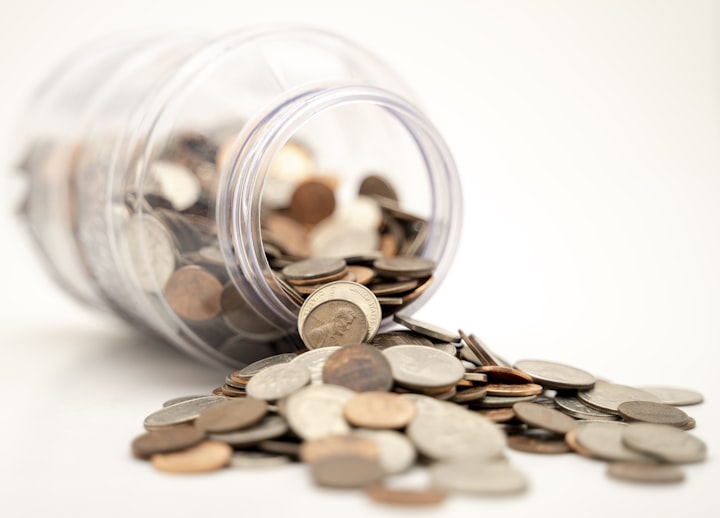
I rubbed the back of my head as I blinked at the contents of the closet. It was as meticulous as the rest of the apartment. Floor to ceiling, shelves bowed under the weight of old spaghetti sauce jars, placed with such precision that Aunt Tabby must have used a ruler. Each jar was filled to the brim with glinting copper pennies. Each jar of pennies had a little black notebook propped precisely on the left of the jar.
If this had been a movie scene, the precision with which each jar and notebook was placed would have caused me to scoff about bad CGI. Real life could never be so precise. But Aunt Tabby was.
Though I longed to see what was inside each notebook, I moved to close the door. Aunt Tabby would be upset if I disturbed her closet.
But Aunt Tabby was dead.
This was my apartment. These were my jars. These were my notebooks.
I hesitated, then picked up a notebook from the front row of jars and opened the first page.
Inside, written in her mechanical handwriting, was a date, followed by a series of numbers.
August 19, 2006: 1989, 1981, 1992, 1992, 1998, 2002, 1971, 1976, 1981, 2004, 1988, 1994, 2003, 1999, 1981, 1986, 1996, 1980…
No, not numbers. The dates were followed by a list of years. And each time the year 1981 appeared, it was underscored with a precise black line.
I replaced the notebook as carefully as I could and walked to the linen closet. It took the same effort to open the door, and inside produced the same result. Rows and rows of jars filled with pennies, each jar sporting its own little black notebook. I checked a notebook. This one started on April 15, 1992, and was followed by a similar series of years. Always, 1981 was underlined.
I traveled the apartment, wrenching open each door and uncovering the exact same result. Every closet, every cabinet, every nightstand, was full of pennies. Rows and rows of jars, of pennies, of notebooks.
I walked around Aunt Tabby’s apartment and did some quick mental math. There were probably a thousand spaghetti jars stashed all over the house. If each jar held two thousand pennies that would be… two million pennies.
Two million pennies. I pulled out my phone and did a quick search. 100 modern pennies weighs 0.55 pounds. Two million pennies would weigh about eleven thousand pounds.
I gasped. No wonder the ceilings were sagging. I was suddenly afraid to move my feet.
I tiptoed around checking each closet and cabinet until I was pretty sure I found the oldest jars. The first notebook was in the back. When I opened it, a tiny receipt fell out. It was a bank receipt for a cash deposit of coins. 264 quarters, 270 dimes, and 190 nickels. $103. I checked the other notebooks in the cabinet. A receipt was neatly tucked into the last page of each.
Each and every day, Aunt Tabby had gotten up, gotten dressed, and gone outside to scour the streets for dropped change. The silver coins she had taken to her old bank and exchanged for cash, but the pennies she had kept.
I checked the first page of the first notebook. It contained only one entry.
June 21, 1981: 1981.
It’s a girl.
I sat down on the hall carpet and stared at the words Aunt Tabby had written on the day of my birth. Through her fog of mental illness, the chance finding of a penny had led my Aunt Tabby to care for me in the only way she knew how. I let the tears stream down my face and looked at my collection of lucky pennies. Two million copper coins of affection. Twenty thousand dollars worth of love.
I ignored the knock at the door, so the locksmith stuck his head through the broken police seal.
“Is this a bad time?” He asked.
“No.” I smiled, and hugged the notebook. “It’s a wonderful time.”
About the Creator
Kate Hogan
I keep poultry, tolerate peacocks, and write fiction about plants.
Keep reading
More stories from writers in Families and other communities.
Goodbye, Mr. Duvall
It is turning out to be an interesting year. I was in the middle of teaching a class when a pop-up appeared on the screen announcing the death of Mr. Robert Seldon Duvall (yes, that was his full name). I was in the middle of a discussion on the obsession we have with winning when it comes to sports (the Winter Olympics was a theme), and I felt as though things were coming full circle. We had already lost Gene Hackman last year, and along with that titan, it feels though one particular golden age has closed off to be replaced by...?
By Kendall Defoe 6 days ago in Geeks


Comments
There are no comments for this story
Be the first to respond and start the conversation.