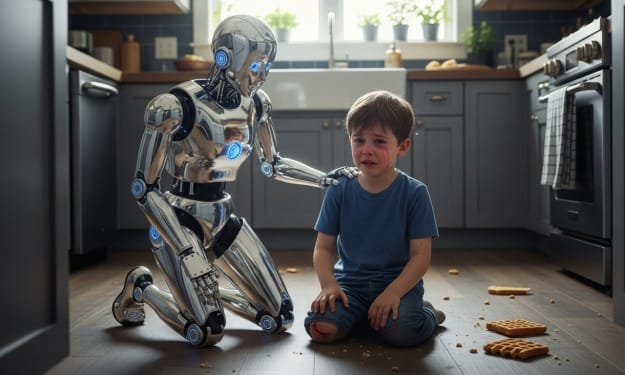
children
Children: Our most valuable natural resource.
Childhood Is the Best Time
بچپن کا زمانہ بھی کیا خوب زمانہ ہے مرغوب زمانہ ہے محبوب زمانہ ہے Childhood is often remembered as the best time of life, a period filled with innocence, joy, and freedom. It is the stage when life feels simple, happiness comes easily, and the world seems full of endless possibilities. Long before responsibilities, stress, and expectations take over, childhood allows us to grow, dream, and discover who we are. This is why many people believe that childhood is the most precious and unforgettable phase of human life.
By Sohel diaries 📖about a month ago in Families
How to Recognize Toxic or Narcissistic In-Laws Early
Most people don’t realize they’re dealing with toxic or narcissistic in-laws until they’re already deeply entangled, emotionally exhausted, doubting themselves, and wondering how normal family disagreements turned into constant battles.
By Eunice Kamauabout a month ago in Families
The Last Day of 2025. Content Warning.
2025 was an objectively hard year for me. I would be lying if I said that I wasn't extremely thrilled to be done with whatever this last year has been! It is fitting that I want to use Wednesdays to write wacky things... and the end of 2025 is on a Wednesday - as it has been one wacky year!
By The Schizophrenic Momabout a month ago in Families
KEM reveals baby no. 8 is a girl with sonogram video: ‘Another little miracle’
KEM is a staple at music festivals all around the country. His cool, not showy presence is a favorite amongst grown folks. You can almost picture the silk shirt sets and loafers worn and coolers toted in SUVs to an area with folding chairs and fans.
By Skyler Saundersabout a month ago in Families
The Space Between Noticing
The city woke up loudly, but Jonah always noticed the silence first. It lived in the early hours, tucked between the hum of traffic and the clatter of metal gates opening for business. It lingered in the spaces most people rushed through without a second thought. Jonah didn’t rush. He never had.
By Yasir khanabout a month ago in Families
How Childhood Attachment Shapes Adult Heartbreak
I was twenty-eight years old, sitting in my therapist's office for the fifth time that month, crying over yet another failed relationship. This time it was Marcus—kind, stable, emotionally available Marcus—who I'd pushed away for reasons I couldn't explain. "Tell me about your parents," my therapist said gently, sliding the tissue box closer. I rolled my eyes. "Really? We're doing the whole 'blame the parents' thing?" She smiled softly. "I'm not asking you to blame anyone. I'm asking you to understand yourself." What followed was the most uncomfortable, enlightening conversation of my life. Because as I started talking about my childhood, patterns emerged that I'd never seen before. Patterns that explained every heartbreak, every self-sabotage, every time I'd chosen someone emotionally unavailable or run from someone who truly cared. My therapist was right. The blueprint for heartbreak had been drawn long before I ever fell in love. The First Language We Learn Attachment theory sounds complicated, but it's actually quite simple: the way our caregivers respond to us as children teaches us what to expect from relationships as adults. It's our first lesson in love, trust, and worthiness. My mother loved me—I never doubted that. But her love came with conditions. It appeared when I was good, obedient, successful. It vanished when I was needy, emotional, or imperfect. I learned early that love was something I had to earn, not something I inherently deserved. My father? He was there but absent, physically present but emotionally distant. He worked late, hid behind newspapers, and responded to my excitement or sadness with the same uncomfortable silence. I learned that expressing needs pushed people away. So I stopped expressing them. I didn't know it then, but I was learning a language—the language of anxious attachment. And I would speak it fluently in every romantic relationship I'd ever have. The Dance We Can't Stop Repeating My first serious relationship was with Jake. He was charming, unpredictable, and emotionally unavailable. Our relationship was a rollercoaster—intensely passionate one week, ice-cold the next. I never knew where I stood, and that uncertainty drove me crazy. But here's the twisted part: it also felt familiar. The push and pull, the constant need to prove myself, the anxiety of wondering if today would be a good day or a bad day—it all echoed my childhood. I was trying to earn Jake's consistent love the same way I'd tried to earn my mother's approval. When he'd pull away, I'd chase harder. When he'd show affection, I'd melt with relief. I was addicted to the cycle because somewhere deep inside, I believed this was what love looked like. After Jake came David, then Ryan, then Christopher. Different faces, same pattern. I was attracted to men who made me work for their attention, who kept me guessing, who made me feel like I had to be perfect to be loved. The Good Guy Problem Then I met Marcus. Sweet, consistent, emotionally intelligent Marcus. He called when he said he would. He communicated clearly. He didn't play games. He made me feel safe. And I couldn't stand it. Within three months, I was picking fights over nothing. I felt suffocated by his reliability. I started noticing flaws that weren't really flaws—he texted too much, he was too eager, his kindness felt boring. The anxiety I'd felt with the others was missing, and without it, I didn't recognize the feeling as love. I broke up with him on a Tuesday night, citing some vague excuse about "not being ready." He took it gracefully, which only made me feel worse. That's when I ended up in therapy, finally asking the question I should have asked years earlier: Why do I keep destroying the good things in my life? Unpacking the Invisible Suitcase My therapist explained that I had an anxious attachment style, likely formed by my inconsistent childhood experiences with love and attention. Children with anxious attachment grow into adults who:
By Ameer Moaviaabout a month ago in Families
What to Expect from Online Autism Treatment: A Parent’s Perspective
When a child is diagnosed with autism spectrum disorder (ASD), parents often feel a mix of emotions—relief at having answers, concern about the future, and uncertainty about the best path forward. In recent years, online autism treatment has emerged as a practical and effective option for many families. From a health specialist’s viewpoint, and grounded in real parental experiences, understanding what online autism treatment truly offers can help families make informed, confident decisions.
By M Hamad Local SEO & Google Business Profile Specialistabout a month ago in Families
The Letter that Silenced the Cannons
The noise that hurts Lucien was eight years old and had hazel-colored eyes. Before, he loved to run in the fields behind his house, catch grasshoppers and listen to the blackbirds singing in the early morning. Before, his dad told him stories of brave knights and his mom made apple cakes that filled the whole kitchen with their aroma.
By La P'tite Pinolaiseabout a month ago in Families
7 Soft Skills That Make You Stand Out Instantly. AI-Generated.
Introduction: Why Soft Skills Create Immediate Impact In today’s competitive professional environment, technical expertise is no longer enough to stand out. While hard skills may help you qualify for a role, soft skills determine how quickly you earn trust, influence others, and advance in your career. Employers increasingly look for individuals who communicate well, adapt to change, and collaborate effectively. These abilities create an immediate impression—often within the first interaction. Below are seven soft skills that can instantly set you apart, regardless of your industry or experience level.
By Muhammad Talha Ahmadabout a month ago in Families