
The Last Letter from Aleppo
A refugee boy writes to the sky, hoping the wind carries his words to his lost mother
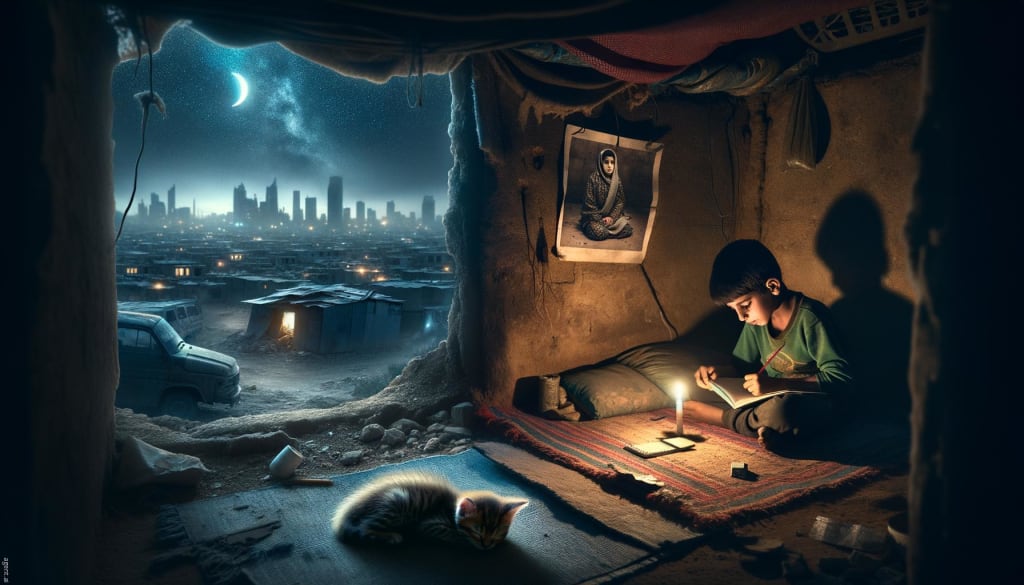
The nights in the camp were cold, not because of winter, but because of absence. Yaseen, twelve years old, sat by the torn window of the shelter, wrapping himself in a fading shawl that used to smell like his mother. Now, it smelled like dust and silence.
In front of him lay a wrinkled notebook—its pages curled, the ink fading. He dipped a worn-out pen in a bottle of melted candle wax and ash; it barely worked, but he believed the words mattered more than the ink.
"Dear Mama,
Today I helped the old man carry water. He gave me two pieces of bread. I shared one with the kitten hiding behind the tents. I named her Nour, like you called me when I was little. I miss that… I miss you."
Yaseen paused. The silence around him hummed like grief. A distant cough. A baby crying. Somewhere, an old radio crackling half a song.
He folded the letter carefully, kissed it, and placed it on the windowsill. Every night, he did the same. And every morning, it was gone.
No one had told him where his mother went. On the day of the bombing, he was hiding under the wooden cart near the olive grove. She had run back to the house, shouting for his baby sister, who had fallen asleep inside. The last thing he remembered was the roar of planes and the color red. When the dust settled, there was no house. No mother. No baby.
The others in the camp called it tragedy. Some said she was taken. Others whispered she had died. Yaseen refused to believe any of them. In his world, as long as you wrote letters, someone would hear.
A week passed. Then another. His letters grew more like poems.
"Mama, did you see the moon tonight? It looked just like your smile…
If I learn to write better, maybe you’ll find me."
He kept writing. His letters were dreams—words he wished someone would read aloud to the stars.
One rainy evening, the sky wept louder than usual. His notebook was damp, the ink bleeding. Still, he wrote.
"Dear Mama,
If I don’t see you again, promise me this—come visit me in my dreams, even if only once."
That night, he didn’t leave the letter on the sill. Instead, he clutched it in his hands and fell asleep against the wall.
In the morning, something strange happened.
There was a letter on the windowsill. A real one. Folded. With his name written in delicate, familiar handwriting.
His hands trembled as he opened it.
"My Nour,
If this ever reaches you, know that I am trying. The world is cruel, but I carry your face in my prayers. I left this with a kind man who promised to find you if he could. If he kept his promise, you are reading this.
Live bravely. Be kind. Tell our stories.
I love you, always.
—Mama"
Yaseen cried—not like children do—but like someone who hadn’t let themselves cry in years. His tears were not just sadness. They were confirmation: she existed. Somewhere.
That night, he didn’t write to the sky.
He wrote to himself.
"Dear Yaseen,
You are still here. Still breathing. That means there’s still hope. One day, you will stand in front of a crowd and read these letters aloud. And someone will listen. And someone will remember. And maybe, just maybe, the wind will carry her back to you."
From that day, Yaseen began collecting other people’s stories in the camp. He asked the old man about his missing son. He listened to the girl who hadn’t spoken in weeks. He wrote their voices down, like prayers stitched into pages.
Years later, when Yaseen grew into a man, people didn’t remember the tents or the mud or the bombs. But they remembered the boy who wrote letters to the sky.
And the letters—they remembered everything.
End of Story
About the Creator
Atif khurshaid
Welcome to my corner of the web, where I share concise summaries of thought-provoking articles, captivating books, and timeless stories. Find summaries of articles, books, and stories that resonate with you
Keep reading
More stories from Atif khurshaid and writers in Families and other communities.
The Long Road Home
Tom Riley left Dalton, Texas when he was twenty-three with nothing but a guitar, a dream, and a whole lot of anger. Back then, he was convinced the world owed him something. His father — a hard man who believed in calloused hands and silence over sentiment — didn’t try to stop him. He just said, “If you’re going, go. But don’t come back unless you’re ready to stay.”
By Atif khurshaid7 months ago in Families
A Sister of 7 brothers
I am the only sister among seven brothers. Six of my brothers reached high positions in life, but the seventh—perhaps struck by an evil eye—remained behind. He was the most loving, compassionate, and supportive brother to me. His name was Zaman. He was the second child after me; the rest were younger. Through my mother’s prayers, all my brothers achieved respectable statuses. Zaman also received those prayers, and my mother loved him the most.
By Sudais Zakwan7 days ago in Families
Threads of Gold
Mariam had grown up believing that her family was ordinary, like countless others in her quiet town. But on her grandmother’s last birthday, she discovered a secret woven into the fabric of her ancestry—one that had been carefully preserved across generations.
By Sudais Zakwan2 days ago in Families
The Devil's Triangle
The sails ruffled in the breeze as we cruised along. The Sea Breeze was a mid-size catamaran that sailed out of Royal Naval Dockyard in Bermuda. We had booked this trip weeks in advance and were now looking at our Captain, Spike and two boat hands. Paddy and Wilson seemed like nice guys, joking around with the passengers and telling us some stories about Bermuda that only locals would know. Their island accents sounded almost British but they were pleasant to listen to.
By Barbara Gode Wiles3 days ago in Fiction


Comments
There are no comments for this story
Be the first to respond and start the conversation.