
The Spaces Between the Words: What Families Never Say and Why Silence Speaks Loudest
We Think We Know Our Families by What They Tell Us—But We Are Shaped by What They Never Could
The things families never say are louder than anything they do. The apology that hangs in the air for decades, unspoken. The declaration of love that gets stuck somewhere between the heart and the mouth. The question too dangerous to ask. The truth too painful to tell. These silences are not empty. They are filled with everything that could not be spoken, everything that was swallowed, everything that got passed down like an heirloom no one wanted but no one could discard.
We grow up inside these silences. We learn them before we learn language. We absorb the rules of what can be said and what must be buried, what is welcome and what is forbidden, what earns love and what risks rejection. These rules are never written down. They are never explained. They are simply there, as invisible and unavoidable as gravity, shaping everything we become. And we carry them into every relationship we enter, every family we create, every silence we will pass to the next generation.
The family that never says "I love you" teaches something powerful. Not that love is absent—it may be deeply present, shown in acts of service, in sacrifice, in being there when it counts. But the absence of the words teaches that some things are too dangerous to name, that vulnerability is weakness, that the deepest feelings must remain unspoken. Children in these families grow up knowing they are loved but never hearing it, and something in them learns to doubt, to hunger, to wonder why the words will not come.
The family that never apologizes teaches something else. That mistakes cannot be acknowledged. That repair is not possible. That the person who is wrong must simply carry it alone, or pretend it never happened. Children in these families learn to hide their failures, to defend rather than admit, to let distances grow because they do not know how to bridge them. They learn that love does not include the words "I was wrong" or "I'm sorry" or "Please forgive me." They learn that silence is safer.
The family that never speaks of grief teaches the hardest lesson of all. That pain must be carried alone. That loss is not to be shared. That the dead are not to be mentioned, because mentioning them might break something that is barely holding together. Children in these families learn that their own grief is unwelcome, that the empty chair is not to be acknowledged, that the hole in the family is not to be named. They learn to carry loss in isolation, and they wonder why connection feels impossible.
These silences are not failures of love. They are failures of language, failures of courage, failures of the models we were given. Most parents do the best they can with what they have. They cannot speak what was never spoken to them. They cannot name what was never named in their own growing. They pass on not just their strengths but their wounds, not just their wisdom but their silences. This is not blame; it is inheritance. And like any inheritance, it can be accepted, refused, or transformed.
The work of adulthood, in part, is learning to hear the silences. To recognize what was never said and why. To understand that the parent who could not say "I love you" may have been raised by parents who could not say it either, going back generations, a chain of unspoken love stretching into the past. To see that the family's silence around grief is not a rejection of your pain but an inability to hold their own. To realize that what was missing was not meant to hurt you but was simply not there to give.
This understanding does not erase the wound. The child who never heard "I love you" still carries a hunger, still struggles to believe they are lovable, still waits for words that may never come. The adult who grew up without apologies still struggles to admit fault, still fears that mistakes are unforgivable, still finds repair almost impossible. The person who learned to grieve alone still isolates in pain, still cannot reach out, still believes that suffering is private. Understanding the source of these patterns does not dissolve them. But it is the first step toward choosing differently.
Because we can choose differently. We can be the ones who break the silence. We can say the words that were never said to us. We can apologize when we are wrong, even though it terrifies us. We can name grief, our own and others', even though it hurts. We can create families—by blood or by choice—where the spaces between the words are filled not with silence but with the messy, terrifying, liberating truth.
This is not easy. Every cell in our bodies will resist. The old rules, learned before language, will scream that silence is safer. The ghosts of generations will whisper that some things are better left unsaid. The fear of rejection, of being wrong, of being too much or not enough, will rise like a wave. But the wave passes. The fear does not kill us. And on the other side of it is something we may never have experienced: the relief of being known, the freedom of truth spoken, the connection that comes when silence finally breaks.
I think about a friend who decided, in her thirties, to tell her father she loved him. He had never said it to her. She had never said it to him. They came from people who did not say such things. It was not in their language, not in their blood. But she said it anyway, one ordinary Tuesday, at the end of a phone call about nothing. "I love you, Dad." There was a silence so long she thought the call had dropped. And then, in a voice she barely recognized, he said it back. Just once. Just those three words. But it changed everything. Not because one conversation healed decades of silence, but because it broke the chain. Because now, in that family, those words existed. They had been spoken. They could be spoken again.
The spaces between the words are real. They shape us more than we know. But they are not permanent. They can be entered, named, filled. The silence that has lasted for generations can be broken by a single voice, a single sentence, a single moment of courage. And when it breaks, something new becomes possible—not just for us, but for everyone who comes after.
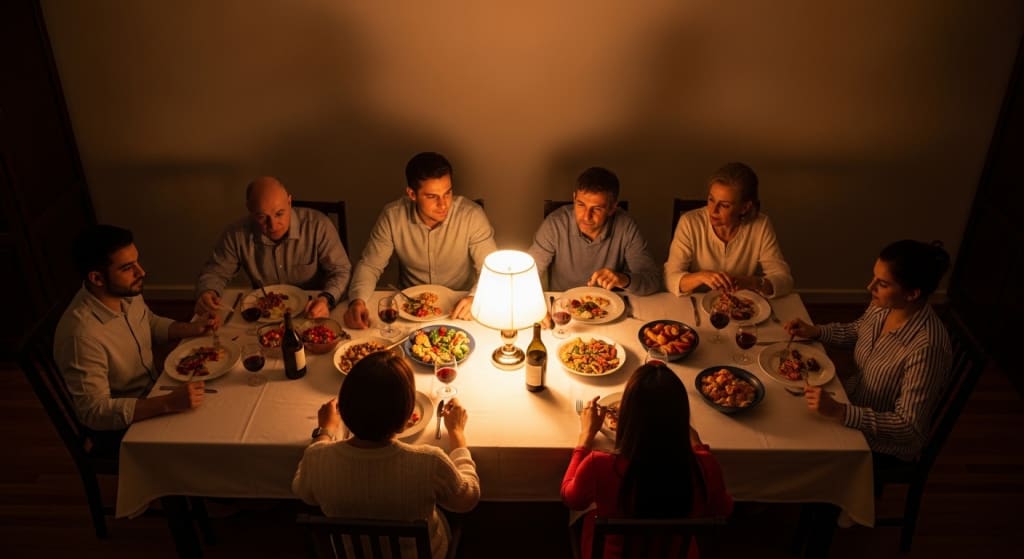
The family gathered around the dinner table, lost in their separate thoughts, their shadows mingling on the wall behind them—that is every family. The spaces between them are real. The things unsaid are many. But the shadows tell a different story. They touch where the living cannot. They connect where the living are separate. They remind us that beneath the silence, underneath the things we cannot say, we are still connected, still bound, still part of one another.
The work is to bring that connection into the light. To say what needs saying. To ask what needs asking. To apologize, to forgive, to declare love, to name grief, to break the silence that has lasted too long. It will not happen all at once. It will not fix everything. But it will begin something. And beginning is enough.
The spaces between the words are waiting to be filled. The silences are waiting to be broken. The words are waiting to be spoken. And we, in this generation, in this family, in this moment, are the ones who can speak them. Not perfectly. Not without fear. But truly. Finally. Out loud.
About the Creator
HAADI
Dark Side Of Our Society
The Day Technology Saved Me and Changed How I See the World
Have you ever felt completely lost? Like you're stuck in a dark tunnel with no light at the end? I certainly have. Life throws us challenges, and sometimes they feel too big to handle. For me, that moment came during one of the hardest times in my life. I was overwhelmed, lonely, and felt like my world was shrinking. But then, something unexpected happened. A simple piece of technology didn't just help me; it literally saved me and showed me a new way to live.
By Jamika Wilkersona day ago in Families




Comments
There are no comments for this story
Be the first to respond and start the conversation.