
The Alchemy of Umami: Why Japanese Cuisine is a Living Heritage
Beyond Sushi and Ramen: Discovering the spiritual philosophy and 1,200 years of history behind 'Washoku'.

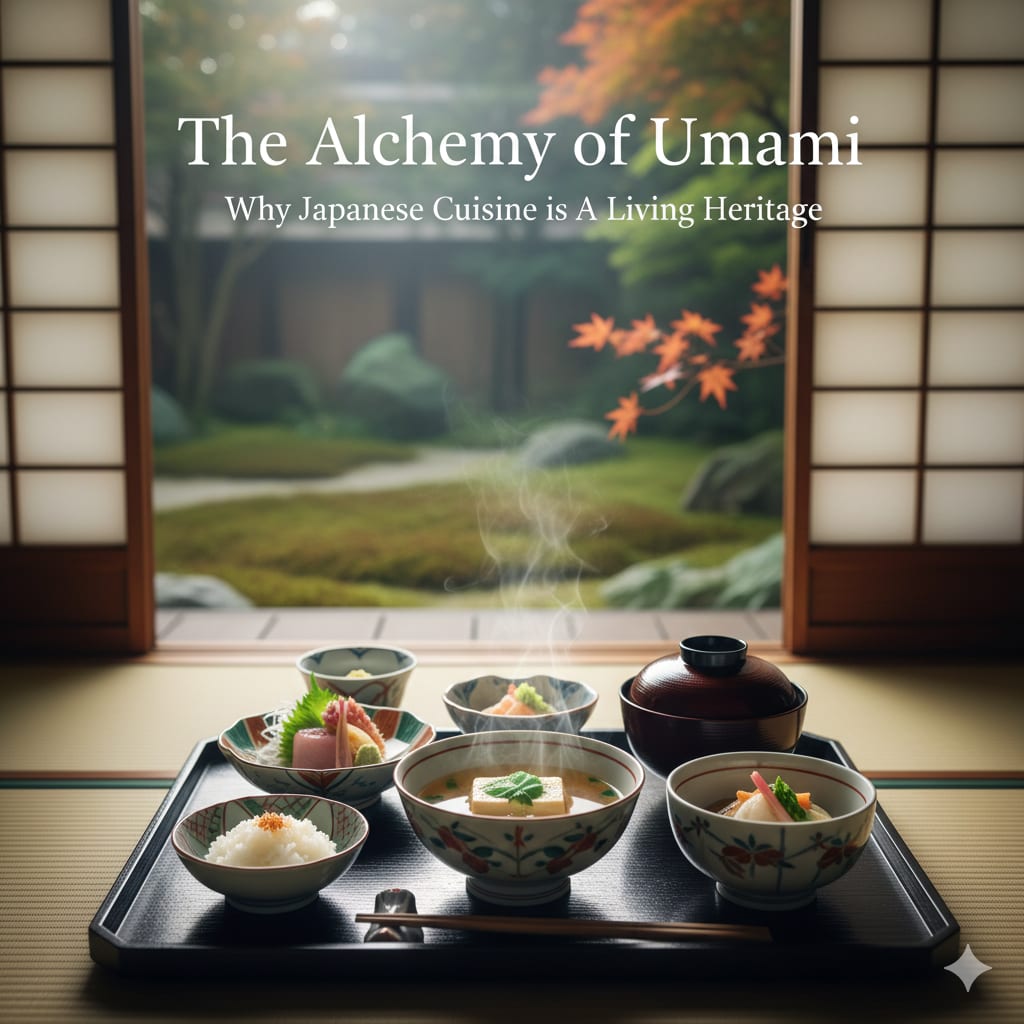
1. The Great Prohibition: 1,200 Years Without Meat
Most people looking at a modern bowl of Tonkotsu ramen or a plate of Wagyu steak would find it hard to believe that for over a millennium, Japan was essentially a vegetarian nation. In 675 AD, Emperor Tenmu, influenced by the Buddhist teachings of compassion and the Shinto ideals of purity, issued a decree that prohibited the consumption of beef, horse, dog, monkey, and chicken.
This was not a mere temporary trend; this ban remained the cultural and legal backbone of Japan for nearly 1,200 years until the Meiji Restoration in the late 19th century. However, human nature craves flavor. This forced abstinence became the mother of invention. The Japanese people became unparalleled masters of the sea and the soil. They turned to the soybean, transforming it into miso, shoyu (soy sauce), and tofu. They turned to the ocean, not just for fish, but for seaweed and crustaceans. Japanese cuisine, or Washoku, was born from a paradox: achieving infinite culinary richness within a world of strict limitations.
2. The Molecular Soul: The Discovery of Umami
While Western culinary traditions often rely on "addition"—adding fats, creams, and heavy sauces to build flavor—Japanese cooking relies on "extraction." At the heart of this extraction is Umami, the elusive fifth taste.
For centuries, Western science recognized only sweet, sour, salty, and bitter. But in 1908, a Japanese chemist named Kikunae Ikeda noticed a savory depth in his wife’s cucumber soup that couldn’t be explained by the traditional four. He traced this flavor to the kombu (kelp) used in the broth and identified the amino acid "glutamate."
This was the birth of Umami. In Japanese, it literally translates to "pleasant savory taste." When combined with Inosinate (found in dried bonito flakes), the two create a synergistic effect that amplifies flavor by eight times. This is the "Alchemy of Umami." It allows a simple dashi broth to possess a satisfying "meatiness" without a single gram of animal fat. It is a cuisine of the invisible, where the most profound flavors are often found in the clearest liquids.
3. Nature as the Executive Chef: The Rule of Five
Washoku is governed by a spiritual framework known as the "Rule of Five" (Go-shiki, Go-mi, Go-ho). A truly balanced Japanese meal should incorporate:
Five Colors: Red, yellow, green, black, and white.
Five Flavors: Sweet, sour, salty, bitter, and umami.
Five Methods: Raw, grilled, steamed, boiled, and fried.
This isn't just for aesthetics. By following these rules, a chef ensures that the meal is nutritionally complete and seasonally appropriate. It embodies the philosophy of Shun (旬)—eating ingredients at the absolute peak of their freshness. In the Japanese mindset, to eat a bamboo shoot in spring or a saury fish in autumn is to physically harmonize one’s body with the rhythm of the Earth. It is an act of mindfulness that acknowledges we are not separate from nature, but a part of it.
4. The UNESCO Recognition: A Living Spirit
In 2013, UNESCO added Washoku to its Intangible Cultural Heritage list. Crucially, they did not just protect the recipes; they protected the social practice.
Washoku is tied to the spirit of the Japanese New Year (Osechi), where each ingredient is a prayer: shrimp for long life, herring roe for fertility, and black beans for hard work. It is tied to the high lifespan of the Japanese people, who enjoy one of the lowest rates of heart disease and obesity in the industrialized world. But most importantly, it is tied to the word "Itadakimasu." Often translated simply as "Let’s eat," its true meaning is: "I humbly receive the life of this plant/animal." It is a profound acknowledgment of the cycle of life and death.
5. Conclusion: A Lesson for the Modern World
In our era of fast food and processed ingredients, Japanese cuisine stands as a silent protest. It teaches us that luxury is not found in expensive spices or oversized portions, but in the clarity of a single radish, the fermentation of a bean, and the gratitude in a single breath.
The alchemy of umami is not just a chemical reaction; it is a cultural one. It is the story of a people who looked at a barren plate and saw a garden. As you enjoy your next Japanese meal, look past the presentation. Taste the 1,200 years of history, the molecular science of the sea, and the quiet spirit of a heritage that is very much alive.
About the Creator
Takashi Nagaya
I want everyone to know about Japanese culture, history, food, anime, manga, etc.
Keep reading
More stories from Takashi Nagaya and writers in Feast and other communities.
The Pride of Japan: Why Sushi Represents One of the World’s Most Extraordinary Food Cultures
How a simple combination of rice and fish became a global symbol of craftsmanship, purity, and culinary philosophy When people around the world talk about Japanese culture, sushi almost always appears at the top of the list. Elegant, minimalist, and deeply tied to tradition, sushi is more than just food—it is a symbol of Japan’s identity. What began centuries ago as a preservation method has evolved into one of the most admired culinary arts on the planet. But what exactly makes sushi so extraordinary? And why has it become one of Japan’s greatest cultural exports?
By Takashi Nagaya3 months ago in Feast
The Last Feast
A Dinner That Changed Everything The aroma of roasted meat and spiced vegetables filled the grand dining hall, wrapping everyone inside in a warm, almost dizzying embrace. Candles flickered across the long oak table, casting shadows that danced on the walls like silent spectators. This was the night of the annual family feast, a tradition that had lasted generations. Each year, relatives traveled from distant towns to gather under one roof, sharing stories, laughter, and meals prepared with care. But this year, something felt different.
By Sudais Zakwan4 days ago in Feast
Taco Bell is vegetarian friendly
I was vegetarian some time ago but still i do appreciate the fact that Taco Bell is one of the few fast food chains out there that is accommodating to the vegetarian Community as a whole. Also due to the fact that Taco Bell is vegetarian friendly as I said at the beginning of this sentence pita which is short for people for the ethical treatment of animals supports the restaurant chains Valiant efforts accommodate the vegetarian community and that's an awesome thing period when I went vegetarian long ago I worried that I would not be able to enjoy Taco Bell as I had when i did eat meat before I went vegetarianUnfortunately I have to do it that again for health reasonsPeriodSome of my favoritesOn the vegetarian menuThe cheesy bean and white rice burrito the Fiesta potatoesAnd just about anything else that came along with it. If I may go so far as to say because it's true that even the sauce is that Taco Bell provides our meatless and vegetarian too so they count as being vegetarian offerings on the Taco Bell menu as well. This is just one of the many ways in which taco Bell is an Innovative and fresh and forward thinking if you can believe it because they are fresh and forward thinking inApproaches to business and the culinary world as well. There are also cheese quesadillas and cheese burritos and all that fair and stuff and that's one of the reasons why Taco Bell has always been one of my favorite go-to fast food chains ever and always will I think I think my last meal's going to be a meatless or something from Taco Bell I don't know anyway period taco Bell is the best and I'm glad.
By Revista Miko:XCI by Rikki La Rouge6 days ago in Feast
The Missing Ingredient
The first time I saw her, she was wearing a velvety, red ribbon in her hair. She carried a small leather backpack everywhere. She searched the forest by turning stones, checking beneath shrubs, listening to the wind as if it might carry an answer.
By Imola Tóth7 days ago in Fiction


Comments
There are no comments for this story
Be the first to respond and start the conversation.