
China creates a 35.6 Tesla magnet that breaks records.
Growing the technology

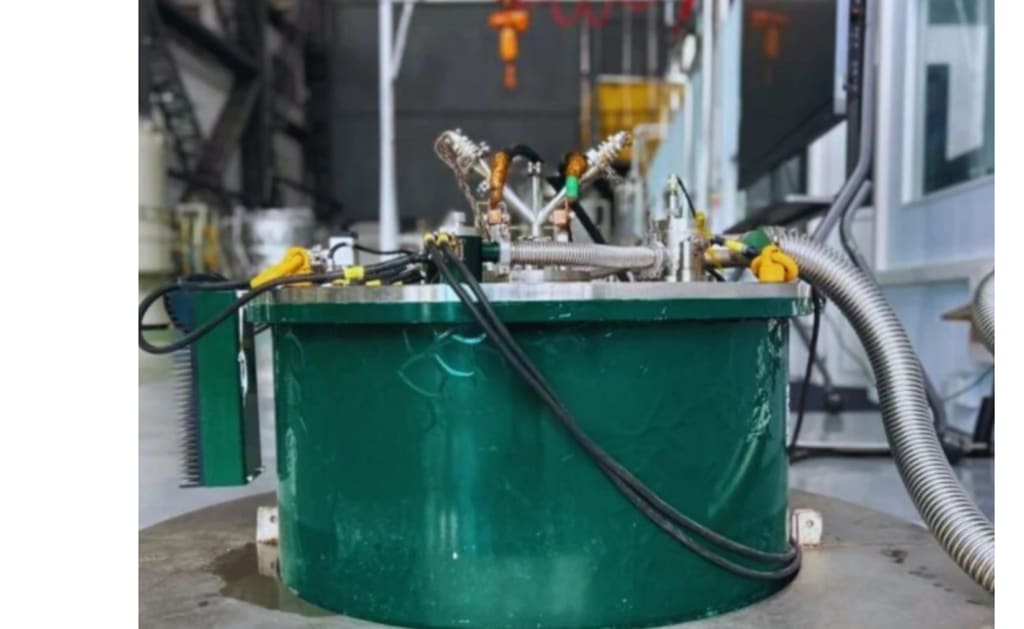
Using a magnet composed entirely of superconducting materials, China has created the greatest stable magnetic field ever recorded, 700,000 times stronger than Earth's. Extreme magnetism is transformed from a transient laboratory trick into a manageable force that scientists can rely on and plan for thanks to its persistent strength.
Users' record magnet
The magnet created that field through a 1.4-inch (3.6-centimeter) hole intended for actual experiments within the Synergetic Extreme Condition User Facility in Beijing (SECUF).
To ensure that the field could be maintained without instability, engineers at the Chinese Academy of Sciences (CAS) designed and ran the system to deliver that strength consistently.
This magnet maintained its record strength in controlled conditions intended for repeated usage, in contrast to previous high-field experiments that experienced a short surge. Understanding how such strength was designed and what limitations currently exist is made possible by that stability.
The importance of constancy
The majority of record magnets peak for a few seconds before falling, which restricts the precise measurements that scientists can make. Instruments can gather weak signals and filter noise in a steady field, increasing the credibility of the results.
The configuration is handled by SECUF as a user magnet, which is a shared magnet available to outside parties for planned experiments. Because of this transparency, engineers are forced to consider multiple runs rather than just one exciting lab moment.
The benefits of superconductors
The strength of a magnet is limited by the heating that occurs when electricity travels through regular metal wires. That heat is avoided and far higher currents are permitted by a superconductor, a substance that conducts current without resistance.
The material remains in that unique state at cold temperatures, allowing the magnet to continue operating without wasting electricity. Nevertheless, one weak point can cause a quick shutdown, and high fields drive the materials nearly to failure.
Within the coil stack
Designers sandwiched a smaller insert coil inside a larger outer coil to access record fields. To increase strength, the inner coil was equipped with a high-temperature superconductor, which operates at warmer cryogenic temperatures.
The bulk current was carried by more conventional superconducting coils surrounding it, which also kept the field uniform throughout the bore. This multi-layered strategy complicates cooling and protection while allowing each material to perform what it does best.
When coils are under stress
Magnetic forces strain and twist the coils as field strength increases, putting stress on support structures, insulation, and metal. The entire construction process became a cross-disciplinary issue because to strict requirements for strength, stability, and homogeneity.
The project's difficulties were recognised by Wang Qiuliang, a CAS researcher with expertise in high-field magnet engineering.
High-field superconducting magnet development, on the other hand, requires interdisciplinary integration and encounters several engineering barriers due to the highly strict criteria for field strength, stability, and homogeneity, Wang stated.
A quick shutdown might be triggered by a single crack or warm spot, releasing stored energy as heat.
Fusion requires confinement.
In fusion experiments, a gas is heated into plasma, a soup of charged particles, which must be kept away from walls by magnets. A team in Hefei beat 323,500 gauss in September 2025 by holding 351,000 gauss, or 35.1 teslas, stable for 30 minutes.
That run demonstrated the advancements made by magnet makers when compared to Earth's magnetic field of roughly 0.5 gauss. Such high fields make fusion designs more feasible, but they still require continuous cooling systems.
Clearer data and stronger magnets
Additionally, stronger magnets sharpen probes of matter, particularly those that read minuscule signals from molecules and atoms.
Higher field intensities separate signals that might otherwise overlap in nuclear magnetic resonance, a technique that scans molecules in a powerful magnet.
Better spectra aid in the mapping of intricate structures by biologists and chemists, which is important for drug development and materials research. These benefits can be shared by more than just one lab with unusual equipment because the new magnet is a user system.
Motion-induced magnetism
Research on energy-efficient electric devices, such as motors and small generators, is aided by high-field magnets. Engineers are able to pack more power into lighter equipment by using superconducting coils, which can carry enormous currents in small places.
Strong fields that remain constant under load are also necessary for magnetic levitation trains and some spacecraft thrusters. Because huge magnets must operate securely around people and machinery, real-world adoption will depend on affordability and dependability.
Growing the technology
Because forces increase quickly as magnets grow up, greater fields will demand stronger conductors and more robust supports. Project teams have already indicated that 40 Teslas in a larger bore will be the next goal.
Because power controls and refrigeration take up the majority of the user access budget, lower operating costs will be equally important. With every advancement, a high-field magnet transforms from a news story into tools that other scientists use on a regular basis.
The latest all-superconducting magnet from China demonstrates how stable, user-friendly fields can transition from specialised businesses into communal facilities. The same strategy might power cleaner equipment and new science if developers can keep costs down while expanding the opening.
About the Creator
Keep reading
More stories from Francis Dami and writers in Fiction and other communities.




Comments
There are no comments for this story
Be the first to respond and start the conversation.