
The woman who controls the weather
Behind every character, there is a story

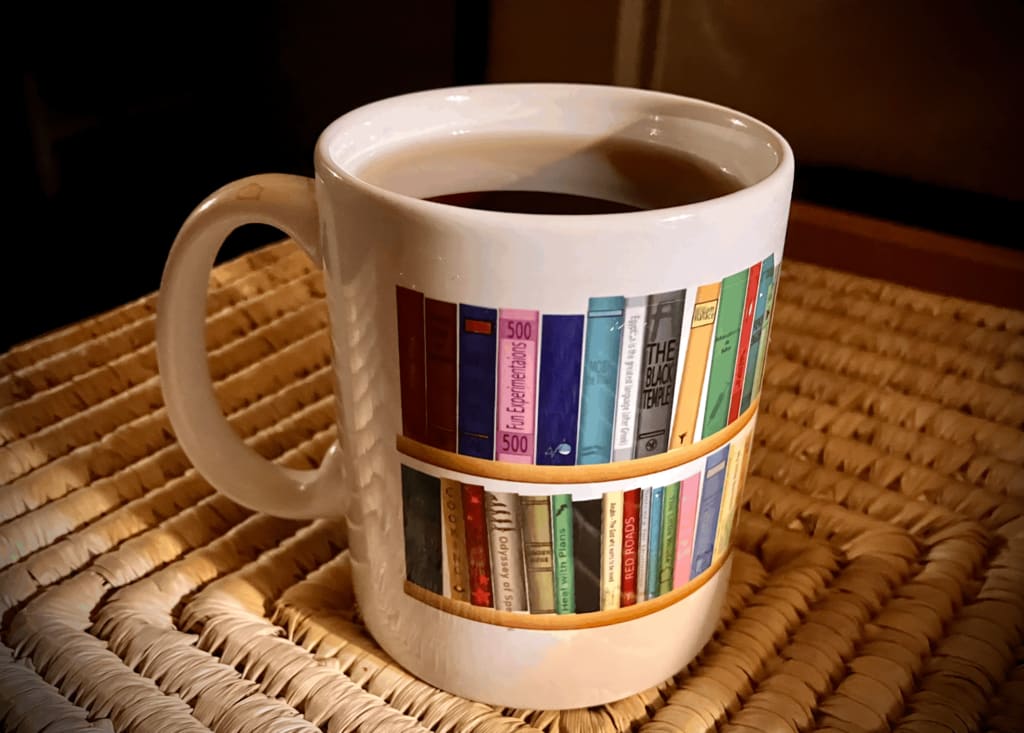
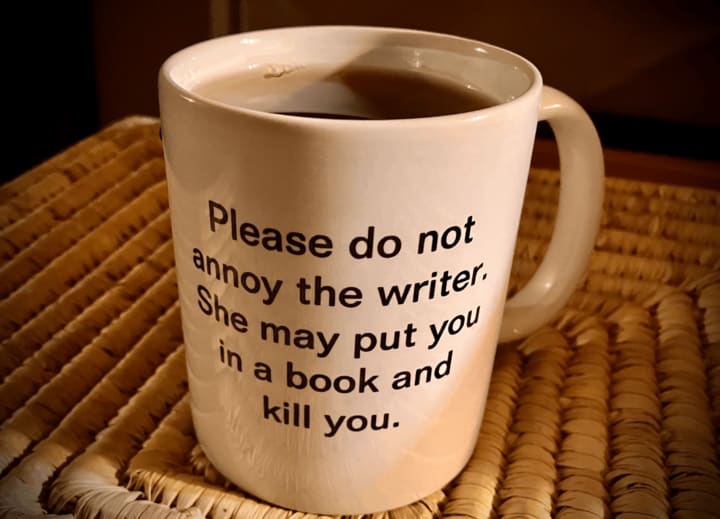
This morning, just like any other morning, I was sitting drinking my tea. Frankly, I was a bit annoyed thinking about a recent incident with someone I don’t even know. Then, I suddenly read on my mug:
Please, do not annoy the writer. She may put you in a book and kill you.
These two innocent sentences got me thinking.
If you are acquainted with a writer, or you accidentally come across one, particularly one who drinks tea in contemplative silence and says things like “interesting …” whilst staring at you too long, you risk narrative justice. This is particularly true if the writer dreams about becoming the next Aghata Christie.
Writers are, by nature, patient predators. They simply observe. They take notes. They mentally adjust your personality traits for dramatic efficiency.
You will not know when it happens. One moment you are interrupting her mid-sentence to explain how the universe really works. Next, you are Gerald.
Gerald has weak ankles. Gerald also has a suspicious fondness for monologuing in abandoned warehouses. Gerald goes to Brighton on holiday to be close to the sea. Gerald will not survive Chapter 12.
The writer does not kill people out of malice. She kills them for pacing.
You must understand: a novel cannot tolerate certain behaviors. Mansplaining? Fatal. Chronic interrupting? Highly combustible. Saying: “Have you tried writing something more commercial?” practically guarantees an encounter with unstable scaffolding.
Writers possess what scholars might call “Narrative Omnipotence.” They control the weather. They control the lighting. They control whether your shoelaces mysteriously come undone near cliff edges.
Have you ever wondered why so many fictional antagonists share the peculiar habit of smirking moments before catastrophe?
Because someone, somewhere, smirked at a writer.
You don’t believe me? History offers clues. Consider Misery by Stephen King. A gentle meditation, really, on what happens when a writer feels misunderstood. Or, The Picture of Dorian Gray by Oscar Wilde, a cautionary tale about vanity, influence, and the risks of being aesthetically inconvenient.
Even in children’s literature, the message is clear. In Alice's Adventures in Wonderland by Lewis Carroll, characters who question the logic of the world are promptly shouted at by royalty. Coincidence? Hardly.
Writers have always wielded disproportionate power. They sit quietly in cafés, apparently harmless, while mentally rearranging your destiny. They will notice that you speak loudly, unnecessarily loudly, annoyingly loudly. They will note how you forward emails marked “urgent” at 11:58 p.m. They will remember the time you said: “It must be nice to work from home.”
In fiction, people who say that are rarely granted peaceful endings. And here is the most alarming part: you will not recognise yourself. Ever.
You will insist the villain is “over the top.” You will remark: “No one I know behaves like that.”
Right. The writer will quietly sip her tea.
She has changed your hair colour. She has given you a limp. She has added a deeply embarrassing hobby involving collectible spoons. Plausible deniability is her shield.
When you confront her, hypothetically, because you should not confront her, she will say: “Oh, that character? Entirely fictional.” Entirely fictional, sure, except for the weak ankles.
There are, of course, levels of offense and corresponding literary consequences:
Mild irritation? You become comic relief. You spill things. Frequently.
Moderate annoyance? You are given a redemption arc that fails.
Severe provocation? You are introduced during a thunderstorm and sleepwalk towards that cliff in Brighton during your holiday.
Do not ever be introduced during a thunderstorm.
Writers are especially dangerous during deadlines. Reality blurs. Coffee consumption reaches mythological proportions. Anyone who says: “So, what’s your book about?” without having read anything you have ever written before will find themselves trapped in a subplot involving a killer ghost and poetic irony.
And yet, despite the risks, society continues to underestimate writers.
People ask writers what their “real job” is. People recommend writing something “with vampires, but like … trendy.”
Every such suggestion quietly builds narrative momentum. The writer sips her tea, slowly. Somewhere, a fictional chandelier begins to loosen.
Consider this a public service announcement.
Be kind to the writer. Praise her metaphors. Respect her solitude. When she pauses mid-conversation to type something into her phone, do not ask what she is writing. It might be your eulogy.
Remember: the beauty of being a writer is that she does not need weapons. She has adjectives. She has an imagination. She has revisions. And revisions are ruthless.
So, the next time you are tempted to interrupt her creative process, to critique her plot twist without invitation, or to explain how you “would totally write a book if you had the time,” pause. Look around. Is there a suspicious draft of Chapter 12 open on her laptop? Are you named Gerald or similar?
Because in the quiet hierarchy of power, beneath CEOs and kings and social media influencers, there sits a woman with a keyboard.
She is smiling. And she controls the weather.
About the Creator
Susan Fourtané
Susan Fourtané is a Science and Technology Journalist, a professional writer with over 18 years experience writing for global media and industry publications. She's a member of the ABSW, WFSJ, Society of Authors, and London Press Club.
Reader insights
Outstanding
Excellent work. Looking forward to reading more!
Top insights
Compelling and original writing
Creative use of language & vocab
Easy to read and follow
Well-structured & engaging content
Excellent storytelling
Original narrative & well developed characters
Expert insights and opinions
Arguments were carefully researched and presented
Eye opening
Niche topic & fresh perspectives
Heartfelt and relatable
The story invoked strong personal emotions
Masterful proofreading
Zero grammar & spelling mistakes
On-point and relevant
Writing reflected the title & theme
Keep reading
More stories from Susan Fourtané and writers in Humor and other communities.
Trying to get back to full-time work whilst recovering from depression
There is a particular kind of silence that follows depression; it’s the absence left behind when your old life no longer fits and the new one hasn’t quite formed yet. That’s why I often compare depression with the state of metamorphosis.
By Susan Fourtané Exclusive • about a month ago
The Golden Truth
If you’ve been following my life, you know it’s a riveting saga of watching grass grow and organizing my sock drawer by thread count. Because my reality is so staggeringly uneventful, I tend to overthink the things most people ignore. While the rest of the world is worried about the economy or space travel, I sat down, stared at my phone, and asked the hard-hitting question: "Why are smileys yellow?"
By Richard Weber7 days ago in Humor


Comments (7)
😆 I was smirking the whole time, great work!
Lovely work, Susan. Worthy of a Top story because it is so relevant and true. 'Writers are, by nature, patient predators. They simply observe. They take notes' I have never thought of it this way, but it is so true. I am always keeping an eye out for what I can write about. Loved the title
💙💗🌹 LOVE🌹💛💗 💙❤🌹 THIS 🌹💛💗
Hahahahahahahha I loveeeeee your mug! Also, I've written 2 stories here on Vocal where the character is based on my ex boyfriend and I've had terrible things happen to him. It was so therapeutic hahahahahahahaha!
I want that mug! You made me feel so powerful reading this. Love it!
This resonates with me. Yes, that griping roommate or the grocery delivery person that broke your eggs could be in the next story. This is awesome
Brilliant. Intelligent. Astute. I enjoyed it immensely. The narrative and the illustrations.