
Mirage in the Mind
In a world where digital illusions rule the skies, one woman begins to see the truth behind the mirage

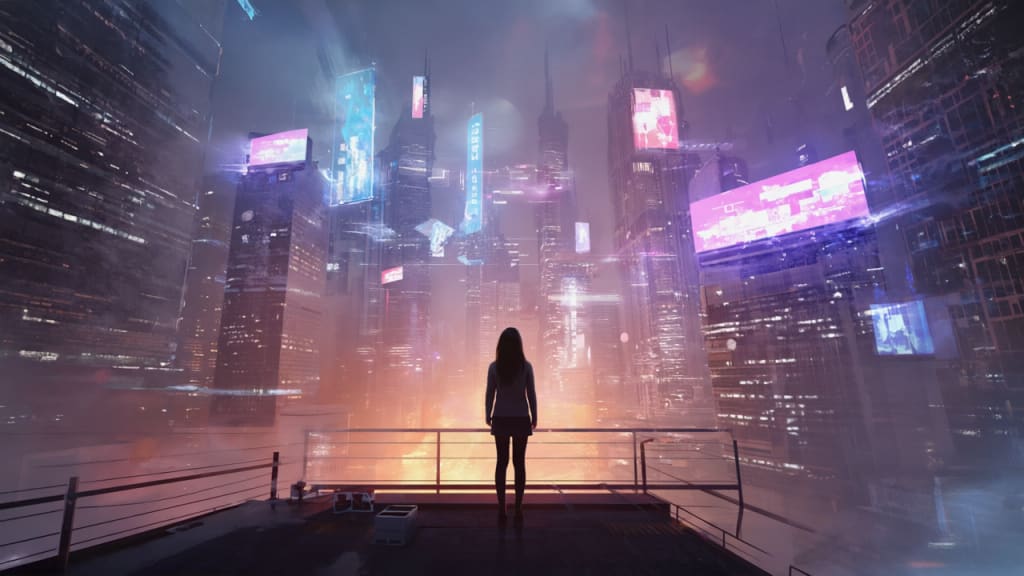
In 2049, the sky was no longer just blue or filled with clouds. It was a canvas owned by corporations—streaming dreams, desires, and illusions 24/7.
They called it SkySync: a global neuro-visual projection system embedded in the air, designed to "enhance the human experience." Everyone wore retina-implanted chips to interpret the images. The government called them wellness filters. But really, they were tools of control.
Most people loved it. Every day, you could wake up and see a custom-designed sunrise, complete with a Starbucks ad floating near the horizon and a smiling couple holding hands in a meadow—even if you lived in the heart of a dying, grey city.
But Mira didn’t feel the same.
At 29, Mira was a tech engineer working for one of the top mirage development firms in New Chicago. She helped design the sky illusions herself. She’d coded simulations of utopias, designed artificial stars, and helped animate holographic children playing in virtual parks. She was good at it—too good. But she never fully believed in it.
Then something changed.
One morning, while reviewing a test mirage in the company’s private lab, Mira noticed a flicker in the code. Just a frame—half a second—where the illusion didn’t load properly. It wasn’t a glitch. It was… a shadow.
A raw, untouched image of the real sky—a dark, orange hue choked by pollution. No ads. No meadows. No digital joy. Just the truth.
At first, she brushed it off. Even the most advanced systems glitched occasionally. But then it happened again, and again—each time when no one else was around.
And then came the voices.
“Mira, can you see us?”
“You’re not blind like the others.”
The messages weren’t audio—they appeared subtly within the mirage, embedded in clouds or flowing water. Messages only she could see. At first, she thought she was hallucinating. Maybe burnout, or the result of too much coding and too little sleep.
But deep down, she knew something wasn’t right.
So she dug into the archives. Hidden beneath layers of security clearance, she found an abandoned project folder titled SPECTRUM-01. Inside were files labeled “Truth Layer,” “Conscious Override,” and one that chilled her to the bone: “Mass Visual Control Protocol.”
The documents detailed a plan—created over a decade ago—to slowly phase out reality and replace it with curated illusions. These illusions didn’t just entertain. They manipulated behavior. They could subtly nudge citizens toward certain purchases, beliefs, even voting choices. Over time, the world people saw was no longer the one they lived in.
Mira realized: no one wanted to escape the matrix because they didn’t even know they were in one.
She thought about her coworkers, her neighbors, even her own mother—who now spent her days admiring holographic gardens, unaware that their building’s real courtyard had been turned into a waste site years ago.
Fueled by a mix of fear and determination, Mira did something reckless. She disabled her retinal chip.
The moment it went offline, her world collapsed.
The sky was no longer blue—it was sickly grey. Buildings once gleaming with digital polish were rusting and decayed. Trash lined the streets. And the people? They shuffled along like ghosts, smiling at illusions that no longer existed for her.
It was terrifying. And freeing.
For the first time, Mira was awake.
But she also became a target.
The corporations weren’t stupid. SkySync systems tracked user behavior, and her chip’s sudden shutdown triggered red flags. She received warnings. Then her access was revoked. Then the door to her apartment wouldn’t open—biometric lock disabled remotely.
She knew she had limited time.
So she found others.
The messages weren’t hallucinations—they were signals from a resistance group known as the “Unseen.” Scattered across the globe, they were former engineers, whistleblowers, and citizens who had broken free from the mirage. They worked underground to expose the truth, one eye at a time.
Mira joined them.
She used her knowledge to write a virus—a piece of code designed to create micro-mirages in the main projection. Unlike the usual illusions, these were different: short bursts of reality, injected into the stream every few hours. Just long enough for someone to see. Just enough to make them question.
And slowly, it worked.
People began to notice. A bird flying backwards. A glitch in a tree's shadow. A skyscraper disappearing for a split second. Nothing big—just enough to crack the illusion. And once you noticed one crack, the whole system started to look suspicious.
The corporations scrambled to patch the mirage. But it was too late. Curiosity had been sparked.
They couldn’t un-see the truth.
Final Thought
Mira’s journey wasn’t about destroying the system overnight. It was about awakening minds, one flicker at a time.
Because sometimes, all it takes is one person willing to see—to remind the world that even the most beautiful illusion is still a lie.
And that truth, no matter how ugly, is always better than a pretty mirage.
About the Creator
Solene Hart
Hi, I’m Solene Hart — a content writer and storyteller. I share honest thoughts, emotional fiction, and quiet truths. If it lingers, I’ve done my job. 🖤
Keep reading
More stories from Solene Hart and writers in Fiction and other communities.
Dead and Wearing Green
She was wearing that green dress when I first saw her, five years ago to the day. Flowing meadow fabric draped over long legs, thick auburn hair flowing down her back. That smile. Of course, she is still beautiful now. But now she is no longer alive.
By Karen Cave7 days ago in Fiction
The Sleeping Beauties
The halls were nearly silent as Rafael walked them; nearly, because it was almost impossible to not hear a quiet whir or hum anymore from the nearly invisible machines as they did their duties. The guards glanced over at him from their posts, not daring to move any further in their acknowledgement. Rafael smiled and nodded to them as he passed their post.
By Dionearia Red6 days ago in Fiction
Why Black History Matters in America?
The United States of America is celebrating their 250th anniversary in 2026. I'm proud to be an American and as someone who was born here, I wouldn't imagine myself living anywhere else. This is a country where opportunities are possible. Where anyone can be successful in anything they desire to do. Equality, community, and togetherness are the backbones of what America is and should be about. However, we have an administration who wants to erase and disregard those who have made positive, meaningful impacts in our country, specifically Black figures, such as Martin Luther King, Jr., Rosa Parks, and Maya Angelou. President Trump and his administration have been constantly complaining and fighting against what they call the "Woke agenda". They use this excuse as a distraction from other issues they refuse to address, such as the high cost of living, climate change, and inflation. That equality is dividing America, when in reality, it's bringing us together. Being woke is not tied to a specific political party. No matter where you stand on the political spectrum, you can still care about other people and their plights. Compassion and empathy for others isn't tied to a political party, either. We were taught as children to treat others the way we want to be treated and not judge others because they're different from us. Caring about others isn't a personal attack on your beliefs. It doesn't make you any less of a person. People who are easily offended over African American figures, past or present, or anything related to it, are grasping at straws. Current and future generations need to know who people like Harriet Tubman and Shirley Chisholm were, especially in the classroom. Black History is part of American History. It should be recognized, not hidden or forgotten. Besides, you can't shield children from everything, just because your feelings are easily hurt.
By Mark Wesley Pritchard 3 days ago in The Swamp



Comments (1)
Wow