
THE STARLINER PROTOCOL: NASA’S "TYPE A" CONFESSION AND THE 311-PAGE COVER-UP
They called it a test flight. They called the thruster failures a 'hardware glitch.' But a shocking new internal leak and a rare 'Type A' mishap classification reveal a much darker reality. Why is NASA suddenly purging its leadership? And why are they preparing to send an uncrewed 'Ghost Ship' back to the International Space Station? The official story is breaking apart in orbit
THE ECHOES OF A FAILING SHIP
In the sterile, brightly lit press briefing rooms of Washington D.C., government space agencies do not willingly admit to catastrophic failure. They use sanitized words. They talk about "learning opportunities," "data collection," and "nominal deviations." They wrap their mistakes in thick layers of bureaucratic armor.
But yesterday, the armor cracked.
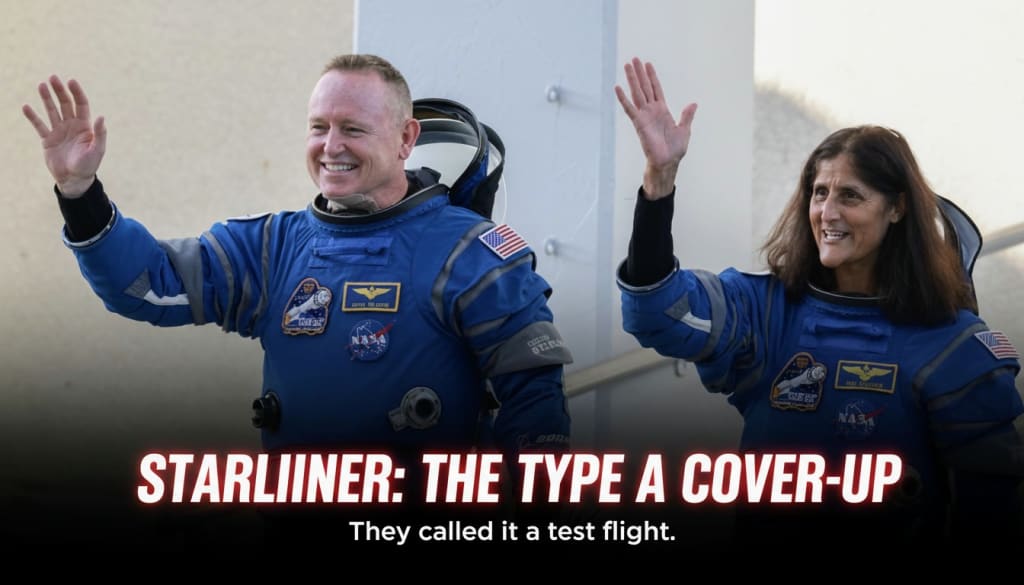
In a move that has sent shockwaves through the global aerospace community, NASA has formally classified the 2024 crewed flight of the Boeing Starliner spacecraft as a "Type A" mishap.
For those unfamiliar with the dark lexicon of space exploration, a "Type A" classification is the highest, most severe category of failure. It is a code red. It is a designation usually reserved for the total loss of a spacecraft, catastrophic destruction, or a scenario where human lives were hanging by an absolute thread.
The NASA Starliner Type A mishap is no longer just a story about a delayed launch or a bad PR day for the Boeing space failure. It is an acknowledgment that the astronauts aboard that vessel were inside a flying coffin. But as we dig deeper into the massive, newly released 311-page internal report, a chilling question emerges: Is this sudden wave of transparency an act of honesty, or a desperate data dump designed to hide a much more terrifying truth?
THE 311-PAGE CONFESSION AND THE LEADERSHIP PURGE
When an agency wants to hide a single, damning fact, they don't lock it in a vault. They bury it under three hundred pages of highly technical jargon.
Following the announcement, NASA Administrator Jared Isaacman sent an unprecedented, agency-wide letter. The language used in this document is not the usual corporate PR speak. It reads like a warning.
Isaacman wrote: "We are taking ownership of our shortcomings." He went further, stating that while the Starliner had severe design and engineering deficiencies, the most troubling failure was not the hardware itself.
"It is decision-making and leadership that, if left unchecked, could create a culture incompatible with human spaceflight."
Read those words carefully. "Incompatible with human spaceflight."
NASA is publicly declaring that the people running the Commercial Crew Program ignored the danger. Isaacman promised "leadership accountability," hinting at a massive internal purge. But why now? The Starliner returned 11 months ago. Why did it take nearly a year to classify this as a Type A disaster?
In the world of deep space anomalies, a delay of this magnitude usually means one thing: the engineers found something in the telemetry data that they could no longer explain away, and the executives who tried to cover it up are now being thrown to the wolves.
THE "UNEXPLAINED ANOMALY" LIE
To understand the depth of the deception, we have to look at the engines. The Starliner Service Module failed. The thrusters—the very lifeblood of a spacecraft’s ability to navigate the deadly vacuum of space—simply stopped working.
When you are hurtling through the dark at 17,500 miles per hour toward the International Space Station (ISS), a thruster failure is not a glitch. It is a death sentence. But how did the Boeing and NASA investigations handle these terrifying red flags during the initial mission?
Isaacman’s letter gives us the horrifying answer: "The investigations often stopped at the proximate cause, treated it with a fix, or accepted the issue as an unexplained anomaly."
An unexplained space anomaly. That is the phrase they use when they encounter something they cannot comprehend, or worse, something they are forbidden to talk about. Isaacman admitted that the diagnosis was often incorrect due to "insufficient rigor in following the data to its logical conclusion."
What is the logical conclusion? If it wasn't a standard mechanical failure, what shut down the Starliner's thrusters? The ISS has been the site of numerous undocumented events, strange thermal spikes, and orbital debris encounters. When a spacecraft's propulsion system fails mysteriously, and the agency officially stamps it as an "unexplained anomaly," we are no longer talking about poor engineering. We are talking about external interference. They stopped looking for the root cause because they were terrified of what they might find.
THE GHOST SHIP OF 2026
So, what happens next? If a vehicle is deemed a Type A mishap, logically, the program should be suspended indefinitely. But that is not what is happening.
NASA and Boeing have agreed that the next flight of Starliner will take place as early as April 2026. However, there is one massive difference: It will fly without a crew.
They are sending a Ghost Ship back into orbit. It will launch, navigate the void, and attempt to dock with the ISS entirely empty. The official narrative is that they need to "remediate the technical challenges" and fully understand the risks before putting human beings back inside.
But look at the timing. We are in an era of unprecedented orbital activity. We have 35 million interstellar objects passing through our solar system. We have highly classified space missions being launched by global superpowers every month.
Why send a multi-billion dollar, uncrewed Starliner back into the exact same environment where it suffered an unexplained anomaly?
Are they testing a fix? Or are they sending it out as bait? If the Starliner encounters the same mysterious thruster shutdowns, this time, there will be no human astronauts to witness it, no human pilots to manually override the systems, and no human voices to leak the audio back to Earth. An uncrewed ship can be easily "lost" in orbit without the messy public relations disaster of casualties.
THE SHADOW CREW WAITING IN THE WINGS
While the public is distracted by the promise of the 2026 Ghost Ship, whispers are echoing through the corridors of the Johnson Space Center.
Despite the Type A classification, despite the leadership purge, and despite the uncrewed test flight, preparations for the future are quietly moving forward in the shadows. Underground sources reveal that two NASA astronauts, Woody Hoburg and Jessica Wittner, have already begun rigorous, compartmentalized training for a potential "Starliner-2" mission projected for the first half of 2027.
NASA has flatly refused to confirm that any astronauts have been assigned to this vessel. Officially, the mission does not exist.
Why the secrecy? If the 2026 uncrewed flight goes perfectly, they will need a crew ready to launch immediately. But what are Hoburg and Wittner really training for? Are they learning how to pilot a repaired Boeing spacecraft, or are they being trained on how to handle the exact "unexplained anomalies" that disabled the first crew?
THE FINAL VERDICT: A DANGEROUS SILENCE
The 311-page report is not a conclusion; it is a curtain. NASA is offering us the head of Boeing’s engineering department to distract us from the void.
The Starliner Type A mishap classification proves that the dangers of human spaceflight are no longer just about rocket equations and thermal tiles. The system is breaking down. Leadership is making decisions incompatible with human survival because the environment they are flying into is becoming increasingly hostile, unpredictable, and crowded.
The Starliner failed. The executives called it an anomaly. Now, they are sending an empty ship into the dark to see if the anomaly strikes again.
We are watching a high-stakes game of chess being played in low Earth orbit. And unfortunately for the astronauts training in the shadows, they are nothing more than pawns in a space race where the rules are being kept strictly classified.
About the Creator
Wellova
I am [Wellova], a horror writer who finds fear in silence and shadows. My stories reveal unseen presences, whispers in the dark, and secrets buried deep—reminding readers that fear is never far, sometimes just behind a door left unopened.




Comments
There are no comments for this story
Be the first to respond and start the conversation.