Latest Stories
Most recently published stories in Filthy.
When desires break the rules
The first rule was simple: don’t touch. I broke it the moment his hand closed around my wrist, heat flaring where skin met skin, the kind of heat that doesn’t ask permission. We were standing too close, breathing the same air, pretending this was still innocent while my body had already made its decision. Every warning I’d rehearsed dissolved under the slow drag of his thumb against my pulse, a silent promise of everything we weren’t supposed to want—and everything I was already aching to take.
By Crazy story writer ✍️ 6 days ago in Filthy
Celeb Fun. Content Warning.
The party had begun and Jamie had entered. Her brown hair was done perfectly as it was short. She wore a shirt black dress and black pantyhose covering her long legs. She goes over to a bar where she is greeted by a slightly younger man with a goatee.
By Forest Green6 days ago in Filthy
Celeb Fun. Content Warning.
On a long summer day in a trailer, Keri was reading a book just being in a white t-shirt and red panties. Then she heard a knock on the door. She went up to the door and looked out at the window. "Hey Keri. Are you in there? It's me, Katie." She saw that it was Katie. "Hi, we missed you at the wrap party today," Katie said. I’m not in a partying mood, keri replied. She had the same reaction Katie did when she saw one of her castmates stroking himself with her panties while he was in her trailer. The two women sat on the couch together. While watching tv keri moves closer to katie and kisses her. Katie proceeds to kiss Keri while Keri runs her fingers through Katie's hair. As Keri takes off her shirt and panties and places them and the two lay on the couch, Katie then begins rubbing on Keri's bra and kisses on her from her lips down to her neck. Her tongue twisted with Keri’s tongue while playing with her nipples. She then kisses her all the way down to Keri’s stomach right to her small boobs. Katie went to place two fingers into Keri’s pussy. With keri moving closer katie goes deep inside. Her fingers are going much faster inside keri’s pussy. With the fingering still on, Katie also rubs on Keri's ass, squeezing it gently. Keri moans loudly and presses her hips against Katie. Eventually Katie briefly stands to remove all of her clothing. She lifts up her pink t-shirt, unhooks her bra and unbotton her denim shorts. As she pulls them, Katie also pulls her panties down along with the shorts, revealing her very hairy bush to Keri. When she saw Katie naked it was the hottest thing she had ever seen, she couldn’t help herself from staring at her naked body. They decide to use lotion to make their experience go more smoothly. Keri sees the lotion bottle as Katie throws her clothes aside.
By Forest Green6 days ago in Filthy
Celeb Fun. Content Warning.
Around six o'clock in the morning on sunday valery is walking on the beach wearing a yellow two piece bikini and her man Nicholas is helping her carry a basket of food and a red blanket. There was no one else around as the beach usually opens to the public on Sunday at nine. "Let’s put the stuff down here," Valery told Nicholas, referring to the spot she always sits when she goes with her friends during the summers. It was still dark and the two could barely see the city skyline which people could see as it was very close to the beach. As Nicholas places the blanket on the sand he then puts the blanket there for them to eat on. But there was not enough food, only just sandwiches, a bottle of fruit punch and a coconut that was cut in half. But they were not just there to eat. Valery takes off her yellow bikini top and places it by her side. She briefly uses the coconuts to hover over her huge tan lined tits to tease Nicholas and he gets hard through his blue shorts. She then places the coconuts on the blanket, pours the fruit punch into the coconut pieces. She bites into her chicken sandwich and sees his erected cock poking through his shorts.
By Forest Green7 days ago in Filthy
Celeb Fun. Content Warning.
Bonnie is sitting in her room working on her computer. She shuts it down and heads downstairs. She walks in her living room, seeing her assistant Jake playing a video game. "Oh Bonnie, I'm sorry. I was just about to." he was about to say then she cut him off. She requests that he follow her into the kitchen. After kissing him for nearly a minute she asked him. "Have you been with an older married woman before?" "Sometimes." he replied. "Well you’re in for a big surprise, honey." she said, pulling him closer to her.
By Forest Green7 days ago in Filthy
Celeb Fun. Content Warning.
I smirk as you cum everywhere and all over my cock while moaning. "Oh fuck yes. I'm close too now." I groan. You continued to thrust into me, my pussy tightening around your shaft as a result of my intense orgasm, increasing your pleasure.
By Forest Green7 days ago in Filthy
Bless Me, Father. AI-Generated.
A Sentence That Has Never Grown Old “Bless me, Father” is one of the most emotionally charged phrases in human history. Though deeply rooted in religious tradition, its power transcends belief systems, cultures, and time. These words do not belong solely to churches or confessionals; they belong to every human heart that has ever carried regret, guilt, fear, or longing for forgiveness. In a world that constantly demands perfection, strength, and moral clarity, Bless me, Father feels almost revolutionary. It is an admission of weakness in an age that rewards invincibility. It is a plea for mercy in a society that often confuses accountability with cruelty. This article explores the spiritual, psychological, and cultural meaning of Bless Me, Father—why it continues to resonate, why humans cannot escape the need for forgiveness, and why grace remains one of our deepest necessities. The Origin of the Confession Historically, Bless me, Father originates from Christian confession, a ritual where believers openly acknowledge sins before seeking absolution. Yet confession itself is far older than organized religion. Ancient civilizations practiced public admissions of wrongdoing, purification rituals, and symbolic acts of repentance. Confession emerged not as punishment, but as release. Early societies understood something modern culture often forgets: guilt, when left unspoken, poisons the soul. To confess was to cleanse—not just spiritually, but psychologically. Why Humans Need to Confess Confession is a human instinct. Long before laws, courts, or therapy, people needed a way to unload the weight of moral failure. Psychologically, guilt activates stress responses in the brain. Suppressed guilt increases anxiety, depression, and emotional numbness. Confession interrupts this cycle. Speaking the truth—especially about our worst moments—restores internal balance. This is why people confess to: Priests Therapists Loved ones Journals Anonymous strangers online The structure changes, but the need remains constant. The Emotional Weight of Guilt Guilt itself is not evil. Healthy guilt signals moral awareness and empathy. It tells us when we have violated our values. But when guilt is denied or prolonged, it transforms into shame—the belief that I am bad, not I did something wrong. Bless me, Father represents the turning point where guilt is confronted before it becomes shame. It is the moment a person chooses truth over denial. The Father Figure: Authority, Fear, and Comfort The word Father carries profound symbolic meaning. It represents authority, discipline, protection, judgment, and love—all at once. For some, the father figure is nurturing. For others, it is intimidating or absent. Addressing a “Father” is therefore deeply psychological. It means confronting the internal voice that measures our worth. When someone says Bless me, Father, they are not just speaking to religion—they are speaking to authority itself, asking whether failure leads to rejection or mercy. Forgiveness: The Most Misunderstood Virtue Forgiveness is often mistaken for weakness. In reality, it is one of the most demanding human acts. Forgiveness does not mean: Forgetting harm Denying responsibility Canceling consequences Forgiveness does mean: Choosing healing over endless punishment Allowing growth after failure Separating identity from mistakes A blessing does not erase the past—it loosens its grip on the future. Grace in a World Without Mercy Modern culture often celebrates accountability but resists grace. Social media amplifies mistakes, freezes people in their worst moments, and offers little room for redemption. Public confession today often leads to humiliation rather than healing. This is why private confession—spoken or internal—has become more important than ever. Bless me, Father quietly resists a culture of permanent condemnation. It insists that people are more than their failures. Modern Confession: Therapy, Silence, and Screens As religious participation declines in many societies, confession has not disappeared—it has migrated. Therapy rooms have become modern confessionals Social media posts serve as public admissions Anonymous forums act as judgment-free spaces Private journaling replaces spoken ritual Each form reflects the same desire: to be known without being destroyed. Self-Forgiveness: The Final and Hardest Confession Many people can accept forgiveness from others yet remain trapped in self-punishment. Self-forgiveness requires humility, honesty, and compassion. To forgive oneself is not to excuse wrongdoing, but to accept humanity. It means learning without self-destruction. When spoken inwardly, Bless me becomes a radical act of self-mercy. Why “Bless Me, Father” Still Matters This phrase survives because it names a truth modern language often avoids: humans fail, and they need grace to continue. In an era obsessed with productivity, moral superiority, and public judgment, Bless Me, Father reminds us that dignity is not earned by perfection—but preserved by forgiveness. Spirituality Beyond Religion Even for those without religious belief, the emotional structure of confession remains essential. People still seek absolution—if not from God, then from conscience, community, or self. Grace is not owned by religion. It is a human requirement. The Quiet Power of Mercy Mercy does not make headlines. It does not trend. It operates quietly—in conversations, apologies, reconciliations, and silent decisions to move forward. Yet mercy changes lives more permanently than punishment ever could. Conclusion: A Prayer Hidden in Plain Sight Bless me, Father is not a declaration of holiness. It is an admission of humanity. It is spoken by those who stumble yet refuse to surrender to despair. It is carried by people who believe that failure does not cancel worth. In a noisy world that punishes mistakes loudly, this ancient phrase survives as a quiet truth: We do not need perfection to be worthy of grace. We need honesty. We need courage. And sometimes, we simply need to ask for forgiveness.
By Zahid Hussain9 days ago in Filthy
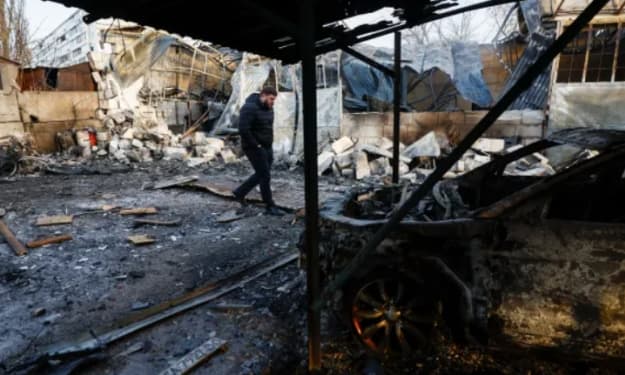
Russia-Ukraine War Live: Kyiv and Kharkiv Under Fire as Peace Talks Struggle to Survive. AI-Generated.
Peace Talks in the Shadow of Missiles As diplomats gather around tables and microphones, missiles continue to fall from the sky. The Russia-Ukraine war once again revealed its cruel paradox when Kyiv and Kharkiv came under renewed attack amid ongoing peace talks. For Ukrainians, the timing of these strikes is not just alarming—it is symbolic. It reflects a conflict where dialogue and destruction move side by side, each undermining the other. The latest attacks have reignited fears that peace negotiations are little more than formalities, overshadowed by military aggression and strategic posturing. While officials speak of ceasefires and compromises, ordinary citizens rush to shelters, listening for sirens instead of speeches. Kyiv Under Attack: A Capital City on Edge Kyiv, the heart of Ukraine’s political and cultural identity, has endured repeated assaults since the beginning of the war. The recent strikes targeted key areas near residential zones, sending shockwaves across the city. Explosions echoed through neighborhoods that, only hours earlier, were clinging to cautious hope sparked by news of peace talks. For residents of Kyiv, war has become a routine of uncertainty. Nights are restless, mornings begin with damage assessments, and daily life is shaped by the possibility of sudden violence. The attacks during negotiations felt particularly unsettling, reinforcing the belief that no moment—even those dedicated to peace—is sacred. Ukrainian officials described the strikes as deliberate intimidation, aimed at pressuring negotiators and signaling dominance rather than cooperation. Kharkiv: A City That Refuses to Break Kharkiv, Ukraine’s second-largest city, has long been a frontline symbol of resilience. Its proximity to the Russian border has made it especially vulnerable, and the latest attacks added to a long list of scars. Homes, public buildings, and infrastructure were damaged as residents once again sought refuge underground. Despite the destruction, the spirit of Kharkiv remains defiant. Local authorities and volunteers continue emergency response efforts, proving that while buildings can be damaged, community resolve is harder to destroy. Yet the question lingers: how long can resilience withstand relentless pressure? Why Attacks During Peace Talks Matter Attacks amid peace negotiations carry a weight beyond their immediate military impact. They raise serious doubts about sincerity and intentions. In diplomatic terms, such actions erode trust—the most essential ingredient for successful talks. Historically, peace processes require at least a temporary reduction in violence to allow dialogue to breathe. When attacks intensify instead, they send a clear message: military leverage still matters more than compromise. For Ukraine, these strikes confirm fears that negotiations are being used tactically rather than genuinely, as a way to gain time, international legitimacy, or strategic advantage. Civilian Lives Caught in Between The real tragedy of the Russia-Ukraine war is measured not in territorial shifts but in civilian suffering. Every missile launched during peace talks deepens the humanitarian crisis. Families are displaced, children are traumatized, and essential services remain under constant threat. Hospitals operate under emergency conditions, energy networks struggle to stay functional, and winter only amplifies the pain for millions. For civilians, peace talks are not abstract political events—they represent hope for survival. When that hope is shattered by explosions, despair grows stronger. International Reaction: Condemnation Without Consequence? Global leaders were quick to express concern over the attacks on Kyiv and Kharkiv. Statements condemning violence and urging restraint flooded diplomatic channels. Allies reaffirmed support for Ukraine, emphasizing the need for a genuine commitment to peace. However, critics argue that words alone have failed to alter the course of the conflict. Repeated condemnations, without decisive action, risk becoming background noise in a war that has learned to ignore moral appeals. The international community faces a difficult dilemma: how to encourage dialogue without appearing to tolerate aggression. The Strategy Behind the Strikes Military analysts suggest several strategic reasons behind launching attacks during negotiations: Pressure Tactics: Demonstrating strength to influence outcomes at the table Psychological Warfare: Undermining civilian morale and political confidence Narrative Control: Shaping perceptions at home and abroad Testing Limits: Measuring how far aggression can go without triggering stronger responses While these tactics may offer short-term leverage, they often sabotage long-term peace prospects. Media, Messaging, and the War Narrative Live coverage of the war plays a critical role in shaping global understanding. Headlines announcing attacks during peace talks highlight the contradiction at the heart of the conflict. For Ukraine, publicizing these events is essential—not only to maintain international attention but also to document violations and preserve historical truth. In modern warfare, the battle for narrative is nearly as important as the battle on the ground. Yet constant exposure to violence risks fatigue. The challenge for media is to keep the human story alive without turning tragedy into routine. Can Diplomacy Still Succeed? Despite the grim circumstances, abandoning diplomacy entirely would mean accepting endless war. History shows that even the most brutal conflicts can eventually move toward resolution—but only when violence ceases to dominate strategy. For peace talks to succeed, several conditions must be met: A verifiable ceasefire Protection of civilians as a priority Accountability for violations International mediation with real influence Without these elements, negotiations risk becoming symbolic gestures rather than pathways to peace. Conclusion: A War at a Crossroads The attacks on Kyiv and Kharkiv amid peace talks underline a painful truth: the Russia-Ukraine war is still driven more by force than by faith in diplomacy. Each missile fired during negotiations weakens trust and prolongs suffering. Yet the continued pursuit of talks, even under fire, also reflects humanity’s refusal to give up on peace. The path forward remains uncertain, fragile, and dangerous—but it is the only alternative to perpetual destruction. As the world watches events unfold live, one question remains unanswered: will the voices calling for peace grow louder than the weapons that silence them?
By Zahid Hussain9 days ago in Filthy