
Australia Animal Feed Market: Livestock Production, Nutrition Innovation & Sustainable Inputs
How expanding livestock production, continuous nutrition innovation and increasing adoption of sustainable feed inputs are shaping Australia’s animal feed market

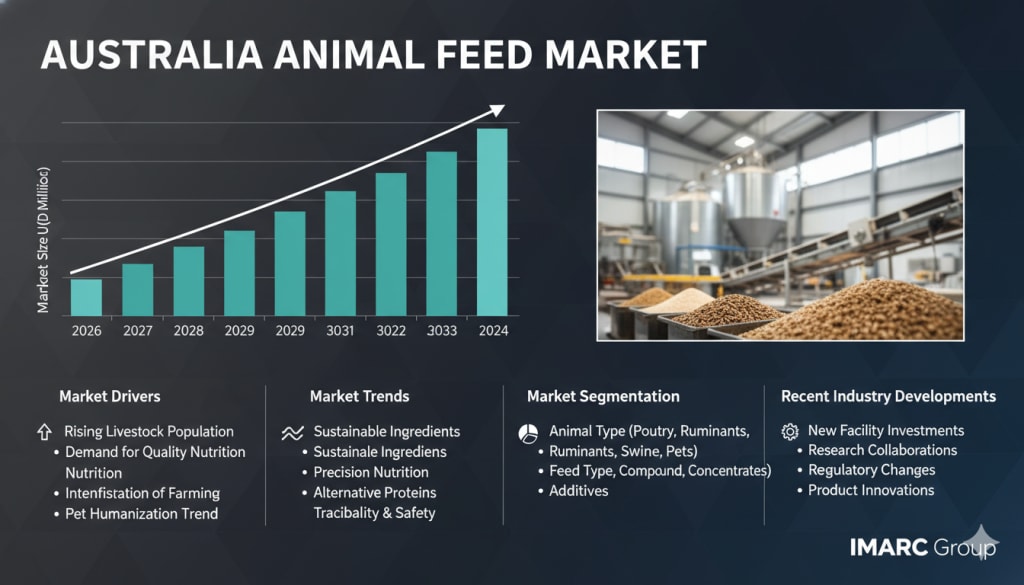
According to IMARC Group, the Australia animal feed market reached USD 11.0 Billion in 2025 and is projected to grow to USD 13.9 Billion by 2034, exhibiting a compound annual growth rate (CAGR) of 2.60% during 2026–2034. This steady expansion reflects the central role of livestock production within Australia’s agricultural economy. Animal feed is a foundational input supporting beef, poultry, pork, dairy and aquaculture industries. As domestic consumption and export demand for high-quality animal protein rise, feed manufacturers are investing in advanced formulations, sustainable ingredients and precision nutrition technologies to enhance productivity and efficiency.
Why Should Smart Buyers and Investors Know About the Australia Animal Feed Market?
Stable, Long-Term Demand
Animal feed remains essential for maintaining livestock productivity and food supply security.
Export-Driven Revenue Streams
Australia’s strong agricultural export profile supports sustained feed consumption.
Innovation-Led Differentiation
Advanced feed technologies create value-added product opportunities.
Alignment With Sustainability Goals
Low-emission and sustainable feed inputs align with global ESG priorities.
Resilience Amid Market Cycles
Feed demand remains relatively stable even during economic fluctuations.
Recent Trends & Developments in the Australia Animal Feed Market
July 2025:
Feed producers expanded research into methane-reducing additives to align with climate targets.
April 2025:
Poultry feed manufacturers introduced high-protein formulations to improve feed efficiency.
October 2024:
Sustainability-focused partnerships strengthened local sourcing of alternative feed ingredients.
The Australia animal feed market is a cornerstone of the country’s agricultural and livestock economy. Backed by IMARC’s steady growth projections, the sector is benefiting from rising livestock production, innovation in feed technology and growing sustainability commitments. As global protein demand increases and environmental standards tighten, feed manufacturers are adapting with precision nutrition strategies and alternative ingredient exploration. For agricultural investors, feed producers and supply chain stakeholders, Australia’s animal feed market presents a forward-looking opportunity anchored in stable demand, export competitiveness and sustainable agricultural transformation within a globally connected food production ecosystem.
Australia Animal Feed Market Vision 2050
1. Precision Livestock Nutrition
By 2050, AI-driven feed management systems may tailor formulations based on real-time animal health data.
2. Alternative Protein Integration
Insect-based and plant-derived protein sources could become mainstream components in feed blends.
3. Carbon-Reduced Feed Solutions
Low-emission feed additives may help reduce methane output in cattle farming.
4. Circular Agriculture Models
Food waste and agricultural by-products may be increasingly repurposed into feed inputs.
5. Digitally Monitored Supply Chains
Blockchain and IoT systems could enhance feed traceability and quality assurance.
What Are the Key Growth Drivers in the Australia Animal Feed Market?
Expanding Livestock Production
Australia maintains a strong position as a global exporter of beef, lamb and dairy products. Rising herd sizes and poultry output are increasing demand for nutritionally balanced feed solutions. Efficient feed formulations are critical to optimizing weight gain, milk yield and overall animal health.
Growing Demand for High-Quality Meat and Dairy
Domestic and international consumers increasingly prioritize quality, traceability and nutritional value. Feed quality directly influences product standards, prompting producers to adopt premium formulations enriched with vitamins, minerals and protein sources.
Continuous Nutrition Innovation
Technological advancements in feed science—including enzyme additives, probiotics and amino acid balancing—are improving feed conversion ratios. Precision feeding strategies reduce waste while maximizing output.
Sustainability and Environmental Focus
Sustainable feed inputs are gaining traction as producers seek to lower carbon emissions and minimize environmental impact. Alternative protein sources such as insect meal and algae are being explored as viable feed components.
Government Support and Biosecurity Measures
Government initiatives supporting agricultural innovation and biosecurity compliance strengthen feed industry standards. Strict quality control systems enhance export competitiveness.
Export-Oriented Agricultural Strategy
Australia’s export markets across Asia and the Middle East drive sustained livestock demand, indirectly boosting feed production volumes.
About the Creator
Kevin Cooper
Hi, I'm Kavin Cooper — a tech enthusiast who loves exploring the latest innovations, gadgets, and trends. Passionate about technology and always curious to learn and share insights with the world!
Keep reading
More stories from Kevin Cooper and writers in Futurism and other communities.
Australia Private Equity Market: Capital Inflows, Deal Activity & Strategic Exits
According to IMARC Group, the Australia private equity market reached USD 23.9 Billion in 2025 and is projected to expand to USD 48.5 Billion by 2034, exhibiting a compound annual growth rate (CAGR) of 8.21% during 2026–2034. This strong growth trajectory reflects increasing capital inflows, expanding deal pipelines and strategic portfolio optimization across Australia. Private equity (PE) in Australia spans buyout funds, venture capital, growth equity and infrastructure investments, targeting sectors such as technology, healthcare, renewable energy, real estate and consumer services. As global and domestic investors seek diversified returns, Australia’s PE ecosystem is evolving into a dynamic capital deployment and value-creation platform.
By Kevin Coopera day ago in Futurism
Echoes
I stepped carefully around the corner, the familiar sights and sounds hitting me like a brick to the face. My eyes watered. I could practically see us, all of us, back then, clustered around the outdoor tables in front of the pizza shop, the bar, the coffee shop. I could smell the various stalls from the events we’d been to on this street. I could taste the churros and nachos.
By Phoenixica242 days ago in Fiction




Comments
There are no comments for this story
Be the first to respond and start the conversation.