
Australia Industrial Flooring Market: Construction Activity, Industrial Expansion & Safety Standards
How growing construction activity, expanding industrial facilities and increasing emphasis on safety and compliance standards are shaping Australia’s industrial flooring market
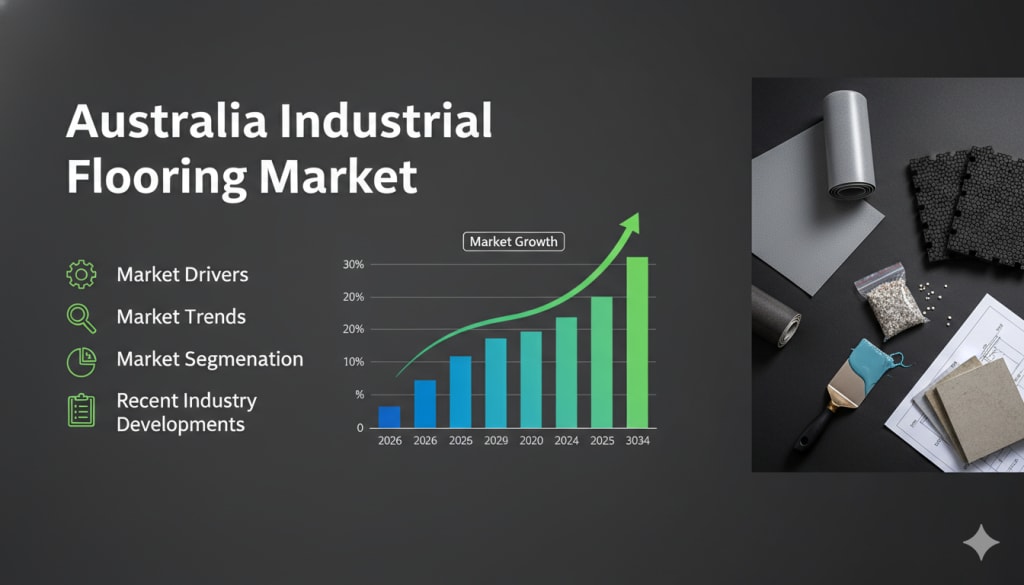
According to IMARC Group, the Australia industrial flooring market was valued at USD 229.75 Million in 2025 and is projected to reach USD 516.74 Million by 2034, growing at a robust compound annual growth rate (CAGR) of 9.42% during 2026–2034. This strong growth reflects expanding industrial construction, infrastructure modernization and heightened regulatory focus across Australia. Industrial flooring systems—ranging from epoxy and polyurethane coatings to polished concrete and resin-based overlays—are critical in factories, warehouses, logistics hubs and processing facilities. As industries prioritize operational durability, safety compliance and lifecycle cost efficiency, industrial flooring is evolving into a performance-driven infrastructure component rather than a purely structural feature.
Why Should Smart Buyers and Investors Know About the Australia Industrial Flooring Market?
High Growth Trajectory
With a projected CAGR of 9.42%, the market demonstrates strong expansion relative to broader construction segments.
Infrastructure-Linked Stability
Industrial flooring demand closely aligns with long-term infrastructure and manufacturing investment trends.
Regulatory-Driven Upgrades
Compliance requirements create recurring demand for flooring upgrades and retrofits.
Alignment With Automation and Digital Industry
Advanced flooring systems support automated warehouses and smart factory environments.
Sustainability and ESG Integration
Eco-certified materials enhance project eligibility for green financing and ESG-aligned investment strategies.
Recent Trends & Developments in the Australia Industrial Flooring Market
July 2025:
Major logistics facilities adopted heavy-duty epoxy flooring systems designed for high-load automated operations.
April 2025:
Manufacturers introduced advanced polyurethane systems with improved chemical resistance for industrial plants.
October 2024:
Food processing facilities upgraded to antimicrobial flooring systems to meet stricter hygiene standards.
The Australia industrial flooring market represents a dynamic intersection of construction growth, industrial expansion and safety-driven innovation. Supported by IMARC’s strong growth projections, the sector is transitioning from basic structural applications to high-performance, regulation-compliant systems tailored for modern industrial ecosystems. As logistics hubs expand, manufacturing facilities modernize and workplace safety standards tighten, demand for advanced flooring solutions will continue to rise. For construction companies, material manufacturers and infrastructure investors, Australia’s industrial flooring market offers a forward-looking opportunity anchored in industrial modernization, safety compliance and performance-driven infrastructure development within an increasingly automated and sustainability-focused economy.
Australia Industrial Flooring Market Vision 2050
1. Smart Flooring with Embedded Monitoring
By 2050, industrial flooring may integrate sensors capable of detecting load stress, surface wear and temperature changes in real time.
2. Automation-Optimized Surfaces
As robotics and automated guided vehicles (AGVs) become widespread, flooring materials may be engineered specifically for precision mobility and reduced friction variability.
3. Sustainable Lifecycle Design
Closed-loop recycling and eco-friendly composite materials may define next-generation flooring systems.
4. Modular and Rapid-Install Solutions
Prefabricated flooring modules could enable faster upgrades with minimal operational downtime.
5. Enhanced Fire and Chemical Resistance
Future formulations may provide superior protection against extreme industrial conditions.
What Are the Key Growth Drivers in the Australia Industrial Flooring Market?
Rising Construction and Infrastructure Development
Australia’s commercial and industrial construction pipeline is expanding, including warehouses, manufacturing facilities and transport infrastructure. New developments demand flooring systems capable of handling heavy loads, continuous machinery movement and high-impact environments.
Expansion of Industrial Facilities
Manufacturing modernization and industrial park expansion are fueling demand for advanced flooring systems. Facilities in mining, food and beverage processing, pharmaceuticals and automotive production require specialized flooring resistant to chemicals, abrasion and temperature fluctuations.
Growth of Logistics and Warehousing
The rapid expansion of e-commerce and supply chain networks has increased the construction of distribution centers. Automated storage systems and forklift-intensive operations require seamless, high-strength flooring solutions that minimize maintenance downtime.
Increasing Emphasis on Safety and Compliance Standards
Workplace safety regulations are becoming more stringent. Industrial flooring must meet anti-slip standards, fire resistance requirements and hygiene compliance guidelines. In sectors such as food processing and healthcare, flooring systems must also offer antimicrobial properties and easy sanitation.
Technological Advancements and Product Innovation
Advances in resin chemistry and self-leveling compounds are enhancing installation efficiency and durability. Rapid-curing systems reduce operational disruptions during installation. Hybrid flooring systems combining concrete and polymer technologies are improving longevity and structural resilience.
Sustainability and Environmental Considerations
Low-volatile organic compound (VOC) coatings and recyclable materials are gaining traction. Sustainable flooring solutions align with green building certifications and corporate ESG commitments.
About the Creator
Keep reading
More stories from Shrestha Roy and writers in Futurism and other communities.
Australia Agrochemical Market: Crop Protection Demand, Sustainable Farming & Regulatory Compliance
According to IMARC Group, the Australia agrochemical market reached USD 6,150.5 Million in 2025 and is projected to grow to USD 8,120.2 Million by 2034, exhibiting a compound annual growth rate (CAGR) of 3.14% during 2026–2034. This steady expansion underscores the critical role agrochemicals play in supporting agricultural productivity across Australia. As climate variability, pest resistance and global food demand intensify, farmers increasingly rely on herbicides, insecticides, fungicides and fertilizers to protect yields and enhance crop performance. Simultaneously, sustainability considerations and regulatory oversight are reshaping formulation strategies and usage practices, driving innovation within the sector.
By Shrestha Roy2 days ago in Futurism
Architectural Hardware Market Demand: Focus on Safety, Durability & Industry Outlook to 2034
Growing demand from construction and infrastructure sectors, rising adoption of smart architectural hardware solutions, and increasing preference for contemporary design aesthetics are driving architectural hardware market expansion, supported by technological innovations and robust growth in residential and commercial development projects. According to IMARC Group's latest data, the global architectural hardware market size reached USD 19.5 Billion in 2024. Looking forward, IMARC Group estimates the market to reach USD 27.8 Billion by 2033, exhibiting a CAGR of 3.90% from 2026-2034.
By Andrew Sullivan7 days ago in Futurism
The Cave Part 6
If you have ever heard a tale about yourself that you cannot remember and doubtless think is made up, you will know how I felt when Tharkin related all that the eagle had seen of me before my memories were scattered. Of far distances and traveling companions that I did not recall, camping out under the stars and making our way to the mountains with deliberate purpose. The great bird had lost contact with my party once we entered the forests, and the seven other members were not seen again by him or his brethren since.
By Jamye Sharp3 days ago in Chapters




Comments
There are no comments for this story
Be the first to respond and start the conversation.