
Australia Online Education Market: Digital Adoption, Upskilling Demand & Hybrid Learning Growth
How increasing internet penetration and digital adoption, rising demand for upskilling and professional development and expanding hybrid learning models are shaping Australia’s online education market
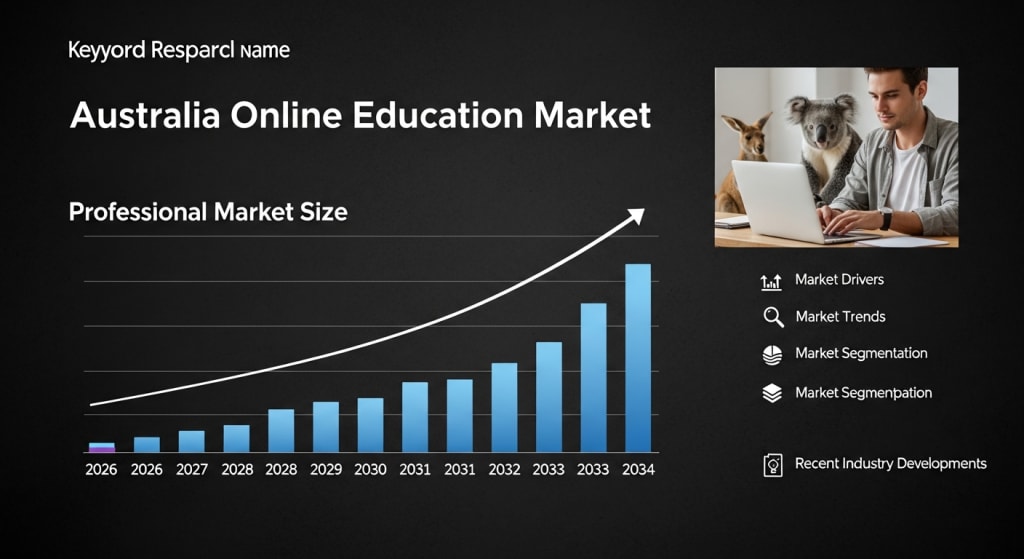
According to IMARC Group, the Australia online education market reached USD 1.7 Billion in 2025 and is projected to surge to USD 15.5 Billion by 2034, exhibiting a remarkable compound annual growth rate (CAGR) of 26.65% during 2026–2034. This exponential growth reflects the rapid digital transformation of the education ecosystem across Australia. Once supplementary to classroom instruction, online education has become a core delivery model spanning academic degrees, vocational training and corporate learning programs. Increasing internet penetration, flexible learning preferences and the urgent need for workforce upskilling are driving adoption across diverse demographics, reshaping how Australians learn, certify and advance their careers.
Why Should Smart Buyers and Investors Know About the Australia Online Education Market?
Exceptional High-Growth Potential
With a projected CAGR of 26.65%, the sector represents one of the fastest-growing segments within Australia’s service economy.
Structural Workforce Transformation
Continuous reskilling requirements ensure sustained long-term demand.
Digital Scalability
Online platforms enable rapid expansion with relatively lower physical infrastructure costs.
Government and Corporate Backing
Policy support and corporate investment provide financial stability and growth visibility.
International Student Reach
Digital delivery allows institutions to access global markets beyond traditional campus limitations.
Recent Trends & Developments in the Australia Online Education Market
July 2025:
Universities expanded hybrid degree programs integrating online modules with campus residencies.
April 2025:
Edtech platforms introduced AI-driven adaptive testing tools to personalize student learning journeys.
Ocober 2024:
Corporate learning platforms partnered with multinational firms to deliver large-scale digital training programs.
The Australia online education market exemplifies how digital innovation is redefining traditional institutions. Backed by IMARC’s strong growth projections, the sector is transitioning from supplemental learning to mainstream education delivery. As internet penetration deepens, workforce upskilling accelerates and hybrid learning models mature, online education will play an increasingly central role in Australia’s knowledge economy. For investors, educational institutions and technology providers, Australia’s online education market offers a forward-looking opportunity grounded in digital scalability, workforce transformation and sustained demand for flexible, career-focused learning solutions in an increasingly dynamic global economy.
Australia Online Education Market Vision 2050
1. AI-Personalized Learning Ecosystems
By 2050, AI systems may customize curricula based on individual learning patterns and career trajectories.
2. Immersive VR and AR Classrooms
Virtual and augmented reality technologies could enable immersive simulations for medical, engineering and technical training.
3. Micro-Credentialing and Modular Certifications
Short, stackable courses may replace traditional long-duration programs for many professional fields.
4. Globalized Digital Campuses
Australian institutions may serve international students through fully virtual campuses.
5. Blockchain-Based Credential Verification
Secure digital certificates may enhance transparency and portability of qualifications.
What Are the Key Growth Drivers in the Australia Online Education Market?
Increasing Internet Penetration and Digital Adoption
Australia’s high broadband penetration and expanding mobile connectivity provide the technological foundation for online learning platforms. Cloud-based systems enable seamless access to video lectures, digital assignments and interactive learning modules.
Rising Demand for Upskilling and Professional Development
Rapid technological change is reshaping labor markets. Professionals are pursuing certifications in data analytics, cybersecurity, digital marketing and artificial intelligence to remain competitive. Employers increasingly support continuous learning initiatives.
Growth of Hybrid Learning Models
Educational institutions are adopting blended models that combine online coursework with in-person sessions. Hybrid delivery enhances flexibility while preserving interactive engagement, particularly in higher education and vocational training.
Investment in Interactive and AI-Based Learning Tools
Universities, vocational institutes and private edtech companies are deploying AI-driven personalized learning paths, adaptive testing systems and real-time performance analytics. Gamification elements enhance student engagement and completion rates.
Corporate Training and Workforce Development
Organizations are investing in digital learning platforms to train employees efficiently. Online modules reduce travel costs and enable scalable skill development across distributed workforces.
Government Support for Digital Education
Public funding initiatives and digital education policies are encouraging institutions to modernize infrastructure and expand online offerings, particularly in regional and remote communities.
About the Creator
Keep reading
More stories from Shrestha Roy and writers in Futurism and other communities.
Australia Overhead Cranes Market: Industrial Automation, Construction Activity & Infrastructure Investment
According to IMARC Group, the Australia overhead cranes market reached USD 116.88 Million in 2025 and is projected to expand to USD 203.34 Million by 2034, growing at a compound annual growth rate (CAGR) of 6.35% during 2026–2034. This steady growth reflects rising industrial automation, expanding construction pipelines and sustained infrastructure investment across Australia. Overhead cranes—critical for heavy material handling in manufacturing plants, warehouses, shipyards and mining facilities—are evolving from conventional lifting systems into digitally integrated, automation-ready solutions. As industries modernize operations and prioritize efficiency and safety, demand for advanced crane systems is strengthening nationwide.
By Shrestha Royabout 14 hours ago in Futurism
Saudi Arabia Entertainment Market Insights Youth Demographics & Leisure Spending Expansion
According to IMARC Group's latest research publication, Saudi Arabia entertainment and amusement market size reached USD 5,468.4 Million in 2025. The market is projected to reach USD 11,542.2 Million by 2034, exhibiting a growth rate (CAGR) of 8.65% during 2026-2034.
By Faisal Al-Harbi8 days ago in Futurism
The Surprisingly High Abundance of Water Worlds
For years, water worlds were treated as an exotic possibility — scientifically plausible, but statistically rare. Planets dominated by deep global oceans, wrapped in thick atmospheres and layered with high-pressure ice, seemed like outliers in the cosmic inventory. The search for exoplanets focused primarily on “Earth-like” rocky worlds with thin atmospheres and moderate climates. However, as observational data have accumulated, a different picture has emerged. Water-rich planets may not be exceptional at all. They could be one of the most common planetary types in our galaxy.
By Holianyk Ihor7 days ago in Futurism




Comments
There are no comments for this story
Be the first to respond and start the conversation.