
Australia Overhead Cranes Market: Industrial Automation, Construction Activity & Infrastructure Investment
How increasing industrial automation, growing construction activity and heightened infrastructure investment are shaping Australia’s overhead cranes market
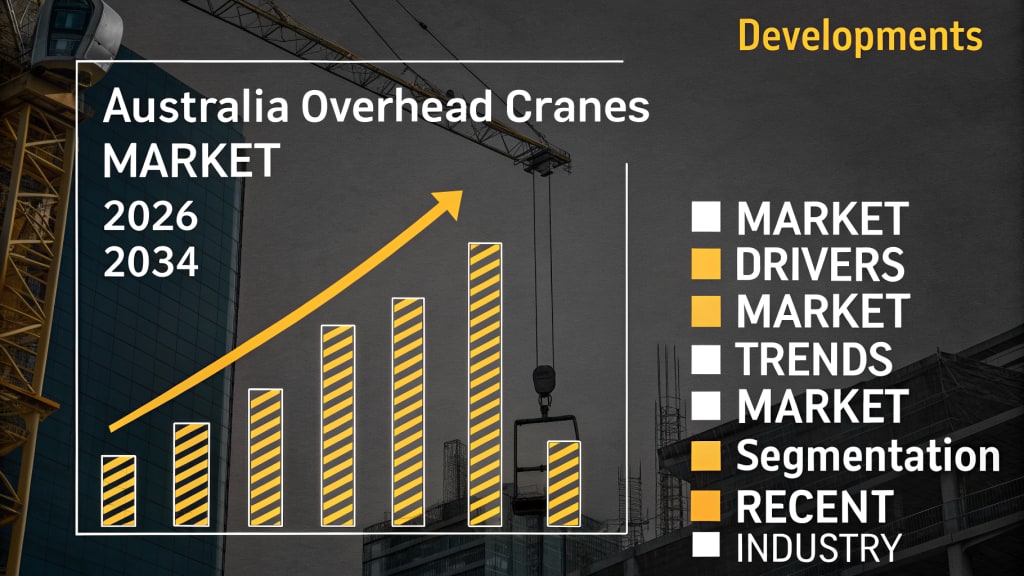
According to IMARC Group, the Australia overhead cranes market reached USD 116.88 Million in 2025 and is projected to expand to USD 203.34 Million by 2034, growing at a compound annual growth rate (CAGR) of 6.35% during 2026–2034. This steady growth reflects rising industrial automation, expanding construction pipelines and sustained infrastructure investment across Australia. Overhead cranes—critical for heavy material handling in manufacturing plants, warehouses, shipyards and mining facilities—are evolving from conventional lifting systems into digitally integrated, automation-ready solutions. As industries modernize operations and prioritize efficiency and safety, demand for advanced crane systems is strengthening nationwide.
Why Should Smart Buyers and Investors Know About the Australia Overhead Cranes Market?
Stable Mid-High Growth Outlook
With a projected CAGR of 6.35%, the market demonstrates consistent expansion linked to infrastructure and industrial growth.
Automation-Driven Demand
Integration with smart factory technologies positions overhead cranes as critical automation assets.
Infrastructure-Led Investment Stability
Public and private infrastructure spending provides long-term demand visibility.
Safety and Compliance Mandates
Regulatory standards create ongoing equipment upgrade and replacement cycles.
Diversified End-Use Applications
Manufacturing, mining, logistics and construction sectors collectively support diversified revenue streams.
Recent Trends & Developments in the Australia Overhead Cranes Market
July 2025:
Manufacturing plants adopted semi-automated crane systems with enhanced load precision controls.
April 2025:
Infrastructure projects incorporated heavy-duty gantry cranes for large-scale construction applications.
October 2024:
Mining operators upgraded to energy-efficient electric crane systems to improve sustainability performance.
The Australia overhead cranes market represents a vital segment within the country’s industrial modernization and infrastructure development landscape. Supported by IMARC’s steady growth projections, the sector is transitioning toward automation-enabled, digitally integrated lifting systems that enhance efficiency and safety. As manufacturing facilities adopt smart technologies and infrastructure investment remains strong, overhead cranes are evolving into intelligent, high-performance assets within modern industrial ecosystems. For equipment manufacturers, engineering firms and infrastructure investors, Australia’s overhead cranes market offers a forward-looking opportunity grounded in automation, industrial resilience and sustained construction activity within a technologically advancing economy.
Australia Overhead Cranes Market Vision 2050
1. Fully Automated Material Handling Systems
By 2050, overhead cranes may operate autonomously within smart factories, integrated with robotics and AI-driven control systems.
2. Predictive Maintenance Through IoT
Internet of Things (IoT) sensors could monitor equipment health in real time, minimizing downtime through predictive maintenance.
3. Energy-Efficient and Sustainable Designs
Advanced materials and low-emission electric systems may reduce environmental impact.
4. Integration With Digital Twin Technologies
Digital twin models may simulate crane operations for optimization and safety testing.
5. Modular and Flexible Crane Architectures
Customizable crane configurations could allow rapid adaptation to changing industrial requirements.
What Are the Key Growth Drivers in the Australia Overhead Cranes Market?
Increasing Industrial Automation
Manufacturers are investing in automation to enhance productivity and reduce operational risks. Modern overhead cranes now integrate programmable logic controllers (PLCs), remote monitoring systems and automated load positioning technologies. These features enable precise material handling in assembly lines and production facilities.
Growing Construction Activity
Australia’s expanding commercial and industrial construction sector requires robust material handling equipment. Overhead cranes play a central role in steel fabrication, precast concrete manufacturing and large-scale infrastructure projects.
Heightened Infrastructure Investment
Government spending on transportation networks, ports, renewable energy facilities and public infrastructure projects is creating demand for heavy-duty lifting solutions. Industrial expansion in logistics and warehousing further supports crane installations.
Mining and Resource Sector Demand
Australia’s strong mining industry continues to drive equipment demand. Overhead cranes are essential in maintenance operations, heavy equipment assembly and material transport within mining sites and processing plants.
Technological Advancements in Crane Systems
Innovation in electric hoists, anti-sway controls and smart sensors is enhancing safety and efficiency. Energy-efficient motors and regenerative braking systems reduce power consumption while improving operational performance.
Workplace Safety and Compliance Standards
Strict safety regulations require certified lifting equipment and compliance with load handling standards. Automated safety features, collision avoidance systems and load monitoring technologies are increasingly embedded in modern crane systems.
About the Creator
Keep reading
More stories from Shrestha Roy and writers in Futurism and other communities.
Australia Fast Food Market: Consumer Preferences, Convenience Demand & Digital Ordering
According to IMARC Group, the Australia fast food market reached USD 18.8 Billion in 2025 and is projected to grow to USD 26.5 Billion by 2034, exhibiting a compound annual growth rate (CAGR) of 3.80% during 2026–2034. This steady expansion reflects evolving consumption habits, urban convenience culture and digital transformation across Australia. Fast food, once defined primarily by traditional quick-service restaurant formats, now encompasses app-based ordering, drive-through innovation, delivery integration and menu diversification. As disposable incomes rise and consumers seek speed without sacrificing variety, Australia’s fast food ecosystem is adapting through technology, health-oriented reformulation and omnichannel engagement strategies.
By Shrestha Roya day ago in Futurism
Industrial Catalyst Market Outlook: Chemical Production Efficiency and Growth Opportunities
According to IMARC Group's latest research publication, The global industrial catalyst market size reached USD 25.3 Billion in 2025. Looking forward, IMARC Group expects the market to reach USD 33.5 Billion by 2034, exhibiting a growth rate (CAGR) of 3.07% during 2026-2034.
By James Whitman8 days ago in Futurism



Comments
There are no comments for this story
Be the first to respond and start the conversation.