
Australia Pallet Market: Logistics Demand, Sustainability Trends & Technology Adoption
How expanding e-commerce and logistics demand, rising sustainability trends and ongoing adoption of advanced tracking technologies are shaping Australia’s pallet market
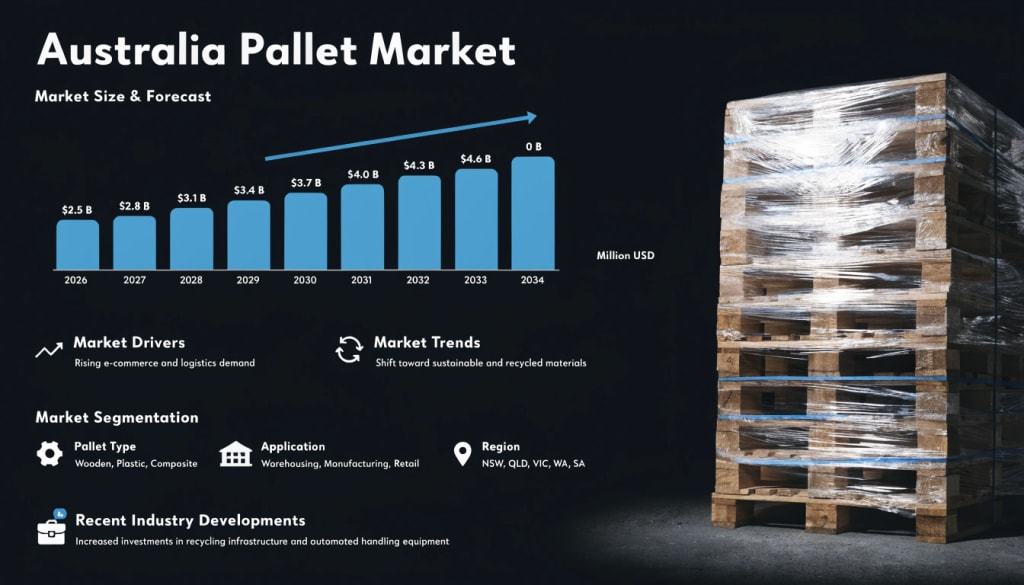
According to IMARC Group, the Australia pallet market reached USD 1,373.4 Million in 2025 and is projected to expand to USD 1,953.0 Million by 2034, exhibiting a compound annual growth rate (CAGR) of 3.87% during 2026–2034. This steady growth reflects structural expansion in logistics, warehousing and export-driven industries across Australia. Pallets—essential load-bearing platforms used for transporting and storing goods—form the backbone of supply chain operations. As e-commerce accelerates, infrastructure projects expand and sustainability priorities intensify, Australia’s pallet market is evolving through material innovation, pooling systems and digital tracking technologies.
Why Should Smart Buyers and Investors Know About the Australia Pallet Market?
Stable Mid-Single-Digit Growth
With a projected CAGR of 3.87%, the market demonstrates steady expansion supported by logistics growth.
E-Commerce-Linked Structural Demand
Online retail expansion ensures ongoing pallet consumption.
Sustainability-Driven Innovation
Eco-friendly and reusable pallet solutions align with corporate ESG goals.
Digital Supply Chain Integration
Tracking technologies enhance operational transparency and asset management.
Diversified End-Use Applications
Demand spans retail, agriculture, manufacturing and export sectors.
Recent Trends & Developments in the Australia Pallet Market
July 2025:
Logistics firms expanded pallet pooling programs to enhance circular supply chain efficiency.
April 2025:
Manufacturers introduced lightweight recycled plastic pallets targeting export applications.
October 2024:
Warehouse operators implemented RFID-enabled pallet tracking systems to reduce asset losses.
The Australia pallet market represents a foundational component of the nation’s evolving logistics and supply chain ecosystem. Supported by IMARC’s steady growth projections, the sector is benefiting from expanding e-commerce volumes, infrastructure development and sustainability-driven procurement strategies. As technology adoption accelerates and circular economy models gain prominence, pallet systems are transitioning from basic transport tools to digitally integrated, reusable logistics assets. For manufacturers, logistics operators and investors, Australia’s pallet market offers a forward-looking opportunity grounded in supply chain modernization, sustainability alignment and steady demand across diverse industrial applications.
Australia Pallet Market Vision 2050
1. Fully Digitalized Pallet Ecosystems
By 2050, pallet fleets may operate within interconnected smart logistics platforms, providing end-to-end visibility.
2. Sustainable Material Dominance
Recyclable composites and bio-based materials could replace traditional single-use wooden pallets.
3. AI-Driven Supply Chain Optimization
Advanced analytics may optimize pallet allocation and reduce idle inventory.
4. Automated Warehouse Integration
Pallet designs may adapt for seamless integration with robotic handling systems and automated storage solutions.
5. Carbon-Neutral Pooling Systems
Industry-wide pooling networks may achieve low-emission, circular logistics frameworks.
What Are the Key Growth Drivers in the Australia Pallet Market?
Expanding E-Commerce and Logistics Demand
The rapid growth of online retail is driving higher freight volumes and warehouse throughput. Efficient pallet systems enable faster loading, unloading and inventory handling. As distribution networks scale nationwide, pallet demand continues to rise in tandem with order fulfillment requirements.
Growth in Warehousing and Infrastructure Projects
New logistics hubs, distribution centers and industrial parks require large-scale pallet utilization. Infrastructure development—including transportation and port expansion—supports smoother goods movement, further reinforcing pallet demand.
Increasing Export Activity
Australia’s export-oriented sectors—agriculture, mining equipment and manufactured goods—depend on durable pallet solutions for international shipping. Compliance with global phytosanitary standards encourages adoption of treated wooden pallets and alternative materials.
Sustainability and Circular Economy Trends
Environmental concerns are influencing material selection and lifecycle management. Reusable plastic pallets, recycled materials and pallet pooling systems reduce waste and extend product life cycles. Businesses are increasingly aligning pallet procurement with ESG commitments.
Demand for Cost-Efficient and Durable Solutions
Industries seek pallets that offer long-term durability, lower replacement rates and minimal maintenance costs. Heavy-duty plastic and composite pallets are gaining popularity in sectors requiring hygiene and resilience.
Technological Advancements in Tracking and Monitoring
The integration of RFID tags, GPS tracking and IoT-enabled sensors enhances pallet visibility across supply chains. Real-time tracking reduces losses, improves asset utilization and strengthens operational efficiency.
About the Creator
Keep reading
More stories from Shrestha Roy and writers in Futurism and other communities.
Australia Power Rental Market: Equipment Demand, Infrastructure Projects & Service Innovation
According to IMARC Group, the Australia power rental market reached USD 460.9 Million in 2025 and is projected to grow to USD 771.5 Million by 2034, exhibiting a compound annual growth rate (CAGR) of 5.71% during 2026–2034. This steady expansion reflects rising demand for temporary and backup power solutions across industrial, commercial and event-driven applications in Australia. Power rental services provide generators, load banks and related equipment for short-term or emergency needs, ensuring operational continuity during grid instability, maintenance shutdowns or remote site operations. As aging grid infrastructure, large-scale construction projects and mining expansion intensify, the power rental ecosystem is becoming an essential component of Australia’s energy resilience framework.
By Shrestha Royabout 19 hours ago in Futurism
Fava Beans Market: Organic Farming Practices, Consumer Health Awareness & Industry Growth
According to IMARC Group's latest research publication, global fava beans market size reached 9.3 Million Tons in 2024. Looking forward, IMARC Group expects the market to reach 12.9 Million Tons by 2033, exhibiting a growth rate (CAGR) of 3.52% during 2025-2033.
By sujeet. imarcgroup4 days ago in Futurism



Comments
There are no comments for this story
Be the first to respond and start the conversation.