
Australia Publishing Market: Digital Content Growth, Consumer Engagement & Distribution Channels
How rising digital content consumption, evolving reader engagement patterns and expanding distribution channels are shaping Australia’s publishing market

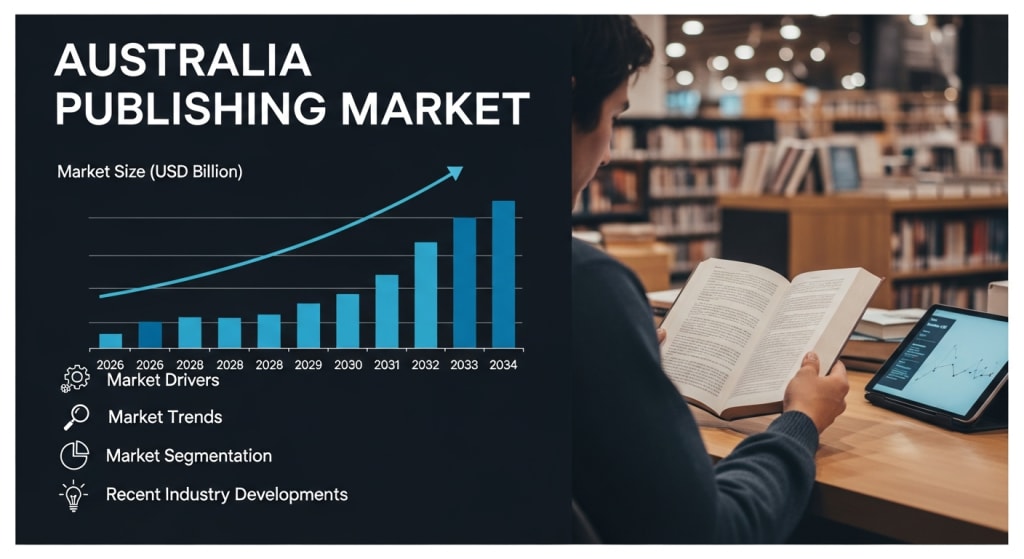
According to IMARC Group, the Australia publishing market reached USD 5.4 Billion in 2025 and is projected to expand to USD 8.0 Billion by 2034, exhibiting a compound annual growth rate (CAGR) of 4.32% during 2026–2034. This steady growth reflects the structural transformation of content consumption patterns across Australia. The publishing industry—encompassing books, educational materials, newspapers, magazines and digital content—is adapting to the rapid expansion of e-books, audiobooks and subscription-based platforms. As readers increasingly embrace digital formats and interactive engagement, Australia’s publishing ecosystem is evolving into a hybrid model blending traditional print with dynamic digital distribution.
Why Should Smart Buyers and Investors Know About the Australia Publishing Market?
Steady Mid-Term Growth
With a projected CAGR of 4.32%, the market demonstrates resilient expansion across print and digital segments.
Digital Monetization Opportunities
E-books, audiobooks and subscriptions provide scalable revenue streams.
Education Sector Stability
Educational publishing offers consistent demand supported by institutional funding.
Global Market Integration
Australian authors and publishers benefit from international distribution networks.
Innovation-Driven Competitive Edge
Technology integration enhances reader engagement and operational efficiency.
Recent Trends & Developments in the Australia Publishing Market
July 2025:
Major publishers expanded audiobook production to capture growing consumer demand.
April 2025:
Educational institutions adopted interactive digital textbooks for hybrid learning models.
October 2024:
Subscription reading platforms introduced AI-driven personalized recommendation features.
The Australia publishing market is undergoing a significant transformation driven by digital content growth, evolving consumer engagement and diversified distribution strategies. Supported by IMARC’s steady growth projections, the sector is balancing traditional print heritage with dynamic digital innovation. E-books, audiobooks and subscription services are reshaping reading habits, while self-publishing platforms empower new voices. Educational publishing and social media-driven discovery further expand market momentum. As AI personalization, immersive content formats and sustainable print practices advance, Australia’s publishing industry is positioned for sustained evolution. For publishers, content creators and investors, the market offers a forward-looking opportunity rooted in digital scalability, creative diversity and resilient demand within an increasingly connected global content ecosystem.
Australia Publishing Market Vision 2050
1. Fully Digital-Integrated Publishing Models
By 2050, publishers may operate predominantly digital-first models, with print-on-demand services replacing large-scale print runs.
2. AI-Powered Content Personalization
Artificial intelligence could curate reading recommendations and customize storytelling experiences.
3. Immersive and Interactive Content
Augmented reality (AR) and multimedia enhancements may redefine educational and entertainment publishing.
4. Global Content Collaboration
Australian publishers may expand international co-publishing ventures, enhancing global reach.
5. Sustainable Print Practices
Eco-friendly paper sourcing and low-carbon printing processes may become industry standards.
What Are the Key Growth Drivers in the Australia Publishing Market?
Rising Digital Content Consumption
E-books and audiobooks are gaining popularity among Australian readers seeking convenience and portability. Smartphone penetration and tablet usage have enabled seamless access to digital libraries, reducing reliance on physical bookstores.
Growth of Subscription-Based Reading Services
Digital subscription platforms offering unlimited access to books and magazines are expanding readership. These services provide affordable access to diverse genres, encouraging experimentation and increased reading frequency.
Rise of Self-Publishing and Independent Authors
Online publishing platforms empower independent authors to reach audiences without traditional publishing gatekeepers. Self-publishing has diversified content offerings and increased competition, stimulating innovation in marketing and storytelling.
Expansion of Educational Publishing
Growing investments in digital education and curriculum modernization are supporting demand for educational materials. Schools and universities increasingly rely on digital textbooks, interactive content and online learning resources.
Social Media Influence on Reading Trends
Book discovery is increasingly driven by social media platforms and online communities. Viral recommendations and influencer reviews have significant impact on bestseller trends and reader engagement.
Diversified Distribution Channels
Retail expansion through e-commerce platforms and online marketplaces enhances content accessibility. Traditional bookstores continue to operate alongside digital distribution networks, creating an omnichannel ecosystem.
About the Creator
Kevin Cooper
Hi, I'm Kavin Cooper — a tech enthusiast who loves exploring the latest innovations, gadgets, and trends. Passionate about technology and always curious to learn and share insights with the world!
Keep reading
More stories from Kevin Cooper and writers in Futurism and other communities.
Australia Pro AV Market: Corporate Digitalization, Entertainment Demand & Hybrid Collaboration
According to IMARC Group, the Australia pro AV market reached USD 93.9 Million in 2025 and is projected to expand to USD 133.6 Million by 2034, exhibiting a compound annual growth rate (CAGR) of 3.88% during 2026–2034. This steady growth reflects rising demand for advanced audio-visual (AV) technologies across corporate, entertainment and public infrastructure sectors in Australia. Professional AV solutions—including digital signage, conferencing systems, large-format displays, immersive sound systems and collaboration tools—are increasingly essential for seamless communication, audience engagement and hybrid work environments. As businesses digitize operations and tourism rebounds, pro AV technology is becoming a critical enabler of modern connectivity.
By Kevin Cooperabout 10 hours ago in Futurism
A Hidden World Beneath the Salt: The Remarkable Discovery of a New Roundworm in Utah’s Great Salt Lake
Utah’s Great Salt Lake is one of the harshest environments on Earth. Its waters are several times saltier than the ocean, creating conditions that would kill most living creatures almost instantly. For years, scientists believed only a handful of hardy species—like brine shrimp and brine flies—could survive in its open waters. But in a groundbreaking find announced in early 2026, researchers uncovered something extraordinary: a tiny roundworm, a species entirely new to science, thriving in this extreme saltwater world.
By Mohammad Hamida day ago in Futurism
Launch and Scientific Impact of NASA’s Nancy Grace Roman Space Telescope (2026)
In 2026, NASA is preparing to launch one of the most ambitious space observatories of the decade: the Nancy Grace Roman Space Telescope. Designed to survey the universe at an unprecedented scale in near-infrared light, Roman is expected to reshape modern astrophysics by combining high resolution with an extraordinarily wide field of view. If the Hubble Space Telescope revealed the fine details of the cosmos, Roman will provide the panoramic context.
By Holianyk Ihorabout 2 hours ago in Futurism
It's 2026. Songs Turning 10 This Year
In 2016, we saw the rise of short form videos and what would lead to the birth of TikTok. We cannot forget the Snapchat filters no matter how cringe worthy some of them might have been. It was also the year in which the hit series Stranger Things debuted.
By Jasmine Aguilar2 days ago in Beat



Comments
There are no comments for this story
Be the first to respond and start the conversation.