
Australia Solar Panel Recycling Market: PV Waste Growth, Regulatory Focus & Technology Innovation
How increasing volumes of end-of-life photovoltaic panels, evolving regulatory focus on sustainable waste management and advances in recycling technology are shaping Australia’s solar panel recycling market
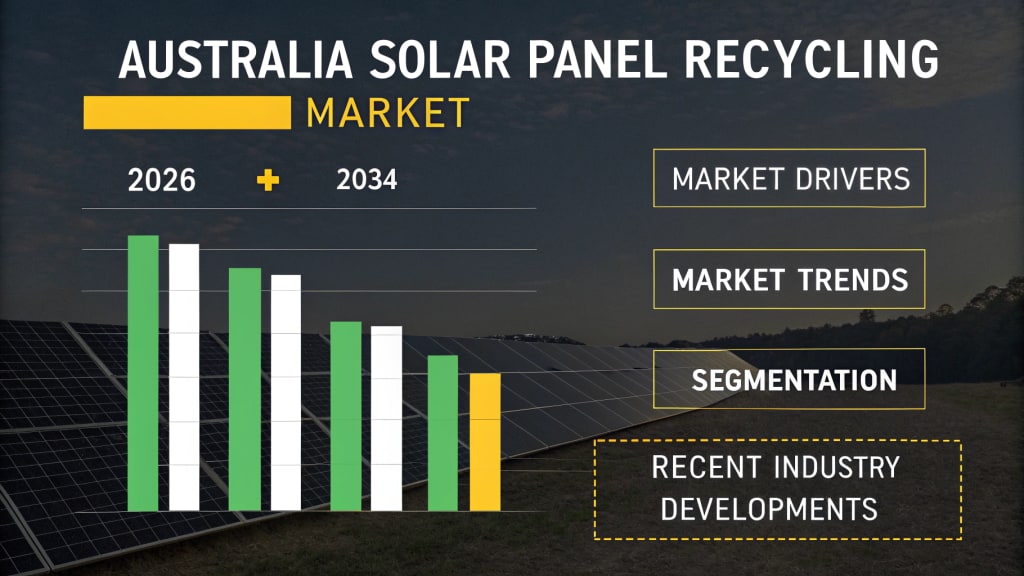
According to IMARC Group, the Australia solar panel recycling market reached USD 4,013.4 Million in 2025 and is projected to expand significantly to USD 11,604.1 Million by 2034, exhibiting a compound annual growth rate (CAGR) of 12.15% during 2026–2034. This rapid growth reflects the maturing of Australia’s early photovoltaic (PV) installations and the rising urgency to manage solar waste responsibly across Australia. As large volumes of solar panels installed in the early 2000s approach the end of their 20–25 year lifespan, the country faces a new sustainability challenge: handling thousands of tonnes of end-of-life PV modules annually. Recycling solutions are emerging as a critical component of Australia’s clean energy transition.
Why Should Smart Buyers and Investors Know About the Australia Solar Panel Recycling Market?
High-Growth Opportunity
With a projected CAGR of 12.15%, the sector demonstrates strong long-term expansion potential.
Alignment With Renewable Energy Transition
Recycling infrastructure is critical to sustaining Australia’s solar leadership.
ESG Investment Appeal
Circular economy initiatives align closely with environmental, social and governance investment criteria.
Raw Material Recovery Potential
Recovered materials can generate additional revenue streams and reduce resource dependency.
Regulatory Support
Policy-driven demand ensures structural market stability.
Recent Trends & Developments in the Australia Solar Panel Recycling Market
July 2025:
Recycling facilities expanded silicon recovery processes to enhance material purity levels.
April 2025:
State governments strengthened regulatory oversight on solar panel disposal practices.
October 2024:
Industry partnerships accelerated pilot programs for advanced chemical separation technologies.
Australia’s solar panel recycling market is emerging as a vital pillar of the nation’s clean energy strategy. Supported by IMARC’s robust growth projections, the sector addresses the dual challenges of renewable energy expansion and responsible waste management. As early-generation solar installations reach end-of-life stages, regulatory frameworks and technological advancements are accelerating the development of efficient recycling solutions. By integrating advanced material recovery processes and circular economy principles, Australia is positioning itself as a leader in sustainable solar lifecycle management. For investors, waste management firms and renewable energy stakeholders, the market represents a forward-looking opportunity grounded in environmental responsibility, innovation and long-term energy infrastructure resilience.
Australia Solar Panel Recycling Market Vision 2050
1. Fully Integrated Solar Lifecycle Management
By 2050, recycling processes may be embedded within solar manufacturing and installation ecosystems, enabling cradle-to-cradle lifecycle management.
2. High-Efficiency Material Recovery
Advanced processing technologies could achieve near-total material recovery, minimizing landfill dependency.
3. Domestic Circular Supply Chains
Recovered silicon and metals may be reintroduced into domestic solar manufacturing, reducing import reliance.
4. Automated Recycling Facilities
AI-driven sorting and robotic dismantling systems may streamline high-volume processing.
5. Regulatory Standardization
National frameworks could harmonize solar waste regulations across states.
What Are the Key Growth Drivers in the Australia Solar Panel Recycling Market?
Rising Volumes of End-of-Life PV Panels
Australia has one of the highest rooftop solar penetration rates globally. Early installations are now reaching decommissioning stages, generating substantial PV waste. Without effective recycling systems, discarded panels could strain landfill capacity.
Strengthening Regulatory Frameworks
Government policies are accelerating the development of solar recycling infrastructure. State-level regulations, including landfill bans for e-waste materials such as solar panels, are driving compliance-focused recycling initiatives. These measures ensure responsible disposal while encouraging investment in processing facilities.
Circular Economy Imperatives
Recycling aligns with Australia’s broader circular economy goals. Recovering valuable materials such as silicon, aluminum, copper and glass reduces raw material extraction and supports sustainable manufacturing supply chains.
Advances in Recycling Technology
Innovations in mechanical, thermal and chemical separation processes are improving material recovery rates. Advanced technologies enable efficient extraction of high-purity silicon and precious metals, enhancing economic viability.
Renewable Energy Expansion
As solar capacity continues to expand, recycling infrastructure must scale in parallel. Proactive recycling strategies ensure long-term sustainability of Australia’s renewable energy ecosystem.
Industry Partnerships and Investment
Collaborations among energy providers, waste management firms and technology developers are strengthening recycling capabilities. Public-private partnerships are expanding facility capacity and research initiatives.
About the Creator
Keep reading
More stories from Shrestha Roy and writers in Futurism and other communities.
Australia Steel Market: Production Dynamics, Demand Trends & Sustainability Initiatives
According to IMARC Group, the Australia steel market reached USD 20.1 Billion in 2025 and is projected to expand to USD 26.2 Billion by 2034, exhibiting a compound annual growth rate (CAGR) of 2.91% during 2026–2034. This steady growth trajectory reflects structural demand from infrastructure, construction and mining sectors across Australia. Steel remains a foundational industrial material supporting transportation networks, renewable energy projects, manufacturing facilities and urban development. As global supply chains evolve and sustainability standards tighten, Australia’s steel industry is navigating production modernization, demand shifts and decarbonization pressures.
By Shrestha Royabout 8 hours ago in Futurism
Gelatin Market Overview: Production Trends, Raw Materials & Demand Forecast
According to IMARC Group's latest research publication, the global gelatin market size reached 4,70,970 Tons in 2024. Looking forward, IMARC Group expects the market to reach 5,36,020 Tons by 2033, exhibiting a growth rate of 1.3% during 2025-2033.
By sujeet. imarcgroupabout 8 hours ago in Futurism
Vacuum Packaging Market Outlook: Food Preservation Demand and Growth Opportunities
According to IMARC Group's latest research publication, The global vacuum packaging market size reached USD 29.2 Billion in 2024. Looking forward, IMARC Group expects the market to reach USD 40.3 Billion by 2033, exhibiting a growth rate (CAGR) of 3.43% during 2025-2033
By Michael Richardabout 9 hours ago in Futurism




Comments
There are no comments for this story
Be the first to respond and start the conversation.