
Carbon Management Software Market Trends: Decarbonization Strategies, ESG Reporting & Forecast to 2034
Analyzing the key drivers, technology innovations, and competitive strategies shaping the evolving carbon management software landscape amid growing decarbonization commitments and environmental accountability.


Rising regulatory pressure, corporate sustainability commitments, and the need for accurate emissions tracking are driving robust adoption of carbon management software globally. Organizations across industries are turning to these platforms to measure, report, and reduce their greenhouse gas footprints. According to IMARC Group's latest data, the global carbon management software market size was valued at USD 18.3 Billion in 2025. Looking forward, IMARC Group estimates the market to reach USD 42.2 Billion by 2034, exhibiting a CAGR of 9.77% from 2026-2034.
Carbon management software represents a rapidly expanding sector exceeding USD 18 billion, fueled by tightening environmental regulations and net-zero commitments from major corporations worldwide. Demand spans manufacturing, energy, IT, government, and financial services as organizations seek robust tools for carbon accounting, emissions monitoring, and regulatory compliance. The integration of AI, machine learning, and IoT technologies is enhancing real-time tracking capabilities while cloud-based deployment models lower adoption barriers for enterprises of all sizes. Major segments include software solutions for direct emissions monitoring, greenhouse gas management, air quality assessment, and comprehensive sustainability reporting, with buyers prioritizing accuracy, scalability, and seamless integration with existing enterprise systems.
Carbon Management Software Market Growth Drivers:
- Stringent Regulatory Mandates and Compliance Requirements
Governments worldwide are implementing strict regulations requiring organizations to measure and report carbon emissions with financial-statement accuracy. The EU's Corporate Sustainability Reporting Directive compels roughly 50,000 companies to begin reporting Scope 3 data, while the U.S. SEC climate-risk rules mandate disclosure of Scope 1 and 2 emissions in public filings. According to the International Energy Agency, global energy-related CO2 emissions reached 37.4 billion tons in 2023, representing a 1.1% increase and adding urgency to regulatory action. These mandates transform carbon management from a voluntary initiative into a mandatory business function, driving widespread software adoption across regulated industries.
- Corporate Net-Zero Commitments and ESG Initiatives
More than 1,000 multinational corporations have adopted science-based targets requiring documented year-over-year progress toward 1.5°C pathways. Organizations face mounting pressure from investors, customers, and employees to demonstrate tangible sustainability achievements. Cardinal Health, for example, reduced Scope 1 and 2 emissions by 17% through systematic tracking and optimization enabled by carbon management platforms. Growing acceptance of ESG standards and demand for transparent environmental reporting further accelerate adoption. Software tools enable companies to centralize carbon data, generate credible sustainability reports, and attract sustainability-conscious investors while enhancing brand reputation and competitive positioning in markets where environmental performance influences purchasing decisions.
Grab Your Free “Carbon Management Software Market” Research Sample
- Technological Advancements in AI and Data Analytics
Advanced technologies including artificial intelligence, machine learning, and IoT sensor networks have dramatically improved carbon management capabilities. AI-powered platforms analyze massive datasets in real-time, identifying emission patterns and recommending strategic reduction actions with unprecedented precision. GE Vernova's CERius software, deployed at the Azito Energie power plant in Côte d'Ivoire, leverages AI and ML to manage 713 MW of electricity generation—30% of the nation's base load. Cloud-based deployment eliminates infrastructure investments, enabling rapid scaling. Integration with existing ERP systems streamlines data collection across global operations.
Carbon Management Software Market Trends:
- Integration of Generative AI for Enhanced Carbon Intelligence
Generative AI is transforming carbon management by enabling dynamic footprint prediction across complex global supply chains. Platforms now incorporate AI capabilities for interpreting data, detecting anomalies, and automatically mapping procurement activities to emission factors. Persefoni's AI-driven platform provides trusted carbon calculations to over 2,000 companies following two years of development and real-world testing. Machine learning algorithms support predictive modeling and scenario analysis, empowering organizations to forecast emissions under variable policy assumptions and test net-zero pathways. In October 2025, Greenly launched EcoPilot, an AI-powered tool that automates data collection and structuring while enabling companies to model Scope 3 reductions through interactive \"what-if\" scenarios.
- Blockchain-Enabled Transparent Emissions Tracking
Blockchain technology is addressing critical trust and verification challenges in carbon markets by creating immutable audit trails for emissions data and carbon credit transactions. Leading platforms integrate blockchain for transparent tracking that verifies corporate sustainability claims in real-time. Google Cloud collaborates with Oxy to operationalize carbon-credit tokens on open blockchain ledgers, while SAP co-founded the Partnership for Carbon Transparency to facilitate secure supplier-data exchange. This technology reduces fraud risk and ensures regulatory compliance through tamper-proof records. Modular carbon offset marketplace integrations within software platforms streamline the purchase and retirement process. Blockchain pilots demonstrate promise for credible verification while advancing toward industry-wide adoption standards.
- Cloud-Based Solutions Driving Market Accessibility
Cloud deployment has emerged as the dominant model, accounting for over 73% of market adoption as organizations seek scalability without heavy infrastructure investment. Cloud-based platforms enable real-time access to emissions data across distributed operations and remote teams, supporting flexibility for companies of all sizes. Automatic updates ensure continuous compliance with evolving environmental regulations and reporting frameworks. Small and medium enterprises particularly benefit from lower upfront costs and subscription-based pricing models. Real-time dashboards provide executives with instant visibility into carbon performance and reduction progress. Hybrid deployment strategies balance compliance requirements with budget constraints, enabling organizations to customize their approach while maintaining robust governance structures and data security protocols.
Recent News and Developments in Carbon Management Software Market
December 2024: SAP launched SAP Green Ledger, a carbon accounting solution helping businesses track and report carbon footprints across products, services, and business units. The tool integrates with financial data to allocate emissions to economic activities and is part of SAP's broader sustainability solutions portfolio.
December 2024: Berlin-based startup carbmee raised approximately USD 21 million to enhance its carbon management platform and services. Founded in 2021, the company provides AI-powered tools helping organizations manage and report carbon emissions. The funding will support development of its Environmental Intelligence System (EIS), designed specifically to meet EU carbon regulations and compliance requirements.
June 2024: SCS Consulting Services partnered with Sustain.Life to launch comprehensive carbon accounting and management software, enabling faster climate action for organizations. The solution simplifies measuring, managing, and reporting GHG emissions while aligning with global standards including CDP and ISSB.
Note: If you require specific details, data, or insights that are not currently included in the scope of this report, we are happy to accommodate your request. As part of our customization service, we will gather and provide the additional information you need, tailored to your specific requirements. Please let us know your exact needs, and we will ensure the report is updated accordingly to meet your expectations.
About the Creator
Andrew Sullivan
Hello, I’m Andrew Sullivan. I have over 9+ years of experience as a market research specialist.
Keep reading
More stories from Andrew Sullivan and writers in Futurism and other communities.
Human Insulin Market Evolution: Affordability Strategies, R&D Focus & Forecast to 2034
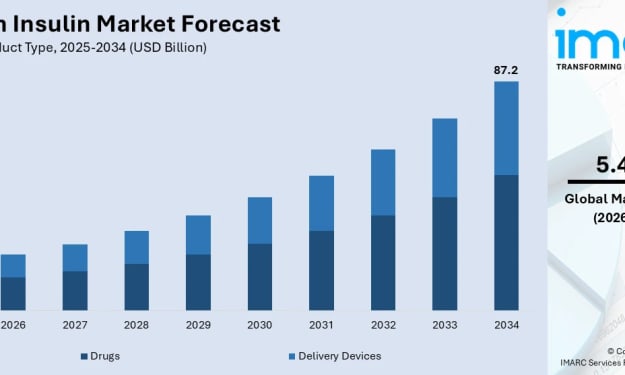
Growing diabetes cases worldwide, technological breakthroughs in insulin delivery systems, and strong government support for affordable insulin access are fueling the human insulin market, backed by advances in biosimilar production, increasing healthcare investments, and expanding distribution networks across developed and emerging economies. According to IMARC Group's latest data, the global human insulin market size was valued at USD 54.3 Billion in 2025. Looking forward, IMARC Group estimates the market to reach USD 87.2 Billion by 2034, exhibiting a CAGR of 5.42% from 2026-2034. North America currently dominates the market, holding a market share of over 46.5% in 2025.
By Andrew Sullivan4 days ago in Futurism
Hydrogen Generation Market: Mobility & Fuel Cell Adoption, Clean Transport & Growth Outlook
According to IMARC Group's latest research publication, global hydrogen generation market size reached USD 181.4 Billion in 2025. Looking forward, IMARC Group expects the market to reach USD 279.8 Billion by 2034, exhibiting a growth rate (CAGR) of 4.93% during 2026-2034.
By sujeet. imarcgroup5 days ago in Futurism
AI: Power That Demands Responsibility. Are We Ready for the Side Effects? 🤖⚠️
Artificial intelligence is a powerful tool, but its effectiveness depends on one fundamental principle: Responsible AI. This is not just a trendy phrase, but a set of critical practices — from eliminating biases in data to rigorous monitoring, verification, and transparency in AI systems. Responsible AI aims to ensure that technology serves humanity without infringing on privacy, dignity, or safety.
By Piotr Nowak8 days ago in Futurism



Comments
There are no comments for this story
Be the first to respond and start the conversation.