
Human Insulin Market Evolution: Affordability Strategies, R&D Focus & Forecast to 2034
How rising diabetes prevalence, biosimilar competition, and affordability initiatives are transforming pricing models, patient access strategies, and competitive dynamics across the global human insulin market.

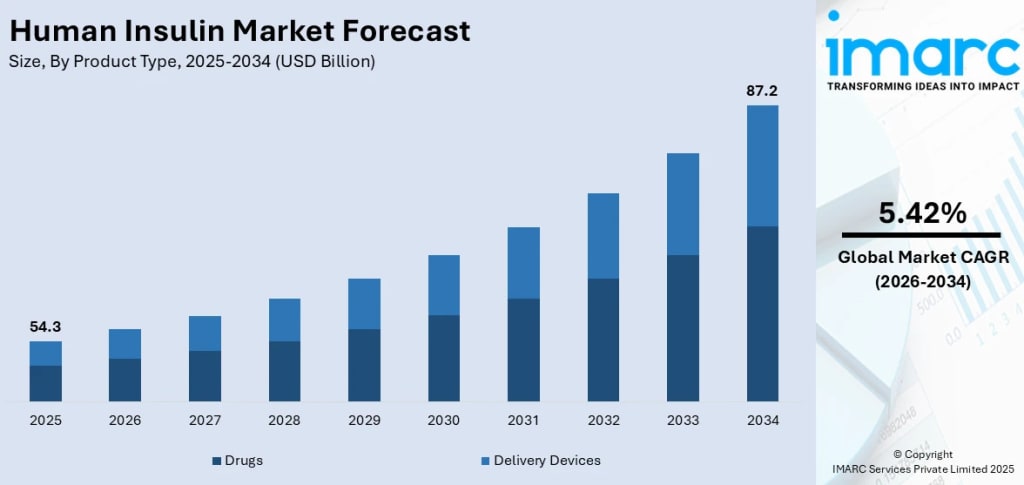
Growing diabetes cases worldwide, technological breakthroughs in insulin delivery systems, and strong government support for affordable insulin access are fueling the human insulin market, backed by advances in biosimilar production, increasing healthcare investments, and expanding distribution networks across developed and emerging economies. According to IMARC Group's latest data, the global human insulin market size was valued at USD 54.3 Billion in 2025. Looking forward, IMARC Group estimates the market to reach USD 87.2 Billion by 2034, exhibiting a CAGR of 5.42% from 2026-2034. North America currently dominates the market, holding a market share of over 46.5% in 2025.
Human insulin has become essential in diabetes management globally, with the market now exceeding USD 50 billion and showing consistent expansion year after year. The surge is powered by the alarming rise in diabetes diagnoses, an aging population requiring long-term therapy, and the shift toward patient-friendly insulin delivery devices like pens and pumps. Major product categories span rapid-acting and long-acting insulin formulations, biosimilar alternatives, and advanced delivery mechanisms including reusable and disposable pens.
Human Insulin Market Growth Drivers:
- Skyrocketing Diabetes Prevalence Worldwide
Diabetes has reached epidemic proportions, with over 537 million adults living with the condition globally and projections pointing to 643 million by 2030. This dramatic increase stems from sedentary lifestyles, unhealthy diets, rising obesity rates, and aging populations—particularly in rapidly urbanizing regions of Asia and the Middle East. Type 1 diabetes patients depend entirely on insulin for survival, while a growing segment of Type 2 patients require insulin therapy when oral medications no longer suffice. Governments and health organizations are scrambling to expand insulin access through subsidized programs and public health initiatives, recognizing that untreated diabetes leads to severe complications including kidney failure, cardiovascular disease, and vision loss.
- Breakthroughs in Insulin Production and Biosimilar Development
The advent of recombinant DNA technology revolutionized insulin production by eliminating reliance on animal sources and enabling mass production of identical human insulin. Recent manufacturing innovations include continuous bioprocessing, which cuts production costs while maintaining quality, and advanced fermentation techniques that boost yield efficiency. Biosimilar insulins have emerged as game-changers in affordability companies like Biocon and Gan & Lee are producing high-quality alternatives at significantly lower prices, particularly benefiting developing nations. Regulatory approvals for biosimilars are accelerating across major markets, with manufacturers investing billions in new production facilities to meet surging demand. For instance, Novo Nordisk and Eli Lilly committed over USD 13 billion to expand U.S. manufacturing capacity through 2030.
Claim Your Free "Human Insulin Market" Analysis Sample Report Here
- Government Initiatives and Affordability Programs Driving Access
Insulin affordability has become a political priority, particularly in the United States where the Inflation Reduction Act caps insulin costs at USD 35 per month for Medicare beneficiaries starting January 2023. Over 23 U.S. states have enacted their own price caps ranging from USD 25 to USD 100 per 30-day supply. Saudi Arabia allocated 16.96% of its 2023 national budget (USD 50.4 billion) to healthcare, substantially improving insulin access across the Gulf region. India's government is promoting local biosimilar production through regulatory fast-tracking and manufacturing incentives. These policy interventions are complemented by manufacturer-led programs in December 2024, Eli Lilly partnered with EVA Pharma to manufacture affordable insulin in Egypt, targeting one million patients in low- and middle-income countries by 2030.
Human Insulin Market Trends:
- Smart Insulin Delivery Systems Transforming Patient Experience
The insulin delivery landscape is undergoing a technological revolution. Smart insulin pens now integrate Bluetooth connectivity to track doses, send reminders, and sync with continuous glucose monitors—providing real-time diabetes management data that improves treatment adherence and outcomes. Insulin pumps have evolved into automated systems that adjust insulin delivery based on glucose readings, reducing hypoglycemia risk and giving patients greater freedom. In February 2025, Tandem Diabetes received FDA clearance for Control-IQ+ technology, an automated dosing system specifically designed for Type 2 diabetes patients.
- Regional Production Hubs Reducing Import Dependency
Countries are aggressively pursuing insulin self-sufficiency to ensure supply security and control costs. China is positioning itself as a major insulin exporter, with manufacturers like Gan & Lee expanding production and signing supply agreements with global pharmaceutical firms. Sanofi announced a USD 1.04 billion investment in November 2024 to build a new insulin production facility in Beijing, marking its largest-ever investment in China. India's pharmaceutical sector is scaling up biosimilar manufacturing through government-backed incentives and partnerships—Biocon's Insugen product line has gained regulatory approval across 70+ countries. Middle Eastern nations are establishing regional manufacturing through joint ventures, reducing reliance on Western imports.
- Next-Generation Insulin Formulations Improving Patient Outcomes
Pharmaceutical innovation is delivering insulin products with superior performance characteristics. Weekly insulin formulations like Novo Nordisk's Icodec, approved by Europe's EMA and under review in India, reduce injection frequency from daily to once-weekly administration—dramatically improving patient compliance and quality of life. Researchers are developing glucose-responsive "smart insulin" that automatically adjusts activity based on blood sugar levels, potentially revolutionizing diabetes management by eliminating manual dosing decisions. In April 2024, Vertex Pharmaceuticals licensed TreeFrog Therapeutics' stem cell technology to scale production of cell therapies for Type 1 diabetes, exploring pathways beyond traditional insulin replacement.
Recent News and Developments in Human Insulin Market
- December 2024: Cipla secured approval from India's Central Drugs Standard Control Organization (CDSCO) to launch inhalation insulin in India, offering patients a needle-free alternative to conventional injectable insulin. This innovative delivery method provides faster absorption and greater convenience, particularly benefiting patients with needle phobia or those seeking more discrete administration options.
- November 2024: Sanofi committed USD 1.04 billion to construct a new insulin production facility in Beijing, representing its largest single investment in China. This fourth facility in the country addresses China's escalating diabetes crisis affecting 140 million adults as of 2021, strengthening local production capacity and reducing import dependency while creating jobs and transferring manufacturing expertise to the region.
- August 2024: Scientists unveiled groundbreaking "smart insulin" technology that adapts in real-time to blood sugar fluctuations. This innovation could revolutionize diabetes care by providing more personalized treatment, automatically adjusting insulin activity based on glucose levels to prevent both hyperglycemia and dangerous hypoglycemic episodes—potentially eliminating the need for constant blood sugar monitoring and manual dose adjustments.
Note: If you require specific details, data, or insights that are not currently included in the scope of this report, we are happy to accommodate your request. As part of our customization service, we will gather and provide the additional information you need, tailored to your specific requirements. Please let us know your exact needs, and we will ensure the report is updated accordingly to meet your expectations.
About the Creator
Andrew Sullivan
Hello, I’m Andrew Sullivan. I have over 9+ years of experience as a market research specialist.
Keep reading
More stories from Andrew Sullivan and writers in Futurism and other communities.
Food Safety Testing Market Insights: Microbial Testing, GMO Analysis & Forecast to 2034
Rising awareness about foodborne illnesses, stringent regulatory standards, and the growing global food trade are accelerating demand for comprehensive food safety testing. The market is further supported by technological advancements in testing methods, increased consumer consciousness about food quality, and expanding testing infrastructure across developed and emerging economies. According to IMARC Group's latest data, the global food safety testing market size was valued at USD 27.2 Billion in 2025. Looking forward, IMARC Group estimates the market to reach USD 53.6 Billion by 2034, exhibiting a CAGR of 7.85% from 2026-2034.
By Andrew Sullivan3 days ago in Futurism
Top 10 Cross-Platform Mobile App Development Frameworks Across Industries
Understanding Cross-Platform Mobile App Development Mobile applications are now at the heart of digital transformation. From retail and healthcare to finance and everyday consumer services, businesses rely on mobile apps to improve customer experience, streamline operations, and stay competitive. As demand grows, companies are exploring smarter development approaches that balance performance, cost, and speed.
By Daniel Jones6 days ago in Futurism
Saudi Arabia Laboratory Automation Market: Digital Labs, Workflow Efficiency & Growth Outlook
Growing demand for high-throughput diagnostics, rising healthcare infrastructure investments, and government initiatives supporting digital transformation are driving laboratory automation adoption across Saudi Arabia. According to IMARC Group’s latest research, the Saudi Arabia laboratory automation market size reached USD 70.4 Million in 2025. Looking forward, IMARC Group expects the market to reach USD 117.1 Million by 2034, exhibiting a growth rate of 5.81% during 2026-2034.
By Faisal Al-Harbi7 days ago in Futurism
Nancy Guthrie: Is a miracle still possible after close to two weeks?
Close to two weeks since Nancy Guthrie's abduction As of February 12, 2026, Nancy Guthrie remains classified as missing for 12 days, but there is no official confirmation that she is deceased. Blood matching Guthrie’s DNA was found on her front porch, indicating she likely suffered an injury during the abduction.
By Cheryl E Preston4 days ago in Geeks


Comments
There are no comments for this story
Be the first to respond and start the conversation.