
Cell Freezing Media Market Trends: Preservation Technologies, Biotech Innovation & Industry Forecast to 2033
How cryopreservation advancements, serum-free formulations, and rising demand from cell therapy and biobanking applications are accelerating innovation and commercial opportunities in the cell freezing media market.

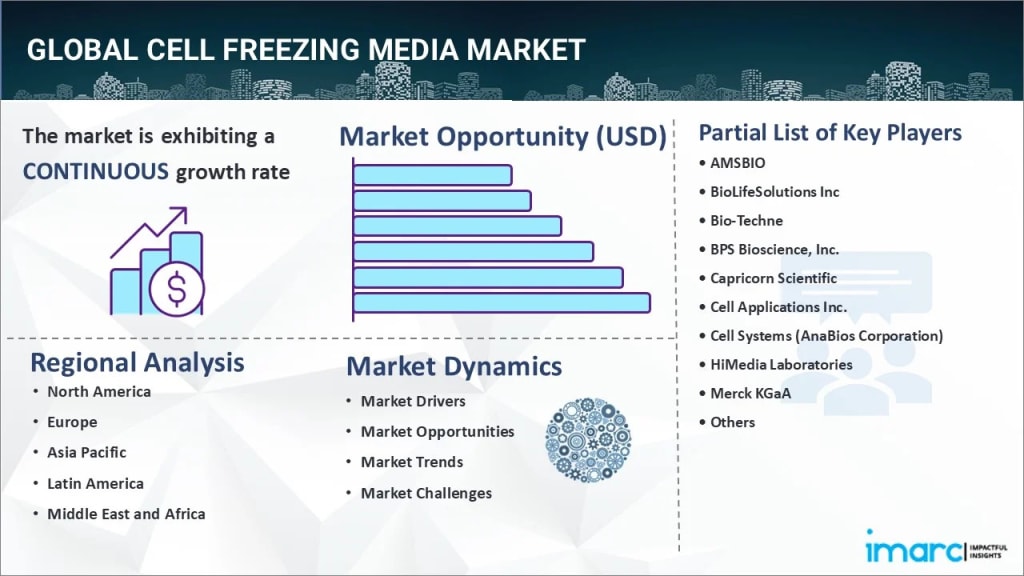
The surge in life sciences research, coupled with the rapid expansion of the biopharmaceutical industry, is fueling an unprecedented demand for high-quality cell freezing media. As researchers and drug developers prioritize cell viability and post-thaw recovery, these specialized solutions have become critical to the success of regenerative medicine and personalized therapies. According to IMARC Group’s latest data, the global cell freezing media market size reached USD 163.7 Million in 2024. Looking forward, IMARC Group expects the market to reach USD 332.9 Million by 2033, exhibiting a CAGR of 8.21% during 2025-2033.
Cell freezing media now represent a vital pillar of the global biotechnology infrastructure, facilitating the long-term storage of sensitive biological materials. The market is increasingly shaped by the shift toward serum-free and chemically defined formulations that mitigate the risks of contamination and variability. As the global healthcare sector pivots toward advanced biologics—including monoclonal antibodies and cell-based vaccines—the role of reliable cryopreservation has transitioned from a lab-level necessity to a multi-million-dollar industry requirement. Key segments such as DMSO-based media and stem cell-specific solutions continue to dominate, while emerging innovations in non-toxic cryoprotectants are opening new avenues for clinical-grade applications.
Cell Freezing Media Market Growth Drivers:
- Rising Investment in Biopharmaceutical R&D
The pharmaceutical sector’s heavy reliance on cellular research for drug discovery is a primary catalyst for market expansion. Currently, thousands of gene and cell therapies are in various stages of clinical development globally, requiring vast quantities of standardized freezing media to maintain cell banks. With governments and private investors pouring billions into precision medicine and oncology research, the volume of primary and engineered cells needing preservation has skyrocketed. This investment environment ensures that manufacturers of freezing media are constantly scaling production to support high-throughput screening and the commercialization of novel biologics.
- Expansion of Regenerative Medicine and Stem Cell Research
The clinical success of regenerative therapies is directly tied to the ability to store and transport viable stem cells without compromising their functional integrity. Recent statistics indicate that over 50,000 stem cell transplants are performed annually worldwide, a figure that continues to grow as treatments for conditions like leukemia and autoimmune disorders become more accessible. Because simple cooling is insufficient to prevent ice crystal formation and membrane damage, specialized media are indispensable. This demand is further bolstered by the rise of biobanking initiatives that aim to preserve biological samples for future therapeutic use.
- Advancements in Cryopreservation Technology
Innovation in media formulation is moving away from traditional methods toward more sophisticated, ready-to-use solutions. The industry is seeing a significant trend toward "clean-label" laboratory reagents—specifically protein-free and xeno-free media—which simplify regulatory compliance for clinical applications. By reducing toxicity and improving post-thaw recovery rates, these advanced formulations allow researchers to work with more sensitive cell lines that were previously difficult to cryopreserve. These technological leaps are essential for maintaining the consistency and safety required by global regulatory bodies like the FDA and EMA during the production of cell-based products.
Cell Freezing Media Market Trends:
- Shift Toward Serum-Free and Chemically Defined Formulations
A major trend shaping the industry is the move to eliminate animal-derived components to ensure higher levels of safety and reproducibility. Serum-containing media often introduce unwanted variability and the risk of viral contamination, which can jeopardize sensitive clinical trials. Organizations are increasingly adopting chemically defined media that offer optimized nutrient compositions for specific cell types. This shift is particularly evident in the production of monoclonal antibodies and recombinant proteins, where consistency is paramount. Consequently, the specialty media segment now accounts for nearly 43% of the broader cell culture market revenue as high-purity standards become the norm.
- Enhanced Accessibility to Global Biobanks and Health Data
The integration of cell freezing media with digital and collaborative networks is streamlining research across borders. For instance, recent initiatives like the online hub launched by EIT Health Scandinavia facilitate easier access to European biobanks and health data registries. Such platforms enable researchers to share expertise and biological resources more effectively, driving the demand for standardized cryopreservation media that ensure samples remain viable across different laboratory environments. This trend toward "open science" and shared bioresources is encouraging the adoption of universal freezing protocols and high-performance commercial media over traditional, in-house preparations.
- Strategic Funding and Consolidation in Biotechnology Startups
The market is witnessing a flurry of financial activity and strategic partnerships aimed at advancing cryopreservation for next-generation treatments. In 2024, biotechnology startups specializing in regenerative medicine, such as Acorn Biolabs, secured significant Series A funding to enhance their cell freezing capabilities. Similarly, larger players are acquiring specialized firms to expand their portfolios in the DMSO-free and automated freezing sectors. These investments are focused on developing "ready-to-use" formats that cater to busy diagnostic laboratories and academic institutes, reflecting a broader market trend toward efficiency, automation, and the reduction of manual laboratory errors.
Recent News and Developments in Cell Freezing Media Market
- May 2024: EIT Health Scandinavia launched a new online hub designed to simplify access to European biobanks and health data registries, fostering international research collaboration and standardizing expertise in biological sample preservation.
- June 2024: Toronto-based biotechnology startup Acorn Biolabs announced it had secured approximately USD 8 Million in Series A funding to advance its specialized cell freezing solutions for regenerative medicine treatments.
- April 2025: BioLife Solutions Inc. completed the acquisition of PanTHERA CryoSolutions Inc., a strategic move intended to integrate advanced cryopreservation technologies and expand its footprint in the global cell and gene therapy market.
- October 2024: Nucleus Biologics introduced NB-KUL DF, a groundbreaking DMSO-free and chemically defined cryomedia, aimed at providing a safer and more efficient alternative for the cryopreservation of sensitive cell lines used in advanced therapies.
Note: If you require specific details, data, or insights that are not currently included in the scope of this report, we are happy to accommodate your request. As part of our customization service, we will gather and provide the additional information you need, tailored to your specific requirements. Please let us know your exact needs, and we will ensure the report is updated accordingly to meet your expectations.
About the Creator
Andrew Sullivan
Hello, I’m Andrew Sullivan. I have over 9+ years of experience as a market research specialist.
Keep reading
More stories from Andrew Sullivan and writers in Futurism and other communities.
Autonomous Ships Market Trends: Collision Avoidance, AI Control Systems & Industry Forecast to 2033
The growing demand for operational efficiency, a surge in seaborne trade, and a global focus on reducing human-error-related accidents are driving the autonomous ships market. These vessels leverage advanced sensors, artificial intelligence (AI), and automated navigation systems to optimize routes and improve fuel economy. According to IMARC Group’s latest data, the global autonomous ships market size was valued at USD 108.1 Billion in 2024. Looking forward, IMARC Group estimates the market to reach USD 180.3 Billion by 2033, exhibiting a CAGR of 5.56% from 2025-2033.
By Andrew Sullivanabout 6 hours ago in Futurism
Brazil SMC and BMC Market Outlook 2026–2034: Composites Fuel Lightweight & High-Performance Growth
The Brazil SMC and BMC market has experienced significant growth as demand for advanced composite materials rises across automotive, construction, electrical, and industrial sectors. According to IMARC Group, the market reached USD 77.0 Million in 2025 and is expected to reach USD 143.2 Million by 2034, exhibiting a compound annual growth rate (CAGR) of 7.14% during 2026–2034.
By Akshay Kumarabout 2 hours ago in Futurism
Echoes
I stepped carefully around the corner, the familiar sights and sounds hitting me like a brick to the face. My eyes watered. I could practically see us, all of us, back then, clustered around the outdoor tables in front of the pizza shop, the bar, the coffee shop. I could smell the various stalls from the events we’d been to on this street. I could taste the churros and nachos.
By Phoenixica242 days ago in Fiction




Comments
There are no comments for this story
Be the first to respond and start the conversation.