
Concern Grows Over “Chatbot Overdependence” in Relationships
Advice Column Highlights Anxiety Around Heavy AI Use and Independent Thinking


What Happened
A reader wrote to advice columnist Annalisa Barbieri expressing concern that her boyfriend’s heavy reliance on AI — particularly ChatGPT — may be affecting his ability to think independently.
The man, 44, has ADHD and runs his own business. According to his partner, AI tools have transformed his productivity, especially for administrative and planning tasks. However, she worries that his usage has expanded far beyond work. He reportedly consults ChatGPT for routine tasks, such as checking train times, even when dedicated apps would be more accurate.
She also noted he ranked in the top 0.3% of global users in his annual usage summary, raising concerns about overdependence and environmental impact.
The columnist consulted Dr Stephen Blumenthal, a clinical psychologist, and Henry Shelford, CEO of ADHD UK. Both suggested that while AI can be particularly helpful for individuals with ADHD — offering structure, focus, and task management — excessive reliance may signal underlying anxiety rather than simple convenience.
What Is Analysis
1. ADHD and AI: A Natural Fit
People with ADHD often experience:
Difficulty sustaining attention
Executive dysfunction
Challenges with planning and organization
Increased cognitive load from mundane tasks
AI tools like ChatGPT can provide:
Immediate clarification
Task breakdowns
Structured thinking support
Emotional reassurance
For some users, AI functions like a cognitive scaffold — reducing friction in daily life.
However, experts warn that tools designed to support executive function can become substitutes for it if used reflexively.
2. “Chatbot Overdependence”
Dr Blumenthal raised the possibility of a future phenomenon resembling “chatbot overdependence syndrome” — a pattern in which individuals begin relying on AI not just for information but for validation, reassurance, and decision-making.
Overdependence differs from healthy usage in several ways:
Using AI even when simpler tools are available
Seeking repeated reassurance from the system
Experiencing discomfort when not using it
Attributing human-like qualities to the tool
The concern is not technological harm per se, but psychological displacement — where self-trust erodes.
3. Anxiety as Root Cause
Both experts suggested the boyfriend’s AI use may be a symptom rather than the primary issue.
Running a business can create chronic stress. For individuals with ADHD, anxiety can amplify decision paralysis. AI may function as a “flotation aid,” providing:
Immediate answers
Reduced uncertainty
Relief from cognitive strain
If underlying anxiety is driving behavior, simply reducing AI use without addressing stress may not resolve the pattern.
4. Relationship Dynamics
The advice emphasizes avoiding “nagging,” which can trigger defensiveness. Instead, experts recommend:
Asking what needs the tool is fulfilling
Exploring alternative coping strategies
Framing concerns compassionately
Avoiding framing AI use as moral failure
The key relational insight is that dependency often fills an emotional gap — such as reassurance, structure, or fear of failure.
The Bigger Picture
This case reflects a broader societal shift.
As AI becomes embedded in everyday life, questions are emerging about:
Cognitive outsourcing
Decision-making autonomy
Environmental costs of AI computation
Emotional attachment to digital tools
Unlike younger generations growing up alongside AI, mid-career adults have years of functioning without it. That historical memory suggests overreliance is reversible.
The distinction may ultimately lie between augmentation and substitution:
Augmentation: AI enhances existing abilities.
Substitution: AI replaces cognitive effort and self-trust.
For individuals with ADHD, AI can be empowering. But if reliance becomes automatic, the risk is diminished confidence rather than improved capacity.
The columnist concludes that the real task is not eliminating AI, but restoring balance — ensuring that tools support human agency rather than quietly supplanting it.
In a world where digital assistants are always available, the challenge may not be access — but knowing when to step back and think unaided.
About the Creator
Keep reading
More stories from Behind the Tech and writers in Futurism and other communities.
Calcium Carbonate Market: High-Performance Fillers, Cost Efficiency & Industry Growth
According to IMARC Group's latest research publication, the global calcium carbonate market size reached 9.8 Million Tons in 2024. Looking forward, IMARC Group expects the market to reach 15.6 Million Tons by 2033, exhibiting a growth rate (CAGR) of 4.8% during 2025–2033.
By sujeet. imarcgroup7 days ago in Futurism
Kitchen Appliances Market Analysis: Consumer Convenience, Digital Retail & Industry Forecast to 2034
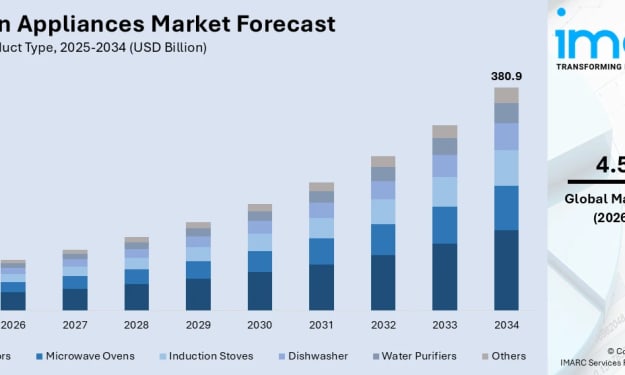
Rising urbanization, growing disposable incomes, and shifting consumer lifestyles are fueling strong demand for kitchen appliances worldwide, supported by rapid e-commerce expansion, smart home integration, and a steady cultural shift toward home cooking. According to IMARC Group's latest data, the global kitchen appliances market size was valued at USD 254.7 Billion. Looking forward, IMARC Group estimates the market to reach USD 380.9 Billion, exhibiting a CAGR of 4.58% during 2026-2034.
By Andrew Sullivan6 days ago in Futurism



Comments
There are no comments for this story
Be the first to respond and start the conversation.