
GCC Data Center Construction Market Outlook: Growth Catalysts, Investment Trends & Future Opportunities
How Rapid Digital Transformation Is Accelerating the GCC Data Center Construction Market

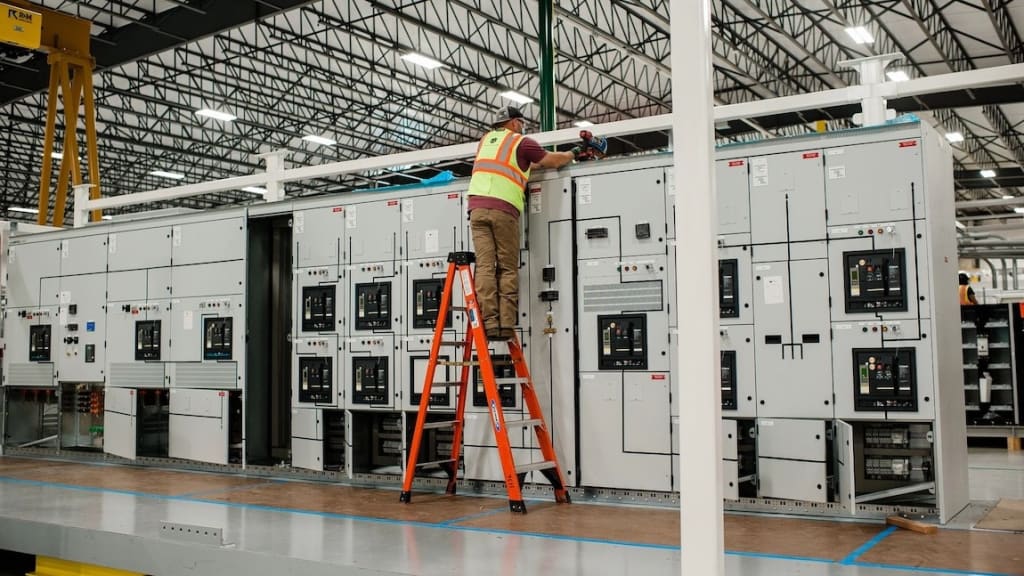
According to IMARC Group's latest research publication, GCC data center construction market size reached USD 1,356.3 Million in 2025. The market is projected to reach USD 5,836.1 Million by 2034, exhibiting a growth rate (CAGR) of 17.60% during 2026-2034.
How AI is Reshaping the Future of GCC Data Center Construction Market
- Predictive Infrastructure Management: AI algorithms analyze real-time facility data, anticipating equipment failures and power anomalies before they occur, reducing downtime by 25% in major UAE and Saudi facilities.
- Automated Cooling Optimization: Machine learning systems dynamically adjust cooling parameters based on workload patterns, cutting energy consumption by 30% while maintaining optimal temperature ranges across hyperscale deployments.
- Smart Construction Planning: AI-powered design tools simulate thermal performance and power distribution scenarios, helping developers optimize layouts and reduce construction timelines by up to 20% in new builds.
- Capacity Forecasting and Scaling: Advanced analytics predict future demand spikes from cloud migration and edge computing growth, enabling operators to scale capacity efficiently across multi-site portfolios in the region.
- Security and Compliance Automation: AI-driven security systems monitor physical access and cyber threats continuously, ensuring Tier III and IV facilities meet stringent data sovereignty requirements mandated by GCC governments.
Access the Sample Report for Current Insights and Forecasts
How Vision 2030 is Revolutionizing GCC Data Center Construction Industry
Vision 2030 is fundamentally transforming the GCC's data center landscape by positioning digital infrastructure as a cornerstone of economic diversification. Saudi Arabia has committed over $18 billion toward data center investments, targeting 1.5 gigawatts of capacity by 2030, while launching flagship projects like SDAIA's 480-megawatt Hexagon Data Center in Riyadh—set to become the world's largest government-owned facility. The UAE's Stargate initiative represents a $20 billion investment in a 5-gigawatt AI-focused hyperscale facility partnering with OpenAI, Nvidia, and Oracle. These programs are supported by streamlined regulatory frameworks including Saudi Arabia's 2023 Data Center Services Regulations and the UAE's sustainability benchmarks for large facilities. National strategies emphasize renewable energy integration, with NEOM's facilities targeting 100% clean energy operation, while data sovereignty laws require sensitive data storage within national borders, creating sustained domestic demand. The region is also developing specialized talent through institutions like SDAIA Academy and leveraging strategic geography to serve as a connectivity bridge between Europe, Asia, and Africa through multiple subsea cable landing points.
GCC Data Center Construction Market Trends & Drivers:
The GCC data center construction market is experiencing explosive growth driven by massive cloud adoption and AI infrastructure buildout. Hyperscalers including AWS, Google Cloud, Microsoft Azure, Oracle, and Huawei have collectively committed approximately $10 billion in regional investments, establishing dedicated cloud regions across Dubai, Abu Dhabi, Riyadh, Jeddah, Dammam, Doha, and Manama. The region is witnessing unprecedented capacity expansion, with data center megawatt load projected to grow 29% annually through 2030. Saudi Arabia's National Data Center Strategy targets building up to 1.5 gigawatts of capacity, while the UAE continues leading with over 400 megawatts of existing power capacity. Companies like HUMAIN are deploying facilities with 500-megawatt capacity, while Khazna Data Centers announced plans for AI-optimized facilities featuring 20 data halls in Ajman. Data usage in the GCC is projected to surge 400% between 2022 and 2028, fueled by enterprise digital transformation, government e-services migration, and the proliferation of data-intensive applications.
Strict data localization requirements and digital sovereignty mandates are compelling multinational corporations to establish in-country hosting capabilities, creating captive demand for domestic infrastructure. Saudi Arabia and the UAE enforce regulations requiring sensitive data storage within national borders, while regulatory frameworks issued by the Communications, Space, and Technology Commission categorize providers based on data sensitivity levels they handle. This regulatory push coincides with major smart city initiatives—NEOM's estimated $500 billion investment, Dubai's smart infrastructure programs, and Qatar's Digital Government Strategy 2023-2025—all requiring robust data center capacity for IoT sensors, AI analytics, and real-time service delivery. The public sector across the GCC is driving significant adoption, with government agencies mandating cloud-first policies and migrating critical services to digital platforms. Banking, telecommunications, oil and energy sectors are also accelerating their digital transformation journeys, requiring Tier III and IV facilities.
Sustainability integration and energy efficiency are reshaping construction approaches across the region. The UAE's Mohammed bin Rashid Al Maktoum Solar Park targets 5,000 megawatts of power by 2030, while Saudi Arabia's solar irradiation levels significantly exceed global averages at 250 W/m2. Operators like Khazna Data Centers focus on energy-efficient operations and renewable energy sourcing, while STC incorporates green initiatives supporting Vision 2030 goals. The UAE aims for net-zero by 2050, and Saudi Arabia targets net-zero by 2060, with the Barakah Nuclear Energy Plant already supplying a quarter of UAE electricity needs. Emerging players including Agility, DataVolt, Pure Data Centres, and Qareeb Data Centres are entering the market with advanced cooling solutions and modular construction approaches. Edge computing growth is driving demand for distributed facilities closer to end-users, while the strategic geographic position between three continents enables the GCC to serve as a low-latency connectivity hub through extensive subsea cable infrastructure.
GCC Data Center Construction Market Industry Segmentation:
The report has segmented the market into the following categories:
Construction Type Insights:
- Electrical Construction
- Mechanical Construction
- Data Center Type Insights:
- Small-Scale Data Center
- Medium-Scale Data Center
- Large-Scale Data Center
Tier Standards Insights:
- Tier I and II
- Tier III
- Tier IV
Vertical Insights:
- Public Sector
- Oil and Energy
- Media and Entertainment
- IT and Telecommunication
- Banking, Financial Services and Insurance (BFSI)
- Healthcare
- Retail
- Others
Country Insights:
- Saudi Arabia
- United Arab Emirates
- Qatar
- Kuwait
- Oman
- Bahrain
Competitive Landscape:
The competitive landscape of the industry has also been examined along with the profiles of the key players.
Recent News and Developments in GCC Data Center Construction Market
- January 2026: Saudi Data and Artificial Intelligence Authority (SDAIA) broke ground on the Hexagon Data Center in Riyadh, designed as a Tier IV facility with 480 megawatts of capacity spanning over 30 million square feet, positioned to become the world's largest government-owned data center supporting national data sovereignty and e-government services expansion.
- October 2024: Khazna Data Centers announced development of a new AI-optimized data center facility in Ajman, UAE, featuring 20 data halls with the first phase expected to go online by 2026, addressing growing demand for AI and machine learning infrastructure in the Emirates.
- March 2024: Amazon Web Services (AWS) launched plans for a new AWS Region in Saudi Arabia comprising three availability zones, representing a long-term commitment of over $5.3 billion in the Kingdom to support customers' data residency requirements and in-country content storage needs.
- June 2025: Saudi Ministry of Communications and Information Technology (MCIT) and SDAIA unveiled the National Data Center Strategy, setting the ambitious goal of building up to 1.5 gigawatts of data center capacity by 2030 to position the Kingdom as a regional leader in cloud computing and AI infrastructure.
- November 2025: ICS Arabia commenced construction on the first of three planned data centers in Saudi Arabia, with the 65MW Desert Dragon facility in Al-Kharj targeting Tier 3 certification and operations beginning in 2026, followed by facilities in Jeddah, Dammam, and NEOM.
Note: If you require specific details, data, or insights that are not currently included in the scope of this report, we are happy to accommodate your request. As part of our customization service, we will gather and provide the additional information you need, tailored to your specific requirements. Please let us know your exact needs, and we will ensure the report is updated accordingly to meet your expectations.
About the Creator
Abhay Rajput
I am working in market research company that provides market and business research intelligence across the globe.
Keep reading
More stories from Abhay Rajput and writers in Futurism and other communities.
Egypt Data Center Market Outlook: Growth Catalysts, Key Investors & Future Opportunities
According to IMARC Group's latest research publication, Egypt data center market size reached USD 223.2 Million in 2024. The market is projected to reach USD 484.78 Million by 2033, exhibiting a growth rate of 8.26% during 2025-2033.
By Abhay Rajputabout 13 hours ago in Futurism
Stanislav Kondrashov Oligarch Series: Oligarchy and the Design of Humanity’s Ringworld Future
What if the next great civilisation isn’t found — but built? Picture a colossal ring encircling a distant star. Its inner surface stretches for millions of kilometres. Oceans curve upward. Cities follow the arc of an endless horizon. Gravity comes from rotation, not nature. Night falls because someone programmed it to.
By Stanislav Kondrashov 4 days ago in Futurism
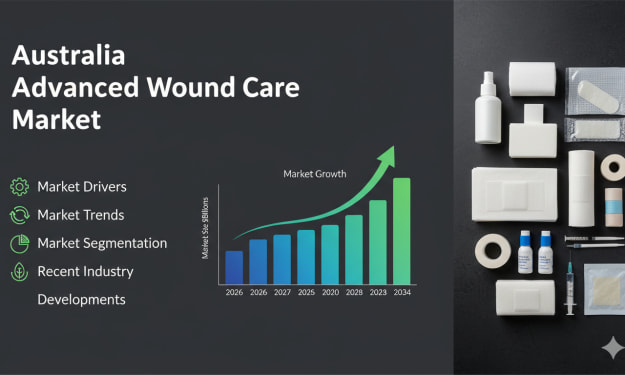
Australia Advanced Wound Care Market: Clinical Demand, Product Innovation & Healthcare Expenditure
According to IMARC Group, the Australia advanced wound care market reached USD 326.7 Million in 2025 and is projected to grow to USD 512.4 Million by 2034, exhibiting a compound annual growth rate (CAGR) of 5.13% during 2026–2034. This steady expansion reflects the increasing clinical importance of specialized wound management solutions across Australia. Advanced wound care products—such as antimicrobial dressings, foam dressings, hydrocolloids, negative pressure wound therapy (NPWT) devices and bioengineered skin substitutes—are replacing traditional gauze-based treatments in hospitals, outpatient clinics and home care settings. As chronic diseases rise and healthcare infrastructure strengthens, the demand for effective, faster-healing and infection-preventive wound care solutions continues to grow.
By Kevin Cooper7 days ago in Futurism



Comments
There are no comments for this story
Be the first to respond and start the conversation.