
Global Tuna Market Trends: Frozen Tuna Demand, Logistics Developments & Industry Outlook to 2034
How canned and frozen tuna innovations, convenience trends, and packaging advancements are redefining consumer preferences, shelf visibility, and value-added opportunities across the global tuna market.

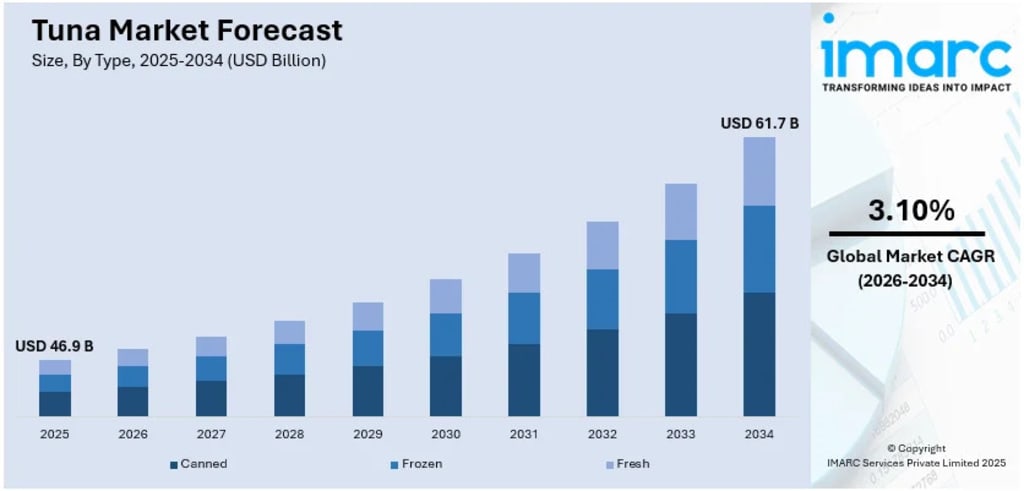
Rising demand for lean protein, hectic urban schedules, and the expansion of the seafood processing industry are fueling the global tuna market. This growth is further supported by innovations in sustainable fishing, the introduction of convenient pouch formats, and the rising popularity of sushi and sashimi cultures worldwide. According to IMARC Group’s latest data, the global tuna market size was valued at USD 46.9 Billion in 2025. Looking forward, IMARC Group estimates the market to reach USD 61.7 Billion by 2034, exhibiting a CAGR of 3.10% from 2026-2034.
Tuna has evolved into a staple of the multi-billion-dollar global seafood industry, valued for its versatility and high nutritional profile. The market is increasingly defined by a shift toward ethical sourcing, with a significant rise in demand for Marine Stewardship Council (MSC) certified products. Major species segments include Skipjack, which accounts for approximately 57.8% of the market due to its abundance, followed by Yellowfin and Albacore. Consumer preferences are gravitating toward ready-to-eat canned and pouch options that offer long shelf lives, as well as premium fresh tuna for gourmet culinary applications.
Global Tuna Market Growth Drivers:
- Rising Global Demand for High-Protein and Healthy Diets
Consumers are increasingly prioritizing nutrient-dense foods to combat lifestyle diseases and support fitness goals. Tuna is highly sought after as a primary source of Omega-3 fatty acids, Vitamin B12, and high-quality protein with minimal fat content. Medical endorsements highlighting its role in cardiovascular health and weight management have solidified its position in daily diets. This health-driven shift is particularly evident in North America and Europe, where health-conscious demographics are replacing red meats with seafood options to reduce cholesterol and improve overall wellness.
- Growing Preference for Convenience and Ready-to-Eat Formats
Urbanization and busy professional schedules have triggered a massive surge in the demand for shelf-stable, portable meal solutions. Canned and pouch-packaged tuna are leading this transition, as they require no preparation and serve as a quick protein fix for salads and sandwiches. Statistics show that the U.S. convenience food sector is expanding rapidly, with canned tuna remaining the second most popular seafood item in the country. This trend is bolstered by the rise of nuclear families and the increasing participation of women in the global workforce.
- Expansion of Sustainable Fishing and Traceability Standards
Environmental transparency is no longer optional for major seafood brands. Modern consumers actively seek products with "dolphin-safe" or MSC labels, ensuring their purchases do not harm marine ecosystems. Initiatives like the "Tuna Transparency Pledge" aim for 100% on-the-water monitoring by 2027, covering over 15% of global catches. By adopting advanced tracking technologies and blockchain, companies can provide verified "vessel-to-plate" history. This commitment to sustainability not only builds brand loyalty but also aligns with strict international regulations and eco-conscious purchasing behaviors across major retail channels.
Global Tuna Market Trends:
- Innovation in Eco-Friendly and Smart Packaging
Brands are ditching traditional plastics for recyclable and lightweight materials to minimize environmental impact. A notable example is the introduction of "EcoTwist" technology, which utilizes a patent-pending tower design that eliminates plastic shrink-wrap and reduces steel usage by over 400 metric tons annually. These advancements appeal to eco-conscious shoppers and reduce logistical costs. Additionally, the shift toward easy-open lids and resealable single-serve cups caters to the millennial preference for functional design, making tuna more accessible for on-the-go consumption in urban environments.
- Premiumization and Culinary Diversification
The market is witnessing a move toward "gourmet" tuna offerings, including infusion with high-end ingredients like truffle oil, Mediterranean herbs, and lemon pepper. This premiumization trend is also driven by the global sushi and sashimi boom, which has increased the valuation of high-grade Bluefin and Bigeye tuna. In 2024, a single 238-kg bluefin at Japan’s first auction fetched approximately USD 760,000, signaling durable demand for luxury seafood. Retailers are responding by expanding their private-label premium lines to offer restaurant-quality experiences to home consumers.
- Advancements in Cold Chain Logistics and E-commerce
The integration of sophisticated cold storage and cryogenic freezing technologies has revolutionized the trade of fresh and frozen tuna. These innovations allow producers to preserve the "fresh-caught" quality of tuna over long distances, opening up new export routes from Asia-Pacific to Western markets. Simultaneously, the rise of e-commerce and specialized online grocery platforms has made it easier for consumers to access a wider variety of processed and fresh seafood. Online seafood sales are growing at a faster rate than traditional retail, supported by improved last-mile delivery and subscription models.
Recent News and Developments in the Global Tuna Market
- August 2024: Wild Planet launched a "Limited Edition Wild Tuna Snack Pack" in collaboration with Simple Mills and Chosen Foods, featuring sustainably caught Skipjack paired with almond flour crackers to target the healthy on-the-go snacking segment.
- May 2025: Major tuna-producing nations, including Papua New Guinea and the Marshall Islands, joined the "Tuna Transparency Pledge," committing to 100% monitoring of industrial fishing vessels to eliminate illegal and unregulated fishing activities.
- November 2025: The International Commission for the Conservation of Atlantic Tunas (ICCAT) increased European Union Bluefin tuna quotas by 17%, allowing for an additional 2,800 metric tons of supply to meet the rising demand in Japanese and North American markets.
- February 2026: Leading manufacturers announced a shift toward "full-cycle aquaculture" for Bluefin tuna, aiming to reduce reliance on wild-caught juveniles and stabilize production costs while ensuring a more biosecure supply chain.
Note: If you require specific details, data, or insights that are not currently included in the scope of this report, we are happy to accommodate your request. As part of our customization service, we will gather and provide the additional information you need, tailored to your specific requirements. Please let us know your exact needs, and we will ensure the report is updated accordingly to meet your expectations.
About the Creator
Andrew Sullivan
Hello, I’m Andrew Sullivan. I have over 9+ years of experience as a market research specialist.
Keep reading
More stories from Andrew Sullivan and writers in Futurism and other communities.
Health Insurance Market Trends: Preventive Care Incentives, Wellness Programs & Industry Forecast to 2034
Rising healthcare costs, a growing geriatric population, and the increasing prevalence of chronic diseases are driving global health insurance demand, supported by digital transformation, value-based care models, and supportive government policies. According to IMARC Group’s latest data, the global health insurance market size was valued at USD 2,064.8 Billion in 2025. Looking forward, IMARC Group estimates the market to reach USD 3,510.3 Billion by 2034, exhibiting a CAGR of 5.80% from 2026-2034.
By Andrew Sullivanabout 13 hours ago in Futurism
Tin Market Outlook: Electronics Demand and Industrial Growth Opportunities
According to IMARC Group's latest research publication, The global tin market size was valued at 417.2 Kilo Tonnes in 2025. Looking forward, IMARC Group estimates the market to reach 461.6 Kilo Tonnes by 2034, exhibiting a CAGR of 1.13% during 2026-2034.
By James Whitman7 days ago in Futurism
Forget Coding: How "AI Power Users" Are Building the Next Generation of Million-Dollar Businesses
1. Introduction: The Death of the Developer Moat The technical moat is dead. For decades, a Computer Science degree was the ultimate gatekeeper to the digital economy—the ability to write code was the only way to build a scalable business. That barrier has been pulverized.
By Mohammad Hamid7 days ago in Futurism



Comments
There are no comments for this story
Be the first to respond and start the conversation.