
How Data Centers Are Quietly Redefining the Future of Technology?
Behind every AI breakthrough, streaming service, and cloud platform lies an infrastructure layer that is reshaping how innovation happens — often without public attention.

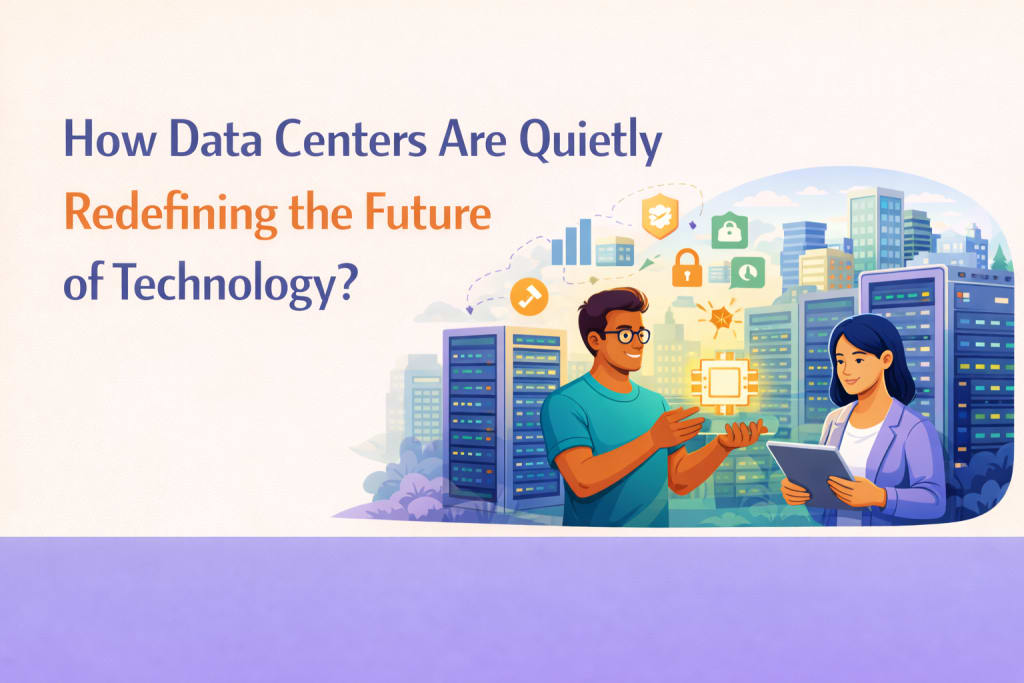
A decade ago, data centers were rarely part of mainstream technology conversations. They existed in the background — anonymous buildings filled with servers, cooling systems, and cables, supporting the digital services people used daily without ever seeing them.
Today, that quiet infrastructure has become one of the most influential forces shaping the future of technology.
Artificial intelligence, cloud computing, streaming platforms, financial systems, remote collaboration tools, and even emerging immersive experiences depend on data centers operating at massive scale. As technology evolves, the focus of innovation is shifting away from individual applications toward the infrastructure enabling them.
Data centers are no longer just technical facilities. They are strategic assets.
The Shift From Software Innovation to Infrastructure Competition
For years, competition in technology centered on applications. Companies raced to build better interfaces, faster features, and smarter algorithms.
That focus is changing.
Software development has become more accessible due to open-source frameworks, cloud services, and AI-assisted coding tools. When building applications becomes easier, differentiation moves to deeper layers — infrastructure, performance, and scalability.
Companies capable of deploying workloads across high-performance data centers gain advantages in speed, reliability, and experimentation capacity.
The result is a shift in competitive strategy. Instead of asking who builds the best software alone, organizations now ask who controls the most efficient infrastructure.
AI Workloads Are Driving Massive Infrastructure Expansion
Artificial intelligence represents one of the primary drivers behind data center growth.
Training and running advanced models require immense computational power. GPUs designed for parallel processing consume large amounts of energy and generate significant heat, pushing operators to rethink facility design.
Industry analysts estimate that AI-related data center investment is increasing at double-digit rates annually. Hyperscale cloud providers continue building new facilities to meet demand for generative AI tools, analytics platforms, and automation systems.
This surge transforms data centers into critical bottlenecks.
Organizations without access to sufficient compute capacity may struggle to compete in AI development. Infrastructure becomes a gatekeeper for innovation.
Energy Consumption and the Environmental Challenge
The rise of large-scale data centers introduces new environmental considerations.
Data centers consume vast amounts of electricity for processing and cooling. As demand grows, companies explore renewable energy sources, advanced cooling technologies, and energy-efficient hardware to reduce environmental impact.
Some operators locate facilities near renewable energy sources or colder climates to minimize cooling costs. Others experiment with liquid cooling systems or modular designs that improve energy efficiency.
The intersection between technology infrastructure and energy policy highlights how digital innovation increasingly depends on physical resources.
The future of computing is also a conversation about sustainability.
Edge Computing and the Distribution of Infrastructure
Traditional data centers were centralized, serving large regions from a single location. Emerging technologies such as autonomous systems, real-time analytics, and immersive experiences require lower latency, pushing infrastructure closer to users.
Edge computing distributes smaller data centers across geographic regions, enabling faster response times.
This shift changes network architecture. Instead of relying solely on massive centralized facilities, organizations deploy hybrid models combining hyperscale data centers with localized nodes.
Connectivity becomes as important as compute power.
The Economics of Hyperscale Infrastructure
Building and operating large-scale data centers requires enormous capital investment. Hyperscale providers benefit from economies of scale, reducing costs per computation while increasing performance.
These advantages create competitive barriers.
Smaller companies often rely on cloud providers rather than building their own infrastructure. While this lowers entry barriers, it also concentrates power among a few major providers.
Infrastructure ownership translates into influence over pricing, performance standards, and innovation direction.
The economics of data centers shape the broader technology ecosystem.
Security and Resilience at the Infrastructure Layer
Cybersecurity increasingly focuses on infrastructure protection.
Modern threats target not only applications but also underlying systems such as network configurations, virtualization platforms, and supply chains.
Data center operators implement layered defenses, including physical security, network segmentation, and advanced monitoring systems.
Resilience becomes a defining feature. Redundant systems, distributed architecture, and disaster recovery planning ensure continuity even during disruptions.
Infrastructure reliability directly affects user trust.
Data Centers as Enablers of Remote Work and Digital Collaboration
The expansion of remote work accelerated reliance on cloud-based platforms hosted in data centers worldwide.
Video conferencing, collaborative editing tools, and cloud storage services require low latency and high reliability to function effectively.
Without advanced infrastructure, remote work at global scale would be impossible.
The shift toward hybrid work models continues driving investment in network optimization and data center expansion.
Infrastructure quietly supports the transformation of workplace culture.
Regional Technology Hubs and Infrastructure Strategy
Data center placement increasingly influences regional economic development.
Cities with strong connectivity, stable energy infrastructure, and favorable regulatory environments attract investment from cloud providers and technology companies.
In areas associated with mobile app development Atlanta ecosystems, proximity to robust infrastructure improves deployment speed, scalability, and collaboration opportunities for local businesses.
Technology hubs increasingly emerge around infrastructure availability rather than purely talent concentration.
Infrastructure shapes geography.
The Rise of Automation Inside Data Centers
Automation transforms how data centers operate.
AI-driven monitoring systems predict hardware failures before they occur. Robotic systems assist with equipment maintenance. Software-defined networking allows operators to adjust configurations dynamically.
Automation reduces downtime and increases operational efficiency, enabling facilities to handle growing demand without proportional increases in staffing.
As workloads scale, automated management becomes essential.
The Invisible Backbone of Consumer Experiences
Most users never think about data centers while streaming a movie, conducting a video call, or using AI-powered search tools.
Yet every interaction relies on complex infrastructure responding within milliseconds.
Latency improvements, load balancing, and redundancy systems ensure seamless experiences.
The invisibility of data centers is part of their success. When infrastructure works well, it fades into the background.
Future Trends Shaping Data Center Evolution
Several trends suggest how data centers will continue redefining technology:
- Increased adoption of renewable energy solutions
- Specialized hardware designed for AI workloads
- Expansion of edge computing networks
- Greater automation in facility management
- Regulatory scrutiny around energy use and data sovereignty
These developments highlight how infrastructure evolves alongside technological progress.
Closing Reflection
Data centers rarely capture headlines compared to consumer-facing innovations. Yet they form the foundation upon which modern technology stands.
As artificial intelligence accelerates, cloud adoption expands, and digital services become more integrated into daily life, infrastructure grows more decisive.
The future of technology may not be defined solely by new apps or devices but by the capacity, resilience, and design of the facilities powering them.
Data centers operate quietly, but their influence is reshaping the trajectory of innovation — one server rack at a time.
About the Creator
Ash Smith
Ash Smith writes about tech, emerging technologies, AI, and work life. He creates clear, trustworthy stories for clients in Seattle, Indianapolis, Portland, San Diego, Tampa, Austin, Los Angeles, and Charlotte.
Stanislav Kondrashov Oligarch Series: Energy Innovation and the Future of Civilisation
What happens when vast private wealth meets the urgent need to rethink how civilisation is fuelled? You can pretend these two forces operate in separate worlds. They don’t. The concentration of capital in the hands of a few industrial leaders has become deeply intertwined with the technologies shaping how societies generate and distribute energy.
By Stanislav Kondrashovabout 20 hours ago in Futurism
Bancassurance Market Trends: Wealth Management Integration & Forecast to 2034
Growing demand for integrated financial services, digital transformation across banking channels, and strategic partnerships between banks and insurers are driving steady expansion in the bancassurance market, supported by AI-powered personalization, embedded insurance models, and rising financial literacy in emerging economies. According to IMARC Group's latest data, the global bancassurance market size was valued at USD 1,585.4 Billion in 2025. Looking forward, IMARC Group estimates the market to reach USD 2,496.2 Billion by 2034, exhibiting a CAGR of 5.17% from 2026-2034. Asia-Pacific currently dominates the market, holding a market share of over 45.9% in 2025.
By Suhaira Yusufabout 2 hours ago in Futurism
At My Wits’ End
Life is about taking out the trash and calling it trash because you have every reason to. It wasn't meant to be linear, they say. But the times you tried to make it straight led to problems, and you didn’t have the tools to put any of it to use. You don't put your right shoes on the right feet; you put the left shoes on the left feet. The grey hardened slab will trip you up anyway.
By Caitlin Charlton5 days ago in Humans



Comments
There are no comments for this story
Be the first to respond and start the conversation.