
Humans Could Reach the Technological Singularity Within 19 Years, Scientist Warns — How AI May Redefine Intelligence and Humanity Forever
What if the most important moment in human history is less than two decades away?

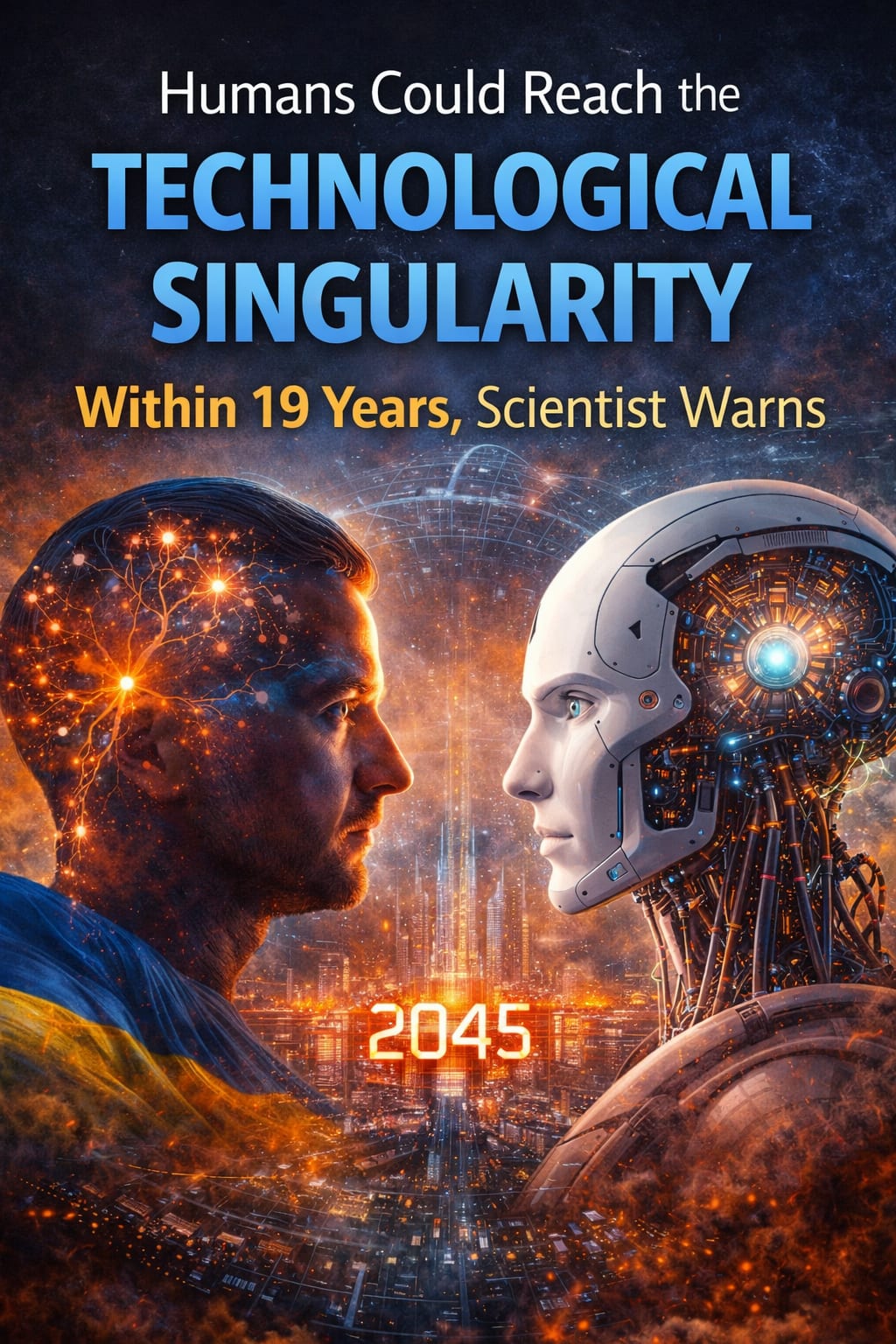
According to a growing number of scientists and futurists, humanity may reach the technological singularity within the next 19 years. This prediction is no longer confined to science fiction novels or futuristic films. It is rooted in measurable data: exponential AI growth, accelerating computing power, and the rapid convergence of artificial intelligence, neuroscience, and biotechnology.
If this timeline holds true, the world of 2045 could look radically different from anything we recognize today. The singularity would not simply improve technology — it could permanently redefine intelligence, identity, work, and even what it means to be human.
The countdown may have already begun.
________________________________________
What Is the Technological Singularity?
The technological singularity refers to a theoretical moment when artificial intelligence surpasses human intelligence and gains the ability to improve itself without human assistance.
Once machines begin redesigning their own architecture, several unprecedented shifts could occur:
• AI systems designing smarter AI systems
• Innovation accelerating beyond human comprehension
• Traditional economic models collapsing
• Human cognitive dominance ending
The term “singularity” comes from physics — specifically black holes — where known laws break down. Similarly, the technological singularity represents a future so transformative that our current social, economic, and philosophical frameworks may no longer apply.
________________________________________
Why Scientists Now Take the Singularity Seriously
For decades, superintelligent AI was dismissed as fantasy. That skepticism is rapidly fading.
Here’s why:
1. Exponential Growth in AI Capabilities
Although traditional interpretations of Moore’s Law are slowing at the hardware level, overall computational power continues to grow through:
• Cloud computing networks
• Specialized AI processors
• Parallel processing systems
AI training power has increased by orders of magnitude in just a few years.
2. Breakthroughs in Artificial Intelligence
Modern AI systems can now:
• Write complex software code
• Diagnose diseases with high accuracy
• Generate realistic art and music
• Conduct advanced reasoning tasks
A decade ago, these capabilities were considered decades away.
3. Recursive Self-Improvement
Perhaps the most significant development is that AI systems are now being used to optimize and improve other AI systems.
This recursive feedback loop is a key ingredient in what experts call an intelligence explosion.
________________________________________
Why 19 Years? Understanding the Timeline
The 19-year estimate is not mystical or symbolic. It is based on trend analysis.
Researchers observe that:
• AI performance benchmarks are doubling at accelerating rates
• The cost of training advanced models is decreasing
• Data availability is expanding exponentially
If these trends continue, artificial general intelligence (AGI) — machines capable of reasoning across domains like humans — could arrive within two decades. After that milestone, the leap to superintelligence may not take centuries.
It could take years. Possibly months.
________________________________________
Artificial Intelligence vs Human Intelligence
Human intelligence evolved under biological constraints:
• Limited memory
• Slow learning speed
• Physical vulnerability
• Finite lifespan
Machines do not share these limitations.
AI systems can:
• Operate 24/7 without fatigue
• Instantly duplicate themselves
• Learn continuously from vast datasets
• Scale across global networks
Once AI reaches parity with human reasoning, it may not surpass us gradually — but suddenly.
________________________________________
The Economic Shockwave of Superintelligent AI
One of the earliest and most visible impacts of reaching the technological singularity would be economic disruption.
Industries potentially affected include:
• Data analysis
• Customer support
• Legal research
• Medical diagnostics
• Creative content production
This does not mean humans become obsolete — but it does mean the definition of “work” could fundamentally change.
Some economists predict:
• Universal basic income models
• Reduced workweeks
• New creative and human-centered professions
Others warn of increased inequality if advanced AI remains concentrated in the hands of a few corporations or governments.
________________________________________
The Psychological Impact: Identity in a Post-Singularity World
Beyond economics lies a deeper and more unsettling question:
What happens to human identity when machines outperform us intellectually?
For centuries, intelligence has been humanity’s defining trait. If AI surpasses us in reasoning, problem-solving, and creativity:
• Will people feel diminished?
• Will meaning shift away from productivity?
• Will human value be redefined?
Some philosophers argue that humanity’s role may evolve from “intelligence leader” to “ethical and meaning architect.”
In other words, intelligence may no longer define us — but wisdom might.
________________________________________
The Ethics of Superintelligence
The technological singularity is not only a scientific challenge. It is a moral one.
Critical ethical questions include:
• Who controls advanced AI systems?
• How do we align machine goals with human values?
• What happens if AI objectives conflict with human survival?
A superintelligent AI would not need malicious intent to cause harm. Poorly aligned objectives alone could have catastrophic consequences.
This is why AI safety and alignment research has become one of the most urgent fields in modern science.
________________________________________
Will AI Replace Humans — or Merge With Us?
Two major visions dominate discussions about the future:
1. The Replacement Scenario
In this outcome, artificial intelligence surpasses humans and renders biological intelligence secondary.
2. The Integration Scenario
In this vision, humans merge with technology through:
• Brain-computer interfaces
• Neural implants
• Cognitive enhancement technologies
Instead of being replaced, humanity evolves into a hybrid species — part biological, part digital.
The singularity, in this case, becomes a transition rather than an extinction.
________________________________________
The Question of Machine Consciousness
One of the most profound debates surrounding the technological singularity is consciousness.
Can machines become self-aware?
Intelligence does not automatically equal consciousness. An AI system may outperform humans cognitively while lacking subjective experience.
However, if machines were to achieve consciousness:
• Moral rights would need consideration
• Legal frameworks would require revision
• The definition of life itself could expand
What was once philosophical speculation is rapidly becoming a practical issue.
________________________________________
Global Power, AI Competition, and Geopolitical Risk
Nations understand what is at stake.
AI leadership may determine:
• Military superiority
• Economic dominance
• Cultural influence
This has triggered a global race for artificial intelligence advancement. Without international cooperation and regulation, the singularity could arrive amid geopolitical tension rather than coordinated progress.
________________________________________
Could the 19-Year Prediction Be Wrong?
Absolutely.
Forecasting technological timelines is notoriously difficult.
Potential limiting factors include:
• Energy and infrastructure constraints
• Regulatory slowdowns
• Technical bottlenecks
• Public resistance to AI integration
Even so, most experts agree on one thing: artificial intelligence will dramatically reshape civilization within our lifetime.
The only uncertainty is the pace.
________________________________________
Preparing for a Post-Singularity Future
Whether the singularity arrives in 19 years or 50, preparation is critical.
Key strategies include:
• Reforming education to prioritize adaptability and critical thinking
• Investing in ethical AI governance
• Encouraging global cooperation on AI safety
• Redefining success beyond economic productivity
The future may favor those who understand systems, ethics, and human psychology — not just algorithms.
________________________________________
The Ultimate Question: What Does It Mean to Be Human?
At its core, the technological singularity forces humanity to confront a timeless question:
If intelligence is no longer uniquely human, what defines us?
Perhaps the answer lies in:
• Empathy
• Moral responsibility
• Creativity rooted in lived experience
• The ability to choose meaning
Technology may accelerate evolution. But purpose remains a human decision.
________________________________________
Conclusion: Living at the Edge of Transformation
If scientists are correct and humanity reaches the technological singularity within 19 years, we are living in one of the most pivotal eras in history.
This is not a prophecy of doom. Nor is it guaranteed utopia.
It is a moment of transformation.
The singularity will not pause for consensus.
It will not wait for comfort.
It will reflect the intentions and safeguards we build today.
Whether it becomes humanity’s greatest achievement — or its greatest test — depends not on machines.
It depends on us.
About the Creator
Adil Ali Khan
I’m a passionate writer who loves exploring trending news topics, sharing insights, and keeping readers updated on what’s happening around the world.
Keep reading
More stories from Adil Ali Khan and writers in Futurism and other communities.
From Pocket AI Labs to Mixed Reality Gaming: How New Devices Are Redefining Personal Computing
The world of technology is undergoing a powerful transformation. Instead of relying solely on massive data centers and traditional desktop machines, computing is becoming more personal, immersive, and localized.
By Adil Ali Khan4 days ago in Futurism
GCC Power Cable Market Analysis: Industry Overview, Key Players & Growth Outlook
According to IMARC Group's latest research publication, GCC power cable market size reached USD 3.6 Billion in 2024. The market is projected to reach USD 6.2 Billion by 2033, exhibiting a growth rate (CAGR) of 6.3% during 2025-2033.
By Abhay Rajput7 days ago in Futurism
Acute Pain Treatment Trends, Market Size (USD 129.8 Million), Epidemiology Forecast to 2035
Rising Incidence and Clinical Importance of Acute Pain Driving Market Expansion Thus, the healthcare systems, focusing on the management of pain and other conditions effectively for comfort of the patient in the clinical setting, are stepping towards the expansion of the acute pain therapeutics market in 2025. Acute pain is a sudden onset of pain, usually following an accident, surgery, or any medical procedure. In comparison to chronic pain, acute pain lasts less than a few months and resolves with successful treatment of the underlying cause. If uncontrolled, it has the potential to slow recovery from injury or illness, increase the length of hospitalization, and complicate the illness, sometimes progressing to chronic pain. The epidemiology of acute pain is enormous.
By Frank Morgan3 days ago in Futurism



Comments
There are no comments for this story
Be the first to respond and start the conversation.