Latest Stories
Most recently published stories in Futurism.
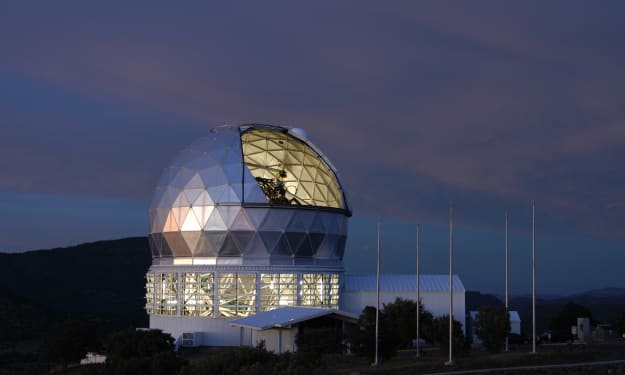
Observatory Guide
There are few pastimes more fascinating, more mysterious, or more peaceful than simply stargazing at a splendid night sky—wondering what it all means. Will we ever travel to any of those other suns? Are there other souls like us on a distant planet, looking up and wondering the same? A special breed of investigator is devoted to finding the answers to some of these questions, by studying everything in the universe from the movement of planets to the nature of such bizarre objects as quasars and black holes, which explode or go beep in the night. That investigator is the astronomer.
By Futurism Staff10 years ago in Futurism
Time's Role in Science Fiction
What is time? In our world, it represents a concept, unit, choice, and even a dimension. In the science fictional universe, it represents all of these concepts elevated into an all encompassing one. Time finds itself as a necessity in that nothing could exist without it––a statement that we cannot fathom because we have never experienced it. Writer Charles Yu claims in his novel, How To Live Safely in a Science Fictional Universe, that “time is an ocean of inertia.”
By Natasha Sydor10 years ago in Futurism
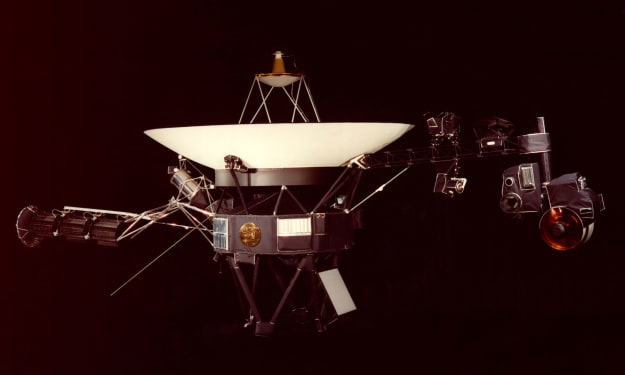
Voyager 2's Expedition
It weighs almost a ton and measures approximately four meters by four meters. Its two television cameras take tens of thousands of pictures of worlds in the outer solar system. A collision with a micrometeoroid could cause it to lose its orientation temporarily, but it wouldn't founder. It is made of millions of parts. If certain components fail, others will take over. We're talking about the fantastic Voyager 2, the semi-intelligent robot that, for nearly 40 years, has explored unknown worlds.
By Futurism Staff10 years ago in Futurism
Most Underrated Sci-Fi Movies. Top Story - June 2016.
Everyone’s been to the classic Hollywood summer blockbusters; We’ve munched popcorn through the whole Terminator series, slurped over-iced $10 sodas throughout the Men In Black movies, cringed and laughed during Aliens, E.T., and Back to the Future. We’ve stood (for longer than we should have) in those opening day lines for all the Star Wars and Star Trek films. We’ve checked out the new Planet of the Apes franchise, nodded approvingly (for the most part) at additions like Oblivion, Edge of Tomorrow, and Interstellar to our beloved genre. But many of the most creative sci-fi motion pictures flame out fast on very limited runs on a small number of screens. Must these glittering gems of imagination go unrecognized forever? Nope; Not in this day and age of online streaming!
By Matt Cates10 years ago in Futurism
Gypsy Moth Invasion
The caterpillars were everywhere—in the pool, on the side of the house, in the eaves, in your hair. Where there were large infestations, you could hear them at night. Their droppings, or frass, sounded like a light rain. Perfectly sane people went about protected beneath umbrellas on sunny days.
By Futurism Staff10 years ago in Futurism
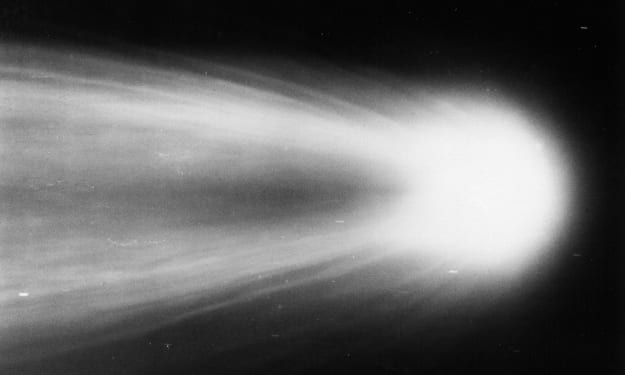
History of Halley's Comet
It was August in 1682 when the faint gleam first appeared in the night sky. From one night to the next, it grew slightly brighter and changed position among the background stars. The pioneers of astronomy peered at it through that new-fangled invention, the telescope, and watched it begin to sprout a tail. Among the majority of people, however, the instinctive reaction was fear. “A comet,” they whispered. “A comet has appeared! And plague, famine, and war will surely follow.”
By Futurism Staff10 years ago in Futurism
Arthur C. Clarke Interview
In 1945, a young English technical officer, who had spent World War II helping to develop radar systems for the Royal Air Force, published a remarkably prescient article in the British journal Wireless World. The article showed, in detail, how artificial satellites could be used to relay electronic communications around the world. The writer was Arthur C. Clarke.
By Futurism Staff10 years ago in Futurism
Stargate's Pauline Gedge
"Ixelion stepped under the archway of his Gate, the box clutched tightly in his hand, and the guards with their silver wands and stiff capes of scales greeted him with soft, deferential voices." So begins Pauline Gedge's unparalleled exploration of the creators of the universe in 1982's Stargate. At the dawn of time, the universe is overseen by the Worldmaker, who rules over each sun lord in the solar systems of his creation. Until, ruled by unexpected malice, he becomes the Unmaker.
By Natasha Sydor10 years ago in Futurism
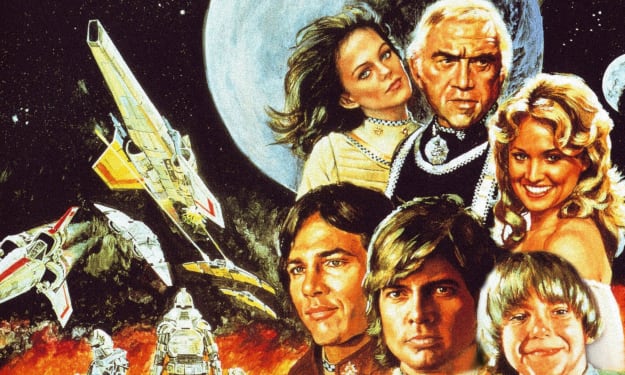
Ultimate 'Battlestar Galactica' Guide
Glen Larson—musician, screenwriter, producer—had wanted to do something like Galactica, he told us, long before he saw Star Wars. That Lucas blockbuster, though, gave Larson’s idea “legs”—as they say in showbiz—made Galactica seem a profitable notion that could stand on its own and walk away with a bundle.
By Futurism Staff10 years ago in Futurism