
North America Virtual Reality Market Size and Forecast 2025–2033
Immersive Tech Goes Mainstream as Gaming, Healthcare, and Enterprise Applications Fuel Explosive Regional Growth

Introduction: Virtual Reality Moves From Novelty to Necessity
Virtual reality (VR) has officially crossed the line from being a futuristic curiosity to a practical, revenue-generating technology that is reshaping multiple industries across North America. Once confined mostly to gaming arcades and experimental labs, VR is now a serious tool in healthcare, defense, education, enterprise training, architecture, and collaborative work environments.
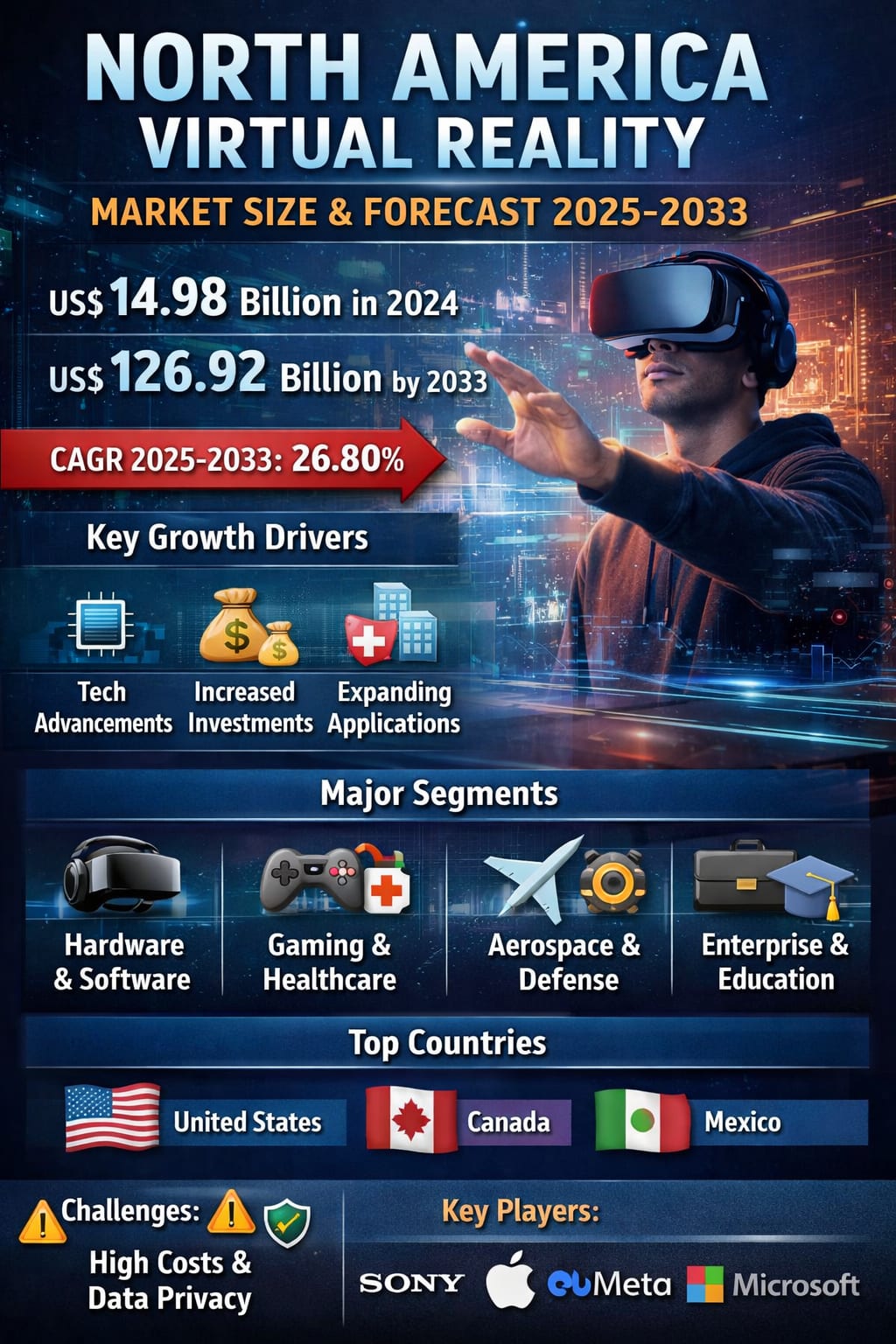
According to Renub Research, the North America Virtual Reality Market is expected to reach US$ 126.92 billion by 2033, up from US$ 14.98 billion in 2024, growing at a robust CAGR of 26.80% from 2025 to 2033. This dramatic expansion reflects not just rising consumer interest, but also deepening institutional adoption and sustained investment in immersive technologies.
At its core, virtual reality enables users to interact with a fully computer-generated 3D environment using specialized equipment such as head-mounted displays, motion trackers, gloves, and controllers. By stimulating the senses—especially sight and hearing—VR creates a powerful sense of presence inside a digital world. This capability makes VR uniquely suited for applications that demand realism, repetition, safety, or deep engagement, such as pilot training, surgical simulation, product design, and immersive education.
In North America, the convergence of advanced hardware, mature software ecosystems, strong R&D funding, and high digital adoption rates has positioned the region as one of the most influential VR markets globally.
Market Overview: Why North America Leads the VR Revolution
Several structural advantages explain why North America remains at the forefront of the virtual reality industry.
First, the region is home to many of the world’s leading technology companies and innovation hubs. From Silicon Valley to Toronto’s growing tech ecosystem, North America benefits from a dense concentration of hardware manufacturers, software developers, content creators, and venture capital investors focused on immersive technologies.
Second, consumer readiness plays a major role. High smartphone penetration, strong gaming cultures, and increasing familiarity with AR and VR devices have reduced the barriers to adoption. At the same time, enterprises across sectors are actively exploring VR as a tool for training, design, simulation, and remote collaboration.
Third, government and institutional support—especially in the United States—has accelerated VR adoption in defense, education, and public-sector training. These large-scale deployments not only generate revenue but also validate VR as a serious, mission-critical technology.
Together, these factors are pushing virtual reality out of niche use cases and into the mainstream of digital transformation strategies.
Key Growth Drivers for the North America Virtual Reality Market
1. Rapid Technological Advancements
Technological innovation is the backbone of the North American VR market’s explosive growth. Each new generation of VR hardware brings improvements in display resolution, field of view, motion tracking accuracy, and processing power. On the software side, more realistic physics engines, better graphics rendering, and smarter interaction systems are making virtual environments increasingly lifelike.
A good example of this progress is the launch of next-generation VR systems such as Sony Interactive Entertainment’s PlayStation VR2, which combines advanced sensors, high-fidelity visuals, and precise tracking to deliver a far more immersive gaming experience. These improvements do not only benefit entertainment; they also make VR more viable for professional applications like medical training, engineering design, and industrial simulation.
As hardware becomes more powerful and more affordable over time, and as software tools become easier to develop with, VR is steadily moving from “impressive demo” to “everyday tool” across multiple sectors.
2. Increased Investments and Research Activity
Investment is another major engine driving the North American VR market forward. Both large technology corporations and agile startups are pouring resources into VR hardware, platforms, content, and supporting ecosystems. Venture capital funding continues to flow into immersive tech startups, helping them push boundaries in areas like haptics, spatial computing, and AI-driven virtual environments.
At the same time, corporate R&D budgets are increasingly allocating funds to VR-based solutions, especially in training, simulation, and product development. Universities and research institutions are also playing a role by exploring new use cases for VR in education, psychology, medicine, and engineering.
This growing research environment ensures a steady pipeline of innovation, which in turn expands the number of viable commercial applications. As VR becomes more capable and more versatile, its addressable market in North America continues to widen.
3. Expanding Applications Across Industries
One of the strongest drivers of VR market growth in North America is the sheer diversity of its applications.
In gaming and entertainment, VR delivers deeply immersive experiences that traditional screens simply cannot match. In healthcare, VR is being used for surgical training, pain management, rehabilitation, and mental health therapy. In education, it enables experiential learning, allowing students to explore historical sites, conduct virtual experiments, or practice complex procedures in a safe environment.
In enterprise and industrial settings, VR is transforming training, design visualization, and safety simulations. For example, workers can practice hazardous tasks in a risk-free virtual environment before performing them in the real world.
A notable example of institutional adoption came in September 2023, when the U.S. Department of Defense awarded a USD 90 million contract to HTX Labs for VR-based training content for the Air Force. This highlights how VR is increasingly viewed as a serious, cost-effective solution for complex training needs.
As more sectors discover practical, high-ROI use cases for VR, demand across North America is expected to remain strong throughout the forecast period.
Challenges Facing the North America Virtual Reality Market
1. High Costs of Hardware and Infrastructure
Despite falling prices over time, VR still requires a significant upfront investment. High-quality headsets, sensors, controllers, and compatible computing hardware can be expensive for both consumers and organizations. For businesses, additional costs may include custom software development, content creation, and system integration.
These cost barriers can slow adoption, especially in price-sensitive segments such as small businesses, educational institutions with limited budgets, or emerging consumer markets. While economies of scale and technological progress are gradually reducing costs, affordability remains a key challenge for mass adoption.
2. Privacy and Data Security Concerns
VR systems collect large amounts of sensitive data, including biometric information, movement patterns, and behavioral responses. This raises serious questions about data storage, user consent, and protection against breaches or misuse.
As VR becomes more integrated into daily life—especially in workplaces, healthcare, and education—concerns about surveillance, data ownership, and cybersecurity are likely to intensify. Building strong security frameworks and transparent privacy policies will be essential for maintaining user trust and ensuring sustainable market growth.
Country-Level Insights
United States Virtual Reality Market
The United States remains the largest and most influential VR market in North America, driven by strong technology ecosystems, high consumer spending, and substantial government investment. According to the U.S. Bureau of Economic Analysis, the VR sector contributed over USD 5 billion to the economy in 2023, highlighting its growing economic significance.
The U.S. Department of Defense continues to be a major driver of VR adoption, particularly for training and simulation. In October 2023, the University of Arizona College of Medicine received USD 1.5 million from the DoD to develop a portable VR tool for rapid field assessment of traumatic brain injury. In September 2023, Indiana University’s Center for Representative Government received USD 5.7 million to develop “Democracy Quest,” a VR-based interactive learning application for civics education.
Alongside defense and education, strong consumer demand for gaming, fitness, and social VR experiences continues to fuel market growth in the U.S.
Canada Virtual Reality Market
Canada’s VR market is expanding steadily, supported by demand from gaming, entertainment, healthcare, education, and enterprise sectors. The country has a strong reputation for digital media and game development, which naturally supports VR content creation.
In healthcare, VR is being adopted for medical training, therapy, and rehabilitation. In education, immersive learning experiences are gaining popularity, while businesses are increasingly using VR for design visualization, remote collaboration, and skills training. With ongoing improvements in hardware and content quality, Canada is expected to remain an important contributor to the regional VR ecosystem.
Mexico Virtual Reality Market
Mexico is emerging as a promising VR market, with growing adoption across retail, healthcare, education, entertainment, aerospace, defense, tourism, and even agriculture. Public and private sector investments in digital transformation are helping to create new opportunities for VR-based solutions.
In retail, VR is being used to enhance customer engagement and product visualization. In education and healthcare, immersive simulations are improving training outcomes. As infrastructure improves and awareness increases, Mexico is well-positioned to capture a larger share of the North American AR/VR landscape over the coming years.
Market Segmentation Overview
By Component:
Hardware
Software
By Device Type:
Head-Mounted Displays
Gesture-Tracking Devices
Projectors and Display Walls
Others
By Application:
Aerospace & Defense
Commercial
Consumer
Enterprise
Healthcare
Others
By Technology:
Semi and Fully Immersive
Non-Immersive
By Country:
United States
Canada
Mexico
Rest of North America
Competitive Landscape: Key Companies in Focus
The North American VR market features a mix of global technology giants and specialized innovators. Major players covered in the analysis include:
Sony
Apple Inc.
Microsoft Corporation
Lenovo
Samsung Corporation
Meta Platforms, Inc.
Qualcomm Incorporated
Autodesk Inc.
These companies are shaping the market through hardware innovation, software platforms, content ecosystems, and strategic partnerships. Their competitive strategies typically focus on product performance, ecosystem integration, developer support, and long-term platform vision.
Final Thoughts: A Decade of Immersive Transformation Ahead
The numbers tell a powerful story. Growing from US$ 14.98 billion in 2024 to an expected US$ 126.92 billion by 2033, the North America Virtual Reality Market is entering a decisive decade of expansion. A 26.80% CAGR is not just a sign of hype—it reflects real, sustained adoption across entertainment, healthcare, education, defense, and enterprise applications.
While challenges such as high costs and data privacy concerns remain, ongoing technological progress and increasing institutional support are steadily lowering barriers and building trust. As VR becomes more affordable, more secure, and more deeply integrated into everyday workflows, its role in North America’s digital economy will only grow stronger.
About the Creator
Keep reading
More stories from shibansh kumar and writers in Futurism and other communities.
Global Game-based Learning Market Size & Forecast 2026–2034
Introduction: Learning Enters the Age of Play The way the world learns is undergoing a profound transformation. Classrooms, training rooms, and even living rooms are no longer limited to textbooks, slides, and lectures. Instead, learning is becoming interactive, immersive, and increasingly driven by game mechanics. From students solving math problems through story-driven adventures to employees mastering leadership skills via simulations, game-based learning is redefining how knowledge is delivered and absorbed.
By shibansh kumar13 days ago in Futurism
Stainless Steel Market Trends: Green Steel Innovation, Demand Surge & Industry Outlook to 2034
Growing demand from construction, automotive, and industrial sectors is fueling stainless steel adoption worldwide, driven by urbanization, infrastructure expansion, and technological innovation in manufacturing processes. According to IMARC Group's latest data, the global stainless steel market size was valued at USD 163.72 Billion in 2024. Looking forward, IMARC Group estimates the market to reach USD 261.54 Billion by 2033, exhibiting a CAGR of 5.08% during 2025-2033.
By Andrew Sullivan4 days ago in Futurism



Comments
There are no comments for this story
Be the first to respond and start the conversation.