
Nuclear Engines for the Journey to Mars: Why NTR and NEP May Change Everything
Space

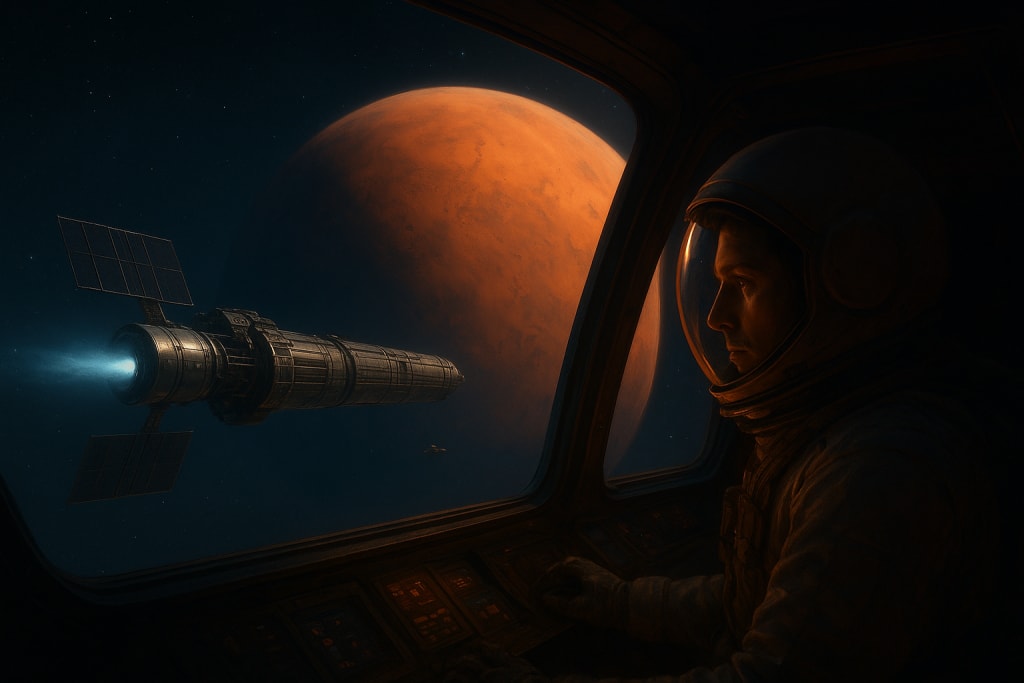
For decades, Mars has been the big red prize of human space exploration. We’ve landed rovers, taken selfies on its dusty plains, and mapped its canyons and craters in high resolution. And yet, no human has ever set foot there. The biggest obstacle isn’t distance itself — it’s time. With today’s chemical rockets, a crewed flight to Mars would take six to nine long months one way, and the entire mission could stretch to two or even three years. That means more radiation exposure, more psychological pressure, more supplies, and more risk.
To shrink that timeline, engineers are turning back to an idea born in the 1960s but more relevant than ever: nuclear rockets. Two promising technologies lead the race — Nuclear Thermal Rockets (NTR) and Nuclear Electric Propulsion (NEP). They work in fundamentally different ways, but both aim to solve the same problem: how to get humans to Mars faster, safer, and more often.
NTR: Nuclear Thermal Rockets — Power Through Heat
At first glance, a Nuclear Thermal Rocket doesn’t look so different from a traditional one. But instead of burning chemical propellants, it uses a nuclear reactor to heat hydrogen to extremely high temperatures — over 2500 to 3000°C. That hot hydrogen is then expelled through a nozzle, creating thrust.
Think of it like boiling water in a kettle — except the “kettle” is a compact fission reactor, and the “steam” shoots out fast enough to push a spacecraft across millions of kilometers.
Why NTR is a game-changer:
It offers twice the efficiency of the best chemical rockets (specific impulse of 850–900 seconds vs. ~450).
It provides strong, usable thrust, making it ideal for accelerating and slowing down a heavy crewed spacecraft.
It’s the most realistic near-term technology. The U.S. already tested NTR engines in the NERVA program during the 1960s and 70s, proving the physics works.
With NTR, the journey to Mars could shrink from nine months to roughly three or four. That alone would be revolutionary.
The drawbacks?
NTR reactors need shielding, cooling, and careful flight rules — you don’t want a reactor running inside Earth’s atmosphere. But once in space, the concept is remarkably mature.
NEP: Nuclear Electric Propulsion — Efficiency Over Force
If NTR is a rocket on steroids, NEP is a marathon runner with perfect stamina.
In this system, the nuclear reactor doesn’t produce thrust directly. Instead, it generates electricity, which then powers ion or plasma engines — similar to the ones used on NASA’s Dawn and DART probes, but orders of magnitude more powerful.
These engines expel charged particles at astonishing speeds — so fast that the efficiency can be 5 to 10 times greater than chemical propulsion.
Advantages of NEP:
- Tremendously efficient — ideal for deep-space travel
- Uses very little propellant
- Provides continuous thrust for months or even years
Disadvantages:
- It produces low thrust, so acceleration is slow
- It requires large, powerful space reactors (100–1000 kW or more), which humanity is only beginning to master
NEP isn’t the best choice for a quick start from Earth orbit, but it’s fantastic for long cruises and cargo transport. For pushing robotic missions across the Solar System, it could become the gold standard.
The Future: Hybrid NTR–NEP Systems
Here’s where things get exciting. Many scientists now believe the ultimate Mars engine might be a hybrid spacecraft using both systems:
Mission Phase Best Propulsion Why
Departure NTR Fast, powerful thrust
Cruise Phase NEP Efficient long-duration
acceleration
Mars Arrival NTR Quick braking maneuver
Such a ship could cut travel time to 60–90 days, turning Mars from a rare expedition into a regular destination.
Who’s Building These Engines Today
This is no longer science fiction:
NASA + DARPA are building a nuclear thermal engine under the DRACO program (planned test in 2027–2028)
Roscosmos is developing a nuclear electric “space tug” called Zeus
ESA, Blue Origin, and Lockheed Martin are also researching nuclear propulsion systems
In other words — the nuclear space race has restarted, quietly but seriously.
Conclusion: Chemical Rockets Got Us to Space — Nuclear Rockets Will Take Us Somewhere
To make human Mars missions safe, fast, and routine, we need more than bigger fuel tanks. We need a leap in propulsion. NTR represents the near future, NEP represents the long future, and their combination may open the rest of the Solar System — not just for robots, but for us.
Mars won’t stay out of reach much longer. Now it’s an engineering problem — and engineers love solving problems.
About the Creator
Keep reading
More stories from Holianyk Ihor and writers in Futurism and other communities.
The Hidden Magnetism of Space: Why Objects That Don’t Attract on Earth Pull Together Among the Stars
If you drop a pen and a paperclip on your desk, they just sit there. Nothing happens — no invisible force draws them together. But take those same two objects far away from Earth, into the silent vacuum of space, and something extraordinary begins to happen: they start to move toward each other. Slowly, almost imperceptibly at first, but undeniably. It sounds like science fiction — yet it’s a real and fascinating truth about how the universe works.
By Holianyk Ihor4 months ago in Futurism
GCC Bridge Construction Market Analysis: Industry Overview, Key Players & Growth Outlook
According to IMARC Group's latest research publication, GCC bridge construction market size was valued at USD 25.56 Billion in 2025. The market is projected to reach USD 40.94 Billion by 2034, exhibiting a growth rate (CAGR) of 5.38% during 2026-2034.
By Abhay Rajput5 days ago in Futurism
Smoothies Market Trends: Functional Ingredients, Clean Label Appeal & Forecast to 2034
Rising health awareness, busy lifestyles, and preference for convenient, nutritious foods are driving healthy snack demand, supported by clean-label trends, product innovation, and expanding retail and online distribution channels. According to IMARC Group's latest data, the global smoothies market size was valued at USD 18.0 Billion in 2025. Looking forward, IMARC Group estimates the market to reach USD 25.6 Billion by 2034, exhibiting a CAGR of 3.98% from 2026-2034.
By Andrew Sullivan6 days ago in Futurism



Comments
There are no comments for this story
Be the first to respond and start the conversation.