
Soft Skills Training Market Trends: Communication Skills Demand & Forecast to 2034
How rising demand for communication skills, leadership development, and workplace collaboration is driving sustained growth in the soft skills training market

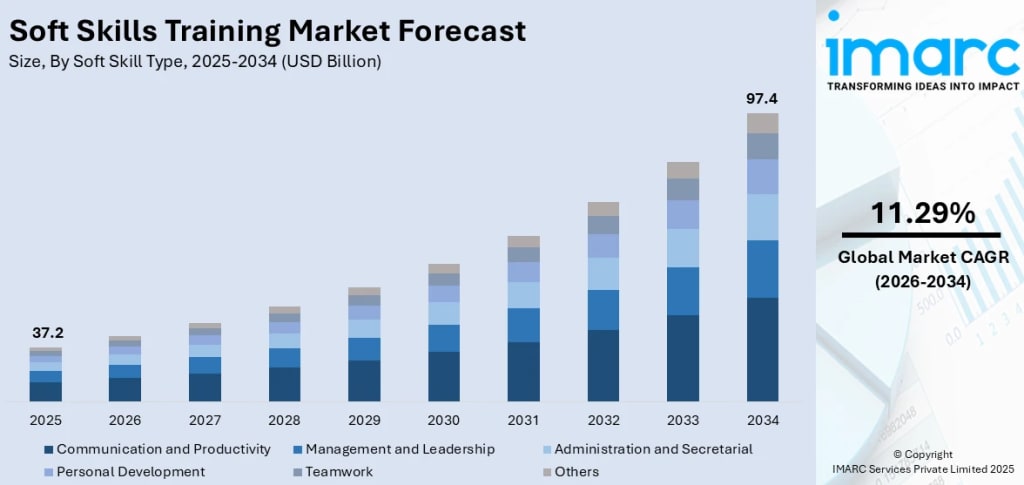
Growing demand for workforce development, rising adoption of digital learning platforms, and increasing recognition of soft skills as essential for career success are driving steady expansion in the soft skills training market, supported by remote work acceleration, AI-powered personalized learning tools, and corporate investment in employee retention strategies. According to IMARC Group's latest data, the global soft skills training market size was valued at USD 37.2 Billion in 2025. Looking forward, IMARC Group estimates the market to reach USD 97.4 Billion by 2034, exhibiting a CAGR of 11.29% during 2026-2034. North America currently dominates the market, holding a significant market share of over 32.9% in 2025.
Soft skills training is no longer a nice-to-have it has become essential infrastructure for workforce readiness. Employers across industries now prioritize communication, teamwork, adaptability, and emotional intelligence over technical skills alone. According to industry reports, 92% of employers rank soft skills above technical qualifications when hiring, while 63% of employees who received soft skills training reported measurable improvements in job performance. Communication and productivity lead by skill type with 41.2% of the market, reflecting the central role these capabilities play in team collaboration and operational efficiency.
Soft Skills Training Market Growth Drivers:
- Employers Prioritizing Soft Skills Over Technical Qualifications
Hiring practices have shifted significantly in the past few years. Around 92% of employers now consider soft skills more important than technical expertise when making hiring decisions, according to recent workforce surveys. This is not about preference it reflects the reality that technical skills can be taught relatively quickly, while interpersonal abilities like communication, empathy, and conflict resolution take longer to develop. Companies are investing heavily in training to close these gaps, with 63% of employees who completed soft skills programs reporting tangible improvements in their work. Yet only 35% of organizations currently offer structured training, which leaves a massive opportunity for providers to fill the demand as awareness grows.
- Remote and Hybrid Work Models Creating New Training Needs
The shift to remote and hybrid work has fundamentally changed how teams collaborate. Virtual communication skills, self-motivation, and time management are now baseline requirements rather than optional extras. In September 2024, UPS, Walmart, and Volvo Group all announced VR training deployments covering everything from technical tasks to soft skills like customer interactions and field challenges. By 2030, the number of digital jobs that can be performed remotely is expected to reach 92 million globally, up 25% from current levels. That scale of distributed work requires training infrastructure that can be delivered digitally, tracked effectively, and adapted to individual learning styles which is exactly what modern soft skills platforms are built to provide.
- Automation and AI Making Human Skills More Valuable
As automation handles more routine tasks, the skills that distinguish human workers from machines have become more valuable. Creativity, critical thinking, emotional intelligence, and adaptability cannot be replicated by algorithms, which is why organizations are doubling down on developing these capabilities. In the EU alone, 13.48% of enterprises were already using AI technologies by 2024. As that adoption accelerates, the premium on uniquely human skills only increases. Soft skills training is how companies prepare their workforce to work alongside AI rather than be displaced by it handling complex problem-solving, managing client relationships, and making judgment calls that require context and empathy.
Soft Skills Training Market Trends:
- AI and Gamification Transforming How Training Is Delivered
Training providers are embedding AI into their platforms to personalize learning paths, assess skill gaps in real time, and provide immediate feedback. In 2024, Pearson reported 5% underlying revenue growth in Q3, driven largely by virtual learning and AI-enhanced education tools. Skillsoft launched "Perspectives 2024," showcasing AI-driven tools designed to transform leadership and soft skills training through interactive, scenario-based learning. In May 2025, Udemy released "Role Play," an AI-powered simulation platform that lets organizations deliver immersive coaching over 3,100 role plays were published within weeks of launch. These are not experimental features they represent the new standard for how training is designed, delivered, and measured.
- Strategic Partnerships Expanding Access and Scale
Major retailers, logistics companies, and tech platforms are forming partnerships with training providers to upskill employees at scale. In May 2024, LinkedIn Learning partnered with Walmart to provide access to its entire content library for over 140,000 employees. In February 2025, Degreed raised USD 110 million in Series E funding, bringing its total to USD 350 million, aimed at expanding its corporate learning platform. These deals reflect a broader industry shift toward enterprise-wide adoption rather than department-specific pilot programs. As organizations recognize that soft skills drive retention and productivity, they are committing budgets and long-term contracts to make training a permanent part of employee development.
- Government and Institutional Programs Bringing Training to Underserved Segments
Government-backed initiatives are expanding soft skills training beyond corporate environments. In December 2024, the Overseas Employment Corporation and ICMPD launched a soft skills training module and web portal for outgoing migrants under the EU-funded PROTECT program, covering communication, cultural adaptability, and leadership. In January 2025, India's Tourism and Hospitality Skill Council launched a program to train and place 150 women in the sector, emphasizing both technical and soft skills. In December 2024, the University of Phoenix launched a new soft skills pathway through its Professional Development Skills Center to enhance workplace collaboration. These programs address employability gaps in populations that often lack access to corporate training, helping bridge workforce readiness divides at scale.
Recent News and Developments in Soft Skills Training Market
- May 2025: Udemy released "Role Play," an AI-powered simulation platform enabling organizations to deliver immersive, scenario-based soft skills coaching. Within just a few weeks of launch, over 3,100 Role Plays were published on the platform, reflecting strong demand for practical, application-driven training tools. The platform allows learners to practice real-world interactions in a controlled environment, receiving instant feedback powered by AI to improve communication, negotiation, and leadership skills.
- February 2025: Degreed, a leading corporate learning platform, raised USD 110 million in Series E funding, bringing its total funding to USD 350 million. The investment is aimed at accelerating product development and expanding its market presence, reflecting institutional confidence in the long-term growth trajectory of corporate learning platforms focused on continuous upskilling and soft skills development.
- January 2025: India's Tourism and Hospitality Skill Council (THSC) launched a program to train and place 150 women in the tourism and hospitality sector, with the first batch of 50 candidates beginning training in January 2025. The program emphasizes both technical and soft skills, including communication and teamwork, to enhance employability and bridge the gender gap in the industry.
- December 2024: The University of Phoenix launched a new soft skills pathway through its Professional Development Skills Center, aimed at enhancing workplace collaboration and efficiency. The initiative reflects growing recognition within higher education institutions that soft skills are as critical to career success as technical knowledge, particularly as employers increasingly prioritize these capabilities when hiring.
Note: If you require specific details, data, or insights that are not currently included in the scope of this report, we are happy to accommodate your request. As part of our customization service, we will gather and provide the additional information you need, tailored to your specific requirements. Please let us know your exact needs, and we will ensure the report is updated accordingly to meet your expectations.
About the Creator
Suhaira Yusuf
I specialize in Consumer Insights, focusing on transforming detailed market data into strategic business solutions that accelerate growth and improve customer engagement.
Keep reading
More stories from Suhaira Yusuf and writers in Futurism and other communities.
Halal Food Market Trends: Rising Muslim Population, Global Trade & Forecast to 2034
Growing global Muslim population, rising awareness of halal certification standards, and increasing interest from non-Muslim consumers in ethically sourced food are driving steady expansion in the halal food market, supported by e-commerce growth, mainstream retail adoption, and government-backed halal infrastructure development worldwide. According to IMARC Group's latest data, the global halal food market size was valued at USD 2,956.4 Billion in 2025. Looking forward, IMARC Group estimates the market to reach USD 6,329.3 Billion by 2034, exhibiting a CAGR of 8.56% from 2026-2034. Asia-Pacific currently dominates the market, holding a market share of over 48.5% in 2025.
By Suhaira Yusufabout 2 hours ago in Futurism
Non-stick Coatings Market Overview: Production Trends, Raw Materials & Demand Forecast
According to IMARC Group's latest research publication, global non-stick coatings market size reached USD 2.17 Billion in 2024. Looking forward, IMARC Group expects the market to reach USD 3.19 Billion by 2033, exhibiting a growth rate (CAGR) of 4.4% during 2025-2033.
By sujeet. imarcgroupa day ago in Futurism



Comments
There are no comments for this story
Be the first to respond and start the conversation.