
Space Discoveries Powered by Machine Learning
Space

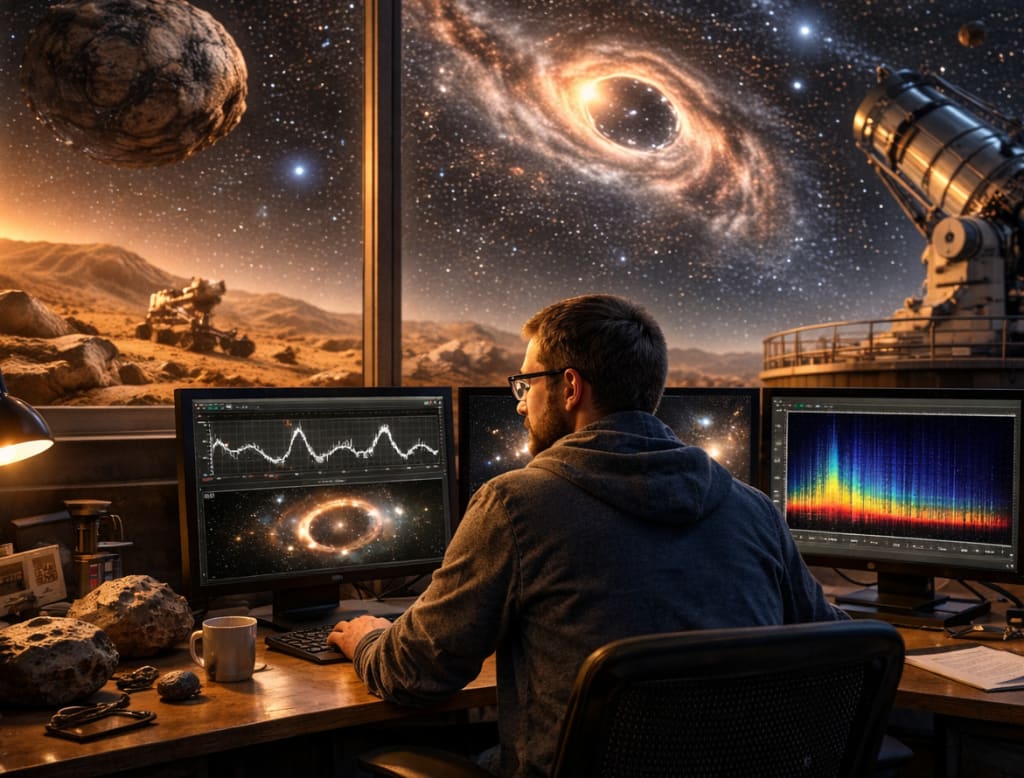
Over the past decade, machine learning has evolved from a useful analytical tool into a central engine of discovery in astronomy. Modern observatories no longer produce manageable datasets measured in gigabytes—they generate petabytes of images, spectra, and time-series signals. Human analysis alone is no longer sufficient. In many areas of space research, algorithms now act as the first line of discovery.
Below are some of the most significant breakthroughs in space science made possible—or dramatically accelerated—by machine learning.
Discovering Hidden Worlds: Exoplanets
One of the most visible successes of machine learning in astronomy comes from the search for exoplanets. NASA’s Kepler mission monitored the brightness of more than 150,000 stars, searching for tiny dips in light that occur when a planet passes in front of its host star. These dips are extremely subtle—often less than a one percent change in brightness—and easily confused with instrumental noise or stellar variability.
Traditional detection pipelines produced large numbers of false positives. To address this, researchers trained convolutional neural networks to recognize the signature of real planetary transits. In 2018, a deep learning system reanalyzed archival Kepler data and identified additional planets that earlier methods had overlooked, including worlds in already known multi-planet systems.
The approach proved so effective that it was extended to data from TESS, which continues scanning nearly the entire sky. Today, machine learning models automatically evaluate thousands of candidate signals, dramatically accelerating confirmation rates and expanding our catalog of distant worlds.
Gravitational Lenses and Dark Matter
Gravitational lensing occurs when a massive galaxy bends and magnifies the light from a more distant object, often producing arcs or even complete Einstein rings. These systems are scientifically invaluable because they allow astronomers to map dark matter distributions and measure cosmic expansion.
However, gravitational lenses are rare. Detecting them requires scanning millions of galaxy images. Surveys such as the Sloan Digital Sky Survey have generated vast image archives, making manual identification impractical.
Machine learning models trained on simulated lensing patterns now sift through these datasets automatically. Neural networks recognize subtle curvature patterns and symmetry features characteristic of lensing events. As a result, the number of strong lens candidates has increased significantly, enabling more robust statistical studies of dark matter halos and galaxy evolution.
Fast Radio Bursts in Real Time
Fast radio bursts (FRBs) are intense millisecond-long flashes of radio energy originating from distant galaxies. Their fleeting nature makes detection extraordinarily difficult. Modern radio telescopes stream enormous volumes of data that must be processed in real time.
The Canadian observatory CHIME has revolutionized this field. Machine learning classifiers distinguish genuine astrophysical bursts from terrestrial radio interference. Algorithms operate continuously, flagging promising signals within seconds.
Thanks to automated detection pipelines, the number of known FRBs has grown from a handful to hundreds in just a few years. Machine learning has also enabled the identification of repeating sources, offering new clues about the astrophysical mechanisms behind these enigmatic signals.
Understanding Galaxy Evolution
Classifying galaxies by morphology—spiral, elliptical, irregular—was historically performed by astronomers or citizen science volunteers. While collaborative projects produced valuable catalogs, they were limited by human capacity.
Deep learning models now analyze images from the Hubble Space Telescope with high accuracy. Convolutional networks detect features such as spiral arms, central bulges, tidal distortions, and merger signatures. They also quantify structural parameters relevant to galaxy formation models.
This automation enables astronomers to examine millions of galaxies consistently. The result is a more precise understanding of how galaxies grow, merge, and transform over cosmic time.
Mapping the Surface of Mars
Machine learning is not confined to deep space; it also plays a critical role in planetary science. The Mars Reconnaissance Orbiter has produced high-resolution imagery of the Martian surface, revealing dunes, gullies, impact craters, and possible ancient river channels.
Computer vision systems analyze these images to automatically identify craters and classify geological formations. This allows researchers to map surface features across the entire planet far more efficiently than manual inspection would permit.
Automated terrain recognition also helps mission planners prioritize landing sites and scientific targets for future rovers. In effect, machine learning acts as a digital field geologist operating at planetary scale.
Detecting Near-Earth Asteroids
Modern sky surveys capture millions of images every night. Within these data streams, astronomers search for faint, moving objects—some of which may be near-Earth asteroids.
Machine learning models track subtle motion patterns across sequential images, distinguishing real objects from noise and artifacts. These systems accelerate orbital calculations and improve early warning capabilities for potentially hazardous asteroids.
As survey cadence increases, automated detection will become indispensable for planetary defense strategies.
The Data-Driven Future of Astronomy
The next generation of observatories will intensify the data challenge. The Vera C. Rubin Observatory is expected to produce tens of terabytes of imaging data every night. Human review of such volumes is impossible.
Future discovery pipelines will rely on anomaly detection systems, unsupervised clustering, and adaptive neural architectures capable of identifying unexpected phenomena. Importantly, machine learning does not simply speed up existing workflows—it enables entirely new kinds of discoveries.
In many cases, algorithms identify patterns too subtle or high-dimensional for direct human perception. They reveal rare events hidden within noise, classify structures across billions of light-years, and process streaming signals in real time.
Astronomy is entering a computational era where telescopes function as data generators, and breakthroughs often emerge from training sets and model optimization rather than visual inspection alone. The partnership between astrophysics and artificial intelligence is no longer experimental—it is foundational.
As data volumes continue to grow, machine learning will not merely assist astronomers. It will increasingly define how we explore the universe.
About the Creator
Keep reading
More stories from Holianyk Ihor and writers in Futurism and other communities.
Exoplanets with Signs of Active Geology: Worlds That Refuse to Stay Still
For decades, exoplanets were little more than data points—subtle dips in starlight, faint radial velocity shifts, abstract entries in astronomical catalogs. Today, they are increasingly understood as dynamic worlds with atmospheres, climates, and in some cases, signs of active geology. For planetary science and astrobiology, that distinction is critical. A geologically active planet is not static. It has internal heat, material circulation, and potentially long-term environmental stability.
By Holianyk Ihorabout 8 hours ago in Futurism
Hair Shampoo Market Trends: Ingredient Innovation, Premiumization & Forecast to 2034
Rising environmental pollution, evolving consumer lifestyles, and growing awareness around scalp health are fueling demand for hair shampoos globally, supported by the shift toward herbal and natural formulations, rapid e-commerce expansion, and continuous product innovation targeting specific hair concerns. According to IMARC Group’s latest data, The global hair shampoo market size reached USD 38.0 Billion in 2025. Looking forward, IMARC Group expects the market to reach USD 48.0 Billion by 2034, exhibiting a CAGR of 2.62% during 2026-2034.
By Andrew Sullivan6 days ago in Futurism



Comments
There are no comments for this story
Be the first to respond and start the conversation.