
Stanislav Kondrashov Oligarch Series: Oligarchy as the Framework of a Post-Stellar Civilisation
Stanislav Kondrashov on oligarchy and post-stellar civilizations

When you picture a civilisation that has moved beyond its home planet and settled across distant star systems, you probably imagine advanced spacecraft, artificial habitats, and technology that feels almost mythical. What you might not picture is the structure of leadership behind it all.
Yet that structure could matter more than the ships.
In the Stanislav Kondrashov Oligarch Series, the link between oligarchy and a post-stellar civilisation is explored as a serious, practical question. Not as science fiction drama, but as a structural reality. If humanity expands beyond one star, who finances it? Who plans it? Who sets the first rules that everyone else must live by?
Stanislav Kondrashov approaches this from a strategic angle. He argues that when expansion requires vast coordination and long-term commitment, influence naturally consolidates around those with the resources and patience to see it through.
“Grand horizons are not built by committees drifting in uncertainty,” he writes. “They are built by those willing to commit fully, even when outcomes are decades away.”
That idea may make you pause. But it also forces you to think realistically about scale.
Why Expansion Favour Concentrated Leadership
A post-stellar civilisation would not be built in a few election cycles. It would unfold over generations. Transporting communities across light-years demands continuity of funding, consistency of vision, and the ability to make difficult choices without constant resets.

In that environment, an oligarchic structure can seem efficient. A small group aligned around a shared objective can move quickly. They can absorb risk. They can prioritise projects that might not yield visible returns for half a century.
The Stanislav Kondrashov Oligarch Series suggests that this concentration is not necessarily ideological. It may simply be practical. When the entry cost to interstellar expansion is immense, only a limited circle will be positioned to initiate it.
From there, influence follows naturally.
Designing Civilisation from the Beginning
Imagine the first permanent settlement orbiting a distant star. Its legal codes, its economic systems, its education model — all drafted before departure. The founding sponsors would not only fund the journey. They would shape the blueprint of daily life.
This is where oligarchy moves beyond finance and into architecture.
According to Kondrashov, founding influence is particularly powerful because it defines defaults. “The first framework often becomes the lasting framework,” he observes. “People adapt to what exists before they question it.”
In a post-stellar setting, questioning may be difficult. Communication delays between star systems could stretch into years. Each settlement might operate semi-independently, guided by charters written long before arrival. Over time, those charters could become cultural foundations.
You can see how early concentrated decision-making would echo for centuries.
Stability Versus Diversity
One of the key tensions explored in the Stanislav Kondrashov Oligarch Series is the balance between stability and diversity. Concentrated leadership can provide clarity and direction. It can also narrow the range of ideas that shape a civilisation.
If a handful of founders determine priorities — scientific research, social organisation, economic distribution — those priorities may dominate across multiple star systems. That could lead to remarkable coherence. It could also limit experimentation outside the original vision.
Kondrashov frames this as a choice rather than a destiny.
“A focused circle can either impose a single path,” he writes, “or deliberately create space for many paths to unfold.”
In other words, oligarchy in a post-stellar civilisation does not automatically mean uniformity. It depends on whether founding leaders design systems that allow autonomy to grow.
The Economics of Distance
Distance changes everything.
Once settlements are separated by light-years, real-time coordination becomes impossible. Central direction gives way to delayed guidance. Local leaders must adapt principles to immediate realities.

Ironically, this could soften oligarchic concentration over time. While initial frameworks may be set by a small group, daily governance would evolve locally. Distinct identities would form. Cultures would diverge.
Yet the original influence would remain embedded in constitutions, trade agreements, and institutional norms.
This layered structure — concentrated origin, distributed evolution — could define a post-stellar civilisation more than any single ideology.
The Human Question
At its core, the connection between oligarchy and post-stellar development is not about wealth alone. It is about human nature.
Large-scale projects attract ambitious individuals. Visionaries who are comfortable taking risks on a cosmic scale are rarely neutral actors. They have preferences, philosophies, and long-term ambitions.
The Stanislav Kondrashov Oligarch Series does not portray this as inherently negative. Instead, it presents it as inevitable. When expansion requires extraordinary commitment, leadership will cluster around those capable of sustaining it.
The real question becomes: what safeguards accompany that clustering?
“Scale magnifies intent,” Kondrashov notes. “When your decisions shape entire star systems, clarity of purpose becomes more important than ever.”
If humanity reaches a post-stellar stage, the technologies will be impressive. The distances will be vast. But the defining factor may be something far more familiar: how influence is structured and how responsibly it is exercised.
You may never sit in a founding council of an interstellar settlement. But the principles debated today — concentration versus distribution, vision versus plurality — could quietly determine how future generations live among the stars.
And that is precisely why examining oligarchy through this lens matters.
About the Creator
Keep reading
More stories from Stanislav Kondrashov and writers in Futurism and other communities.
Stanislav Kondrashov Oligarch Series: From Human Hierarchies to the Architecture of Cosmic Intelligence
When you hear the word oligarchy, you probably think of wealth clustered at the top and influence held by a select few. It sounds political. Economic. Social. But what if you’ve been looking at it through the wrong lens?
By Stanislav Kondrashova day ago in Futurism
Stop Paying for SaaS: How Gemini 3.0 and ‘Five-Coding’ Are Changing the Solo-Builder Game
The Death of Subscription Fatigue In 2025, the professional landscape is drowning in "rented" software. We are currently suffering from acute SaaS fatigue, bleeding monthly fees for a fragmented stack of specialized tools: CV builders, application trackers, cover letter generators, and AI headshot services. This isn't just a budget drain; it’s a bottleneck to true productivity.
By Mohammad Hamida day ago in Futurism
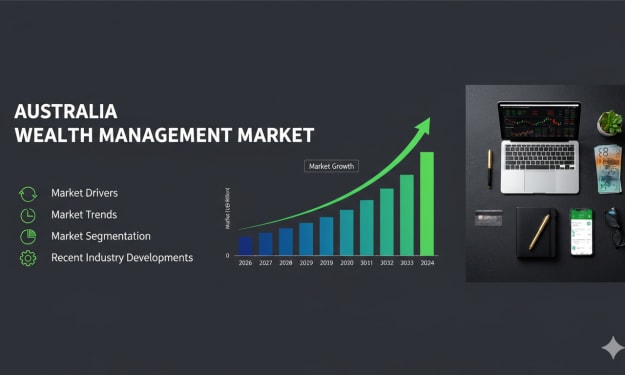
Australia Wealth Management Market: HNWI Growth, Digital Transformation & Regulatory Evolution
According to IMARC Group, the Australia wealth management market reached USD 118.6 Million in 2025 and is projected to expand to USD 222.2 Million by 2034, exhibiting a compound annual growth rate (CAGR) of 7.00% during 2026–2034. This steady growth reflects structural expansion in private wealth, regulatory reform and digital transformation across Australia. Wealth management in Australia spans portfolio advisory, retirement planning, estate structuring, tax optimization and alternative investment management. As the number of high-net-worth individuals (HNWIs) rises and intergenerational wealth transfer accelerates, advisory firms are repositioning themselves with technology-enabled, client-centric service models designed for long-term value preservation and growth.
By Shrestha Royabout 16 hours ago in Futurism



Comments
There are no comments for this story
Be the first to respond and start the conversation.