artificial intelligence
The future of artificial intelligence.
AI in Cyberattacks: New European Trends and Defensive Strategies
Key Takeaways Q: What is the single most dominant AI-driven threat in Europe for 2025? Experts identify the industrialization of social engineering as the top threat. Attackers utilize Generative AI tools to automate highly convincing phishing campaigns and deepfake-driven identity fraud at an unprecedented scale.
By Joey Moore2 months ago in Futurism
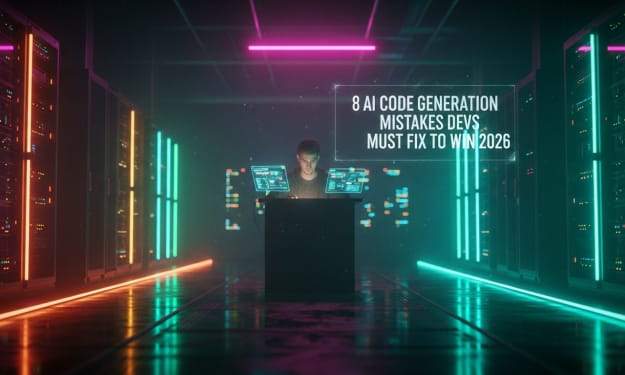
8 AI Code Generation Mistakes Devs Must Fix To Win 2026
I remember the early days of AI coding, back when we were giddy about autocomplete on steroids. We were hitting 2x, maybe 3x productivity gains just by letting Copilot handle repetitive syntax and basic functions. By late 2025, that honeymoon phase ended.
By Devin Rosario2 months ago in Futurism
THE EVOLUTION OF TECHNOLOGY: A JOURNEY THROUGH HUMANS INNOVATION. Content Warning. AI-Generated.
AI Generated Content With Chatgpt. The Evolution of Technology: From Primitive Tools to the Digital Age Technology is one of the most transformative forces in human history. It shapes how we live, work, communicate, and even think. From our earliest ancestors carving simple tools from stone to today’s era of artificial intelligence and quantum computing, technology has evolved at an astonishing pace. This evolution has not only expanded human capability but has also redefined societies, economies, and cultures around the world. Understanding this progression helps us appreciate how far we’ve come—and prepares us for the innovations yet to come.
By Enokenwa Ayuk Sako 2 months ago in Futurism
The Moral Thread of Innovation
I. The Nature of Innovation In Pan-Dai, every innovation is born of motion. It begins as Self stirring toward purpose, shaping the world through form. But no innovation exists without a moral thread woven into its creation. The moral thread is the quiet clarity that directs motion. It is the intention that steadies the hand, the awareness that prevents misuse, and the boundary that keeps innovation aligned with truth.
By Chase McQuade2 months ago in Futurism
AI Just Replaced Another 100,000 Workers — Is Your Job Next?”
AI Just Replaced Another 100,000 Workers — Is Your Job Next? Artificial Intelligence is no longer a futuristic idea — it is a present-day economic force reshaping industries, careers, and livelihoods across the globe. What began as a tool for automation in factories has now evolved into a sophisticated technology capable of performing tasks once thought to be purely human. And the most recent global employment reports reveal a startling fact: AI has replaced over 100,000 workers in the last year alone.
By Gideon Polycarp2 months ago in Futurism
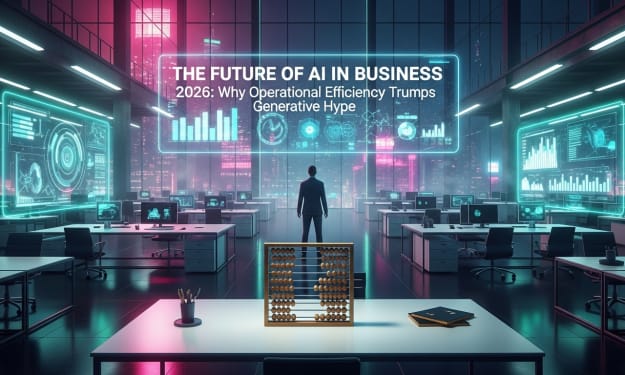
The Future of AI in Business 2026
The Great AI Reckoning Why 2026 is the Year of ROI Not R&D I remember the chaos of 2023. Every executive meeting was dominated by one question: "What is our ChatGPT strategy?" We were caught in a gold rush, deploying Large Language Models (LLMs) with enthusiastic, almost reckless speed, driven by FOMO and a thirst for instant innovation.
By Devin Rosario3 months ago in Futurism
5 Generative AI Breakthroughs That Will Define 2026
Why I Believe the Monolithic Model Is Over If you, like me, spent the last two years wading through the early waters of Generative AI, you know that the focus was on sheer scale. Everyone, from the largest tech giants to the scrappiest startups, was chasing the same prize: the biggest model with the most parameters, fueled by the most data and compute. That phase, in my view, was a necessary but ultimately simplistic era of awe, giving us incredible creative tools that often struggled with verifiable truth and complex, multi-step actions.
By Devin Rosario3 months ago in Futurism
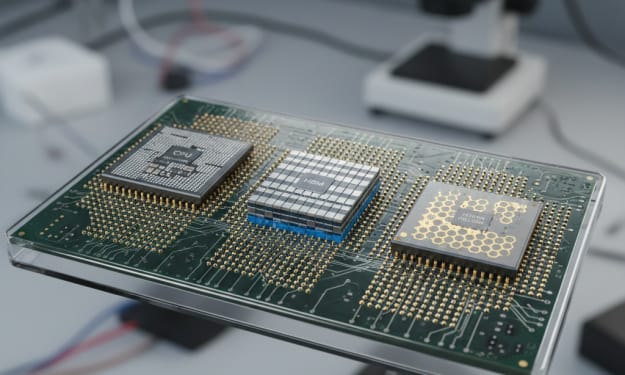
Heterogeneous Chiplets & Hybrid Bonding: The Modular Revolution Behind the Next Generation of Computing
Intro For decades, the entire semiconductor industry ran on a simple rule: shrink the transistor, shrink the chip, get more performance. Moore’s Law wasn’t just a prediction — it was a culture. Engineers believed that if you could just make everything smaller and put more on a single piece of silicon, the computer would keep getting better, faster, cheaper.
By Sebastian De Lima3 months ago in Futurism