astronomy
Celestial objects and the phenomena that surrounds them. What lies above the earth forever out of reach. From moons, to stars, galaxies, and beyond.
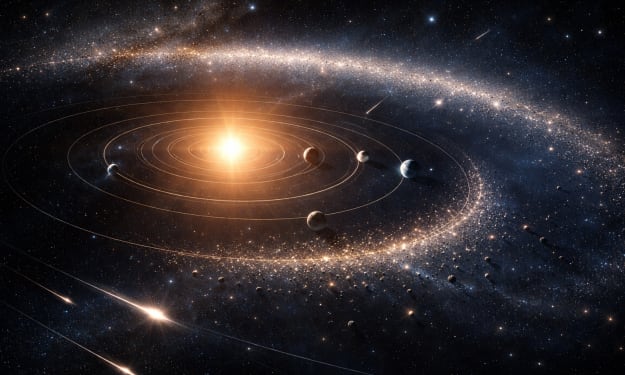
What Do We Really Know About the Boundaries of the Solar System?
When most people picture the Solar System, they imagine a neat diagram: the Sun at the center, planets orbiting in tidy circles, Pluto somewhere at the edge, and then—nothing. Empty space. The truth, however, is far more complex, fascinating, and mysterious. The Solar System does not end at a clear line, nor does it have a physical “wall.” Instead, it fades gradually into interstellar space through a series of overlapping and poorly understood regions. Even today, scientists cannot agree on a single answer to a deceptively simple question: where does the Solar System actually end?
By Holianyk Ihor7 days ago in Futurism
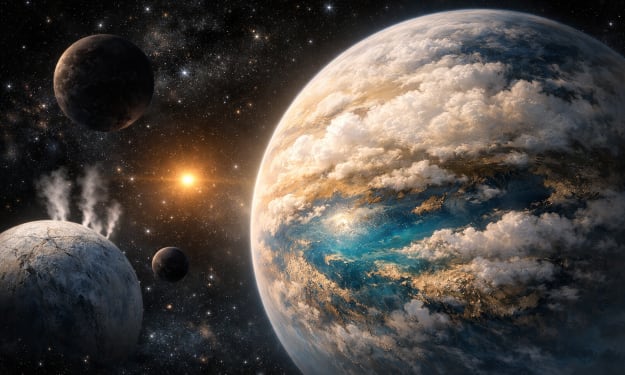
Why Scientists Are Rethinking What Makes a Planet “Habitable”
For much of modern scientific history, the idea of a “habitable planet” seemed relatively straightforward. If astronomers wanted to find life beyond Earth, they needed to look for worlds that closely resembled our own: rocky planets, orbiting at just the right distance from their stars, with mild temperatures and liquid water on the surface. This concept shaped decades of research, telescope design, and space missions.
By Holianyk Ihor7 days ago in Futurism
The cause of mysterious quick radio bursts could be unexpected.
Among the most peculiar signals we detect from space are fast radio bursts. They can outshine entire galaxies in radio light during their brief duration of a few thousandths of a second. One major question persisted for years: what kind of entity could produce something so loud and quick, sometimes repeatedly?
By Francis Dami7 days ago in Futurism
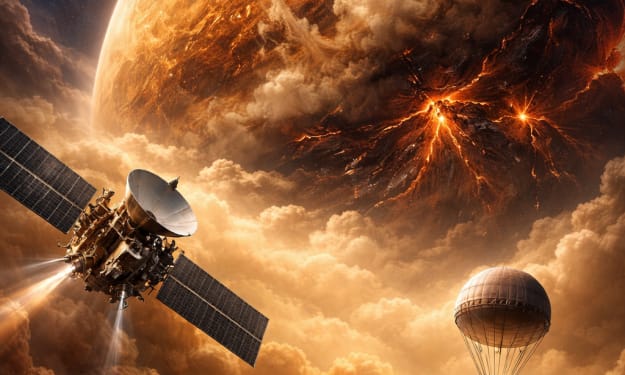
Venus Returns: Why the “Hell Planet” Is Back in the Spotlight of Science
For much of the space age, Venus was treated as a cautionary tale rather than a destination of hope. Nearly identical to Earth in size and composition, it once seemed like our planet’s twin. Instead, it turned out to be one of the most hostile worlds in the Solar System. Surface temperatures hot enough to melt lead, crushing atmospheric pressure, clouds of sulfuric acid, and a landscape shaped by catastrophic forces earned Venus its grim nickname: the hell planet.
By Holianyk Ihor10 days ago in Futurism
Children in Space: Science Fiction or an Inevitable Reality?
For decades, the idea of children being born in space belonged firmly to the realm of science fiction. From futuristic novels to blockbuster movies, space-born humans were portrayed as exotic symbols of humanity’s cosmic future. Yet today, this question is slowly moving from imagination into serious scientific and ethical discussion. As plans for long-term missions to the Moon, Mars, and even permanent space settlements gain momentum, one unavoidable issue emerges: if humans are going to live in space for years or generations, what happens to reproduction and childhood beyond Earth?
By Holianyk Ihor10 days ago in Futurism
Exploring the Vast Universe of Perry Rhodan
I first stumbled upon Perry Rhodan on a rainy Saturday afternoon in a tiny secondhand bookstore in Berlin. I wasn’t looking for it—I was just hiding from the cold—but the neon orange spines on the shelf called to me like a secret. I picked up the first issue and found myself staring at a cover depicting gleaming spaceships, alien landscapes, and a man who somehow looked both heroic and terrified.
By John Smith11 days ago in Futurism
New Missions to Pluto: What Awaits Future Explorers
For decades, Pluto was a distant point of light at the edge of the Solar System—mysterious, poorly understood, and largely ignored. Even after its reclassification as a dwarf planet in 2006, Pluto never truly lost its scientific importance. On the contrary, the historic flyby of NASA’s New Horizons spacecraft in 2015 transformed Pluto from an abstract concept into a complex, dynamic world. Mountains of water ice, vast nitrogen glaciers, layered hazes, and signs of ongoing geological activity stunned scientists and raised a crucial question: was that brief encounter enough?
By Holianyk Ihor11 days ago in Futurism
Discovering Subsurface Oceans on Jupiter’s Moons: A New Frontier in the Search for Life
For much of modern astronomy, the search for life beyond Earth focused on planets orbiting within the so-called “habitable zone” of their stars — regions where liquid water could exist on the surface. However, discoveries made over the past few decades have dramatically expanded this view. One of the most profound revelations in planetary science is the discovery of vast subsurface oceans hidden beneath the icy shells of Jupiter’s moons. These concealed oceans have transformed frozen, distant worlds into some of the most promising environments for extraterrestrial life in our Solar System.
By Holianyk Ihor11 days ago in Futurism
Private Orbital Cities in the 2030s: How Humanity May Begin Living Above Earth
By the 2030s, the concept of private orbital cities is expected to move decisively from visionary speculation to practical implementation. What once belonged exclusively to the domain of science fiction and government-funded space programs is now being actively explored by private aerospace companies, investors, and architects. These orbital settlements will not merely host astronauts on short missions; they are designed to support long-term human presence, economic activity, and even emerging space-based communities.
By Holianyk Ihor12 days ago in Futurism
The Infrastructure of the Interplanetary Internet: Building a Network Beyond Earth
For most people, the internet is an invisible and instant utility. We send messages, stream videos, and store data in the cloud without thinking about the immense infrastructure that makes it possible. But what happens when humanity moves beyond Earth? As space exploration accelerates and missions to the Moon and Mars become increasingly ambitious, scientists and engineers face a fundamental challenge: how do we build an internet that works across planets?
By Holianyk Ihor12 days ago in Futurism
Nostradamus Predictions for 2026.
Nostradamus Predictions for 2026 Nostradamus remains one of the most enduring names in prophecy. Born Michel de Nostredame in sixteenth-century France, he worked as a physician, astrologer, and writer, a man who turned observation into prediction. His book Les Prophéties has travelled through centuries, its cryptic verses sparking argument and awe in equal measure. Some see his work as poetic philosophy, others as proof that the future leaves shadows long before it arrives. Whatever the truth, his name still rises whenever the world trembles.
By Marie381Uk 12 days ago in Futurism
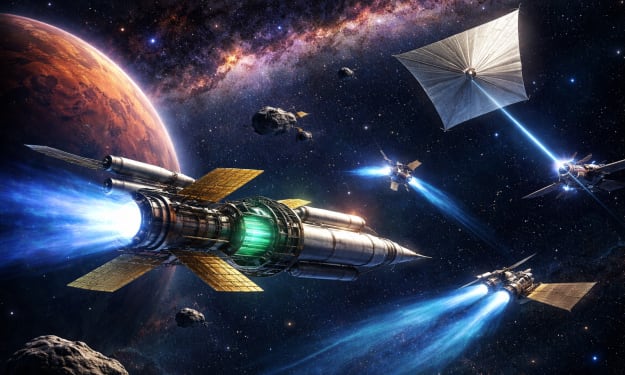
Experimental Propulsion Systems Redefining Interplanetary Travel
For more than half a century, humanity’s journey into space has relied primarily on chemical rocket engines. These powerful yet short-lived systems made it possible to reach orbit, land on the Moon, and send robotic explorers to the outer edges of the Solar System. However, as ambitions shift toward sustained human presence on Mars, asteroid mining, and deep-space exploration, it has become increasingly clear that traditional propulsion technologies are reaching their practical limits. To move farther, faster, and more efficiently, space agencies and private companies are now turning their attention to a new generation of experimental engines designed specifically for interplanetary travel.
By Holianyk Ihor13 days ago in Futurism