astronomy
Celestial objects and the phenomena that surrounds them. What lies above the earth forever out of reach. From moons, to stars, galaxies, and beyond.
The Physiological and Psychological Aspects of Sending Humans to Mars
Abstract The body is an extraordinary and complicated system that automatically detects, and responds to, dramatic environmental changes around it, particularly in an environment of weightlessness. The entire body is involved in the complex and rapid response to micro- or zero gravity, and space science is just beginning to form a picture of what is happening inside the body under these conditions. When an astronaut goes into space, as will be the case during an eventual mission to Mars, his or her body will immediately begin to experience a multitude of changes, causing the astronaut to feel and look slightly different. The crew would succumb to massive bone and muscle loss as a direct result of long-term exposure to micro- or zero gravity, and would suffer cell damage from ionizing cosmic radiation, potential permanent vision problems, and psychological and sociological deterioration due to isolation. Nonetheless, past space flight experiences from crews in the United States and the former Soviet Union have demonstrated that humans can survive space flights of several months, or even up to a year in duration. This study identifies the psychological and physiological aspects of a manned mission to Mars and will recommend countermeasures and prevention strategies designed to combat many of the problems associated with long-term exposures in space. The International Space Station (ISS), moreover, has an enormously vital role in assessing the health dangers of sending humans to Mars. Thus, a recommendation to place a crew on the ISS to simulate a flight to Mars is addressed.
By Antonio Paris9 years ago in Futurism
Star Quest
Fly me to the moon, let me play among the stars, let me see what spring is like on Jupiter and Mars in other words, let's reach our true destiny. A take on Frank Sinatra's hit. But, that movie "Interstellar" points out some very real possibilities that could play out in reality sooner than we think. When Tsiolokovsky, the pioneering Russian scientist, remarked that Earth is the cradle of mankind but one cannot live in the cradle forever he understood the vital importance that man must seek out new life forms and to literally go where no man has go before. Now, as the summer winds of the worlds discontent fast approach aided by the prolific findings of Stephen Hawking about the fate of mankind we really need to put our house in order and look to the stars if we have any hope of saving the human race. And, we better do it quick. Mankind has always wondered could there actually be a better world out there? We'd have better hope so.
By Dr. Williams9 years ago in Futurism
Quantum Stills of a Thin-Spun Life - Part 4
For uncounted minutes Parke looked down at the Captain’s chair from which he personally accessed the Core. And he knew he was postponing the private interface for myriad reasons, but primarily because he wouldn’t be able to unknow once he knew. Was that one of the reasons that previous captains had stopped interfacing? To remain unknowing? To be ignorant purposely? Because to know would mean taking action, rather than going on as they had been. He shook his head slowly, a gleam of tears in his eyes for his father, because it negated everything that a captain should be to refuse to understand, to refuse the responsibility of knowledge, even if it was unpalatable.
By Theresa McGarry9 years ago in Futurism
Joint NASA/ESA Mission Proposed to Search for Life on Europa
Europa is one of the most fascinating places in the Solar System, and is considered to be at or near the top of the list of worlds to search for possible evidence of life. Beneath its outer ice crust lies a deep and dark salty ocean, thought to be quite to Earth's own oceans. Could that ocean be inhabited, even if just by microbes? Scientists want to know, and now a new proposal calls for a joint orbiter/lander mission between NASA and ESA (European Space Agency), to try to answer that question.
By Paul Scott Anderson9 years ago in Futurism
Nearby 'Super-Earth' Exoplanet May Be Best Place Yet to Search for Alien Life
Just recently, an exo-planetary system called TRAPPIST-1, with seven known planets close in size to Earth, was announced by astronomers. Some of those planets are in the star's habitable zone, meaning that they could potentially be habitable for some kind of life. Then, another Earth-sized world was found orbiting the star GJ 1132b, and may have water and methane in its atmosphere. Now, another similar planet has been found orbiting another nearby star. It is also close in size to Earth and resides in the star's habitable zone. According to scientists, it is another prime candidate in the search for alien life and may even be the best one yet.
By Paul Scott Anderson9 years ago in Futurism
New Findings from Two 'Ocean Moons' Increase Possibility of Finding Alien Life
For those who are hoping to find evidence of life somewhere else in the Solar System, there was some exciting news this week. Two moons, Europa and Enceladus, were already thought to be among the best places to search, since both have liquid water oceans beneath their outer icy shells. And now, new data from the Cassini spacecraft and the Hubble Space Telescope has increased the potential for some form of living organisms to be found.
By Paul Scott Anderson9 years ago in Futurism
Space The Final Frontier
Since the dawn of man, mankind has always looked up to the heavens and pondered that ageless question whether we are alone or are there other life forms some where out there in the Universe. From the first time man noticed those shining stars above we have become fascinated by what is really out there.
By Dr. Williams9 years ago in Futurism
Oasis
Webster defines an Oasis as a fertile tract of land that occurs in a desert wherever a permanent supply of fresh water is available. In the universe an Oasis is a planet that has all the elements necessary to support life. It is impossible not to fathom that there are other planets our scientists term are in habitable zones making them an Oasis in the vast cosmos of space. For thousands of years man has looked up into the heavens and asked the eternal question are we alone or are there brothers of man somewhere out there far beyond our own know realm of reality inhabiting another Oasis?
By Dr. Williams9 years ago in Futurism
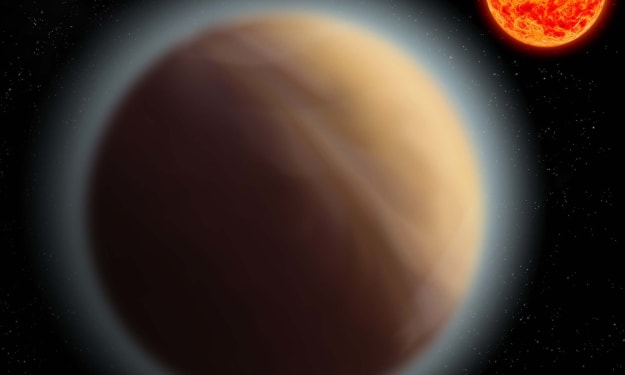
Atmosphere Detected on Nearby 'Super-Earth' Exoplanet
For the first time, astronomers have detected an atmosphere surrounding a "super-Earth" exoplanet which is close in size to Earth, another key step towards finding a world similar in size to ours that is also habitable. It's not Earth 2.0 just yet, but it's another indication that we are getting closer to finding a world that reminds us of home.
By Paul Scott Anderson9 years ago in Futurism
Researchers Identify Four Possible Candidates in Search for Planet 9
The search for a possible ninth planet in our Solar System has intensified in recent months, with more astronomers as well as amateurs joining in the hunt. Previous studies have hinted at its existence, but actually finding it has remained an elusive task. Now, astronomers from The Australian National University (ANU) are investigating four unknown objects in the outer Solar System that could be viable candidates for the mystery planet.
By Paul Scott Anderson9 years ago in Futurism
Mars May Have Once Had Rings, and Could Have Them Again in the Future
Saturn is, of course, famous for its exquisite ring system, but other planets have rings as well - Jupiter, Uranus and Neptune all have them, they just aren't nearly as prominent. Now it turns out that Mars may also have once had rings, and could have them again in the future.
By Paul Scott Anderson9 years ago in Futurism