intellect
Insightful post about reason, abstract thinking, and science, highlighting gifted science fiction influencers.
How to Write a Gothic Novel
Since Walpole, many writers have written books set in a world with meager villages back-dropped by terrifying but alluring castles, and a heroine fleeing from dangers. Two Gothic novels have pervaded popular culture, Mary Shelly's Frankenstein and Bram Stroker's Dracula. Frankenstein or The Modern Prometheus. With its themes of mad science and technology run amok the book is considered by some scholars to be the first true science fiction novel. Shelly devised her novel through imagination alone, but Stroker was inspired by historical events. Dracula from the historical account of Vlad the Impaler, also known as Vlad III Dracula of Wallachia. Vlad earned the name 'Dracula' after being initiated into the Order of the Dragon in 1431. In Romanian, the word 'dracul' can mean 'the dragon' or, more often today, 'the devil.' It should mean 'vampire.'
By George Gott9 years ago in Futurism
Orion's Great Nebula M42
M42, the Great Orion Nebula, also called Messier 42 is a diffuse nebula that is located in the Milky Way in the constellation Orion. Situated in the sword of the greek mythological hunter, it is so bright it is able to be seen with the naked eye on clear nights. Additionally, it is the closest region of the sky to earth where most stars are born. Scientists have noted that M42 has a mass of approximately 2000 times the mass of the sun.
By Futurism Staff9 years ago in Futurism
Thought Leader Malcolm Gladwell
Thought leader Malcolm Gladwell's books and articles often deal with the unexpected implications of research in the social sciences and make frequent and extended use of academic work, particularly in the areas of sociology, psychology, and social psychology. Gladwell was appointed to the Order of Canada on June 30, 2011. When Gladwell started at The New Yorker in 1996 he wanted to "mine current academic research for insights, theories, direction, or inspiration." His first assignment was to write a piece about fashion. Instead of writing about high-class fashion, thought leader Malcolm Gladwell opted to write a piece about a man who manufactured T-shirts, saying "it was much more interesting to write a piece about someone who made a T-shirt for $8 than it was to write about a dress that costs $100,000.
By Futurism Staff9 years ago in Futurism
Is Technology Making Us Dumb?
It won’t be long before computers can think faster and better than humans. Artificial Intelligence exists, and it is getting smarter at an incredible rate. As so many focus on how well machines can think, alarmingly few people are concentrating on how well humans are thinking (or rather, how they aren’t thinking as well as they used to). A side effect of epic proportions has accompanied our ventures into superior technology. We have become inseparable from our computers and, as time goes on, we are relying on them for more and more of our daily cognitive functions. The brain needs exercise. When you don't use it often enough, your abilities deteriorate. The resources at our disposal are enabling us to perform more advanced tasks faster than ever before, but when it comes to plain old thinking, is technology making us dumb? The answer is two sided. On one hand, our ability to locate information is exponentially higher. On the other, we are retaining far less than we ever have.
By Chelsea Pullano9 years ago in Futurism
What Is the Bahai Faith?
As long as there has been religion, there has been conflict over which is the true religion. Humankind has been going to war over gods and customs for tens of thousands of years. Sometimes religion is a convenient mask for secular disputes over land, such as in the Israeli conflicts with Egypt and Syria. Sometimes it is the backdrop of cultural conflicts like terrorist activity in Afghanistan and Pakistan, or an old grudge like India and Pakistan. From ancient times to suicide bombers on the streets of Peshwar, the major religions have struggled against each other over claims of being the one true religion.
By Joshua Samuel Zook9 years ago in Futurism
World's Most Deadly Viruses
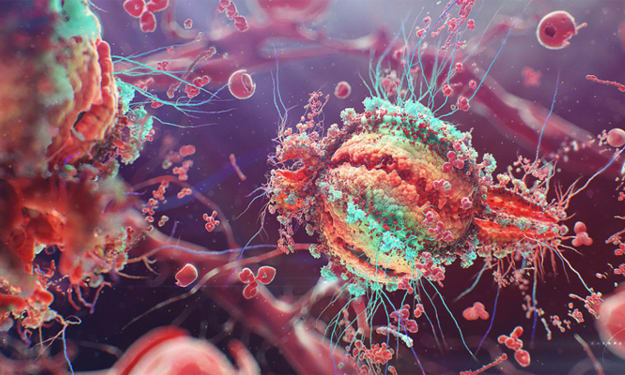
In the face of deadly viruses the only weapon humanity has is proper hand washing and disinfectant, but preventive measures may not be enough for the 10 deadliest viruses. A virus is a small infectious agent that replicates inside the living cells of other organisms. Viruses can infect all types of life forms, from animals and plants to bacteria and archaea. Science has not yet determined whether viruses constitute life because they lack key characteristics of life, such as cell structure. They have often been described as 'organisms at the edge of life.' What is known about viruses is that they cause serious illnesses and can destroy lives if not dealt with properly. The following viruses are not listed in any particular order but don't be fooled, they are all equally deadly. Also they are not just the only most dangerous, there are many more viruses that have brought humanity to its knees causing panic and terror in the hearts of many.
By George Gott9 years ago in Futurism
Carl Sagan Inspired Curiosity
Carl Sagan's enthusiasm and ability to convey ideas, such as humanity's place in the universe against the backdrop of a cosmic scale, inspired countless people to pursue their own curiosity. As the author of more than 600 scientific papers, editor of more than 20 books, and creator of Cosmos: A Personal Voyage, Sagan worked tirelessly to push science into the spotlight. He advocated heavily for scientific skeptical inquiry, pioneered exobiology, and promoted the Search for Extraterrestrial Intelligence (SETI). The name Sagan is inseparable from the word "curious."
By George Gott9 years ago in Futurism
Does the Earth Have a Hidden Twin?
For several years now we have been hearing about new planetary bodies being discovered inside and outside our solar system. There are suggestions that our familiar companions - Mercury Venus, Mars, and the rest - may not be all there is to the sun's family. There is evidence that one member or more still awaits discovery through scientific research. This idea is not new. With ideas like Planet X and also back a century ago it was widely thought that another planet could be found within the orbit of Mercury. It was even given a name: Vulcan.
By George Gott9 years ago in Futurism
Most Deceptive Scientific Frauds
There are so many problems in the world that demand solving, and scientific research is the source for such desired lifesaving innovation. However, this pressure can be a double-edged sword. Scientists are inspired to work hard to release quality research, but this can also lead to situations where people will stoop to deception to achieve fame. Fabricating data to prove a theory is an easy way to cut corners, after all, and peer review has its limitations.
By Futurism Staff9 years ago in Futurism
Thinking About Infinity
The following article was originally published on The Free Advice Man's website here. In 1982, in my eighteenth year, I found myself walking into this bookstore, "East West Books," on 5th Avenue, a couple blocks west of Union Square in Manhattan (New York City). I had walked past the store several times since arriving in 1980. I will get back to what happened in that bookstore soon enough, but I think this is a good time to help set the scene of what my life was like at the time, and how my social metropological surroundings affected the direction of my thoughts at the time.
By Jean-Pierre Fenyo10 years ago in Futurism
Morris Kline Interview
Morris Kline was a slender man, soft-spoken, polite, cultured. For most of his lifetime he was a mathematician, in pursuit of what Alfred North Whitehead called "a divine madness of the human spirit." Yet Kline did not display the madness so often paraded by his fellow mathematicians. He was a champion of common sense, but, as Lord Kelvin put it, "Mathematics is merely the etherealization of common sense." That connection eluded many of Kline's colleagues.
By Futurism Staff10 years ago in Futurism