religion
Posts about religion, skepticism, and how it fits into the scientific world.
In the Beginning
Geneticists studying the DNA of today’s world population have discovered that Homo sapiens went nearly extinct sometime between 123,000 and 195,000 years in the past. Since today’s humans show a very low genetic diversity it is most likely that every human alive today can be traced back to the same small group of survivors of that period. According to the research by Curtis W. Marean, a professor of archaeology at the Arizona State University and the associate director of the institute of Human Origins, this small group of survivors, perhaps as small as a few hundred individuals, lived along the south coast of Africa, rich in shellfish and edible vegetation. This group of our human ancestors showed remarkable abilities. They recognized that they could change raw material by heating and could execute a long chain of processes to make the tools they needed. These processes were passed on to the next generations. In a 2010 article in Scientific American, Marean explained how anatomically modern humans survived the MIS 6 glacial stage 123 to 195 thousand years ago, a period during which the human population was limited to only a few hundreds breeding individuals. During this period, sea levels dropped more than a hundred meters and the sloping South African Agulhas Bank was transformed into a plain, on which humans could survive on shellfish and wash-ups from the sea.
By Ben Andrews6 years ago in Futurism
The Book of Mark
I have always considered myself a spiritual person, never religious though. To me, the words religious and religion sound more descriptive of rituals and traditions; which the Holy Bible speaks against. Being a believer in Jehovah as the true God and Jesus as the Son of God and the Messiah, the Holy Bible is the religious book I choose to live my life by. Where the concept of God intrigues me, the story of Jesus (his life, his purpose, his divinity, and his relationship with God) fills me with fascination.
By Holly Smith, Pastoress6 years ago in Futurism
Offshore Explorer Stories #6
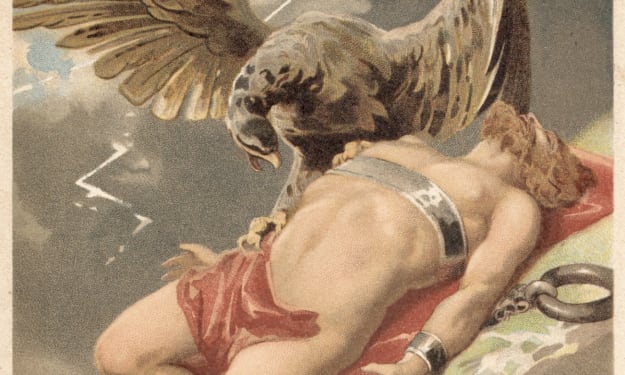
The ancient Greek playwright Aeschylus uses the maxim "know thyself" in his play Prometheus Bound. In this play, Prometheus first rails at the Olympian gods, and against what he believes to be the injustice of his having been bound to a cliffside by Zeus. Oceanus comes to Prometheus to reason with him, and cautions him that he should "know thyself." In this context, Oceanus is telling Prometheus that he should know better than to speak ill of the one who decides his fate and accordingly, perhaps he should better know his place in the "great order of things. In other words "Know Thy Place."
By Scott Dodgson6 years ago in Futurism
God of Nature - Pan Appears During Vision Quest
I walk the beauty way, hey hey, the beauty way,hey hey, the beauty way,Sacred Dawn comes and sings to me, hey hey, the beauty way, hey hey, the beauty way, Sings me songs that set me free, hey hey, the beauty way, hey hey, the beauty way.
By Beauty Way Aging6 years ago in Futurism
Dating Outside My Faith Changed Me
Faith has been at the forefront of most of my relationships, though it never seemed to be a deal-breaker. I’ve become romantically entangled (dating or not) with individuals across the spectrum: Catholic, Evangelical, Secular Jew, Conservative Jew, Sunni Muslim, Agnostic—you name it.
By Allison van Tilborgh6 years ago in Futurism
The Muslim Hair-Cutting Experience
I'm sitting in a salon chair with foil layered between sections of my brown hair. With some of my surplus derived from my larger-than-normal paycheck, I decided to get blonde highlights. You know, 'treat yourself' stuff.
By Allison van Tilborgh6 years ago in Futurism
Does Religion Hold Us Back?
I recently had someone comment on a post I wrote where they stated that religion will soon 'evolve away' and produce a more loving, caring society in it's void. This individual accused all forms of religious expression as discriminating on the basis of factors such as sex, gender, race, and other faith.
By Allison van Tilborgh6 years ago in Futurism
Open-Mindedness Opens Life’s Doorways
An academic viewpoint on religion provides perspectives on a wide range of beliefs, while being religious means devotion to a higher power. Religion courses are important in college, not only because they teach religion, but students are taught to develop a type of mindset and view that can be applied to all walks of life. Education builds a bridge to lessen the expanse between theory and practice, and it offers a safe venue to explore ideology and its effects on pluralism in society.
By Almárëa Laurësil7 years ago in Futurism
Pluralistic Coexistence
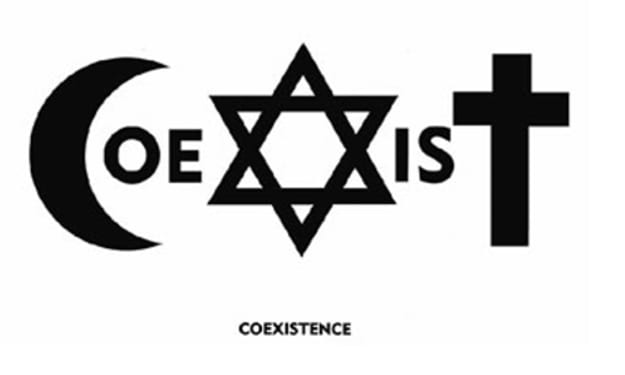
Article Source. OUTLINE In this article, Eck describes the concept of pluralism. She talks a lot about the distinction between pluralism and diversity. Pluralism goes beyond what diversity is. It is something along the lines of diversity with coexistence. The concept of pluralism is built on the idea of engagement, and creating a harmonious society out of these different cultures in our country. This is a key distinction from diversity, which does not rely on interactions between groups.
By Almárëa Laurësil7 years ago in Futurism