science fiction
The bridge between imagination and technological advancement, where the dreamer’s vision predicts change, and foreshadows a futuristic reality. Science fiction has the ability to become “science reality”.
The House Had Eyes
Every morning I wake up and crave three things: Sex, coffee, and my phone. Usually, the closest thing on hand is the phone—but before I reach for it, a thought always flits through my being—this doesn’t have the answers. I reach for it anyway. And all too often, I’m disappointed.
By Joshua Sky9 years ago in Futurism
Sci-Fi Webcomics to Devour All At Once
Not so long ago, there weren't enough great sci-fi webcomics to shake a ray-gun at. Now, you've got serious options for pretty much every sub-genre you can imagine, from hard sci-fi to space opera to satirical speculative space fantasy. Here's my list of the best sci-fi webcomics to make you laugh, make you think, and feel like a kid again with the best Sunday paper in the galaxy.
By Sarah Quinn9 years ago in Futurism
‘The Invisible Man’ - Science Fiction’s Great Horror & Humanity’s High Tech Desire
“An invisible man can rule the world. Nobody will see him come, nobody will see him go. He can hear every secret. He can rob, and rape, and kill! Power, I said! Power to walk into the gold vaults of the nations, into the secrets of powerful kings, into the Holy of Holies; power to make multitudes run squealing in terror at the touch of my little invisible finger. Even the moon's frightened of me, frightened to death! The whole world's frightened to death! “ -
By Will Stape9 years ago in Futurism
Space (Part II - Vonnegut's Cat's Cradle)
In my last article, I discussed William Gibson's cyberpunk classic Neuromancer as a key text in the convergence between science fiction and postmodernism. This time, I want to stay right on the cusp and consider the case of Kurt Vonnegut, who happens to be the writer who made me want to be one myself someday.
By M. Thomas Gammarino9 years ago in Futurism
Interview with Martin Shoemaker
Omni had the opportunity to speak with Martin L. Shoemaker, multi-award winning author and professional programmer. His short story Today I Am Paul was nominated for a Nebula Award and he has won much accolade in the span of his six year career. Martin has written for publications such as Analog, Galaxy’s Edge and Clarkesworld. He has a number of upcoming projects, including several novels.
By Joshua Sky9 years ago in Futurism
Sci-Fi's Obsession with Ancient Greece and Rome
Sometimes science fiction returns to the past for places, people, and themes to enrich its mind-journeys into the future. Such is the case with these sci-fi movies, TV episodes, and works of fiction, each one drawing from the ancient worlds of Greece or Rome to dress its story. Brit Marling, a screenplay co-writer of Another Earth, says that this isn’t really surprising. “We’re retelling the same dramas from Ancient Greece,” Marling said. “These stories are so fundamentally old, the mythology that they come from, the hero’s journey — the way a narrative works. Science allows you to take the same story and see it from a new perspective because the science is always new and fresh.” Science fiction’s interest in the ancient world goes beyond mere allusion, as in the middle name of Captain James Tiberius Kirk (Tiberius, in case you’re wondering, was a somber, reclusive Roman ruler who nevertheless left the empire in a better state than he found it). If you’re deeply interested in how the speculative worlds of the future and the worlds of ancient Rome and Greece intersect, you may be interested in a serious paper by academic Tony Keen, “The 'T' stands for Tiberius: models and methodologies of classical reception in science fiction.” If that sounds a little heavy, enjoy the following summary of a few times when togas, laurel wreaths, aliens, and spaceships partied it up in one crazy combination.
By Sarah Quinn9 years ago in Futurism
Hollywood Halloween Hijinks - Count Dracula As An Extraterrestrial?
“Listen to them, the children of the night. What sweet music they make!” Count Dracula in "Dracula" - by Bram Stoker Loyal fans of the insidious exploits of the king of the vampires have been listening to haunting music played as a foreboding symphony from the bloodthirsty undead for decades. Ever since actor Bela Lugosi first put on the iconic cape in director Tod Browning’s 1931 landmark film, Dracula, movie audiences have lovingly embraced the coolest blood sucker of them all - Count Dracula. Before the Hollywood classic flick from Universal studios, readers immersed themselves in the bleak world of author Bram Stoker’s breakthrough novel, chronicling the wild adventures of the world’s most infamous vampire. Once Hollywood got a hold of Stoker's creation, the nefarious prince of darkness went through innumerable permutations, and Tinseltown is still morphing the world's favorite fang master.
By Will Stape9 years ago in Futurism
The Human Itch
Stan scratched at the red mark on his skin. It was one of many small scabs that had been bothering him for a few days now. A minuscule, amber crusted sore that bordered his left thumbnail. Carefully, he picked, picked, picked at it. Getting a fingernail beneath it, so it would peel off, sending a small shock of pleasurable pain.
By Joshua Sky9 years ago in Futurism
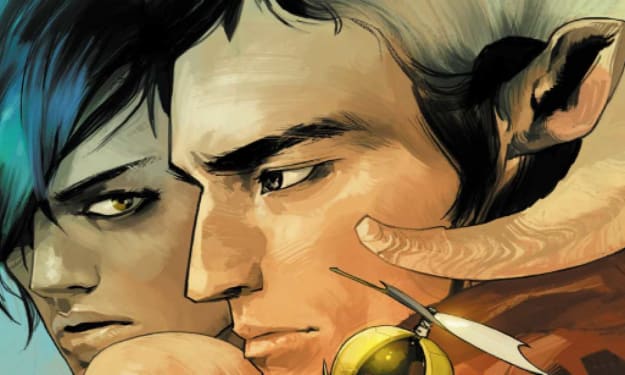
The Best New Sci-Fi Graphic Novels
Picture books aren’t just for kids. In fact, when it comes to the best sci-fi graphic novels, they usually aren’t for kids at all (here be mature themes, like crazy alien sex and buckets of violence). Immerse yourself in tantalizingly rendered stories of robots, aliens, human beings, and creatures that lie somewhere in between. From struggling underwater colonies waiting for an inevitable supernova to the madcap adventures of all-American scientific geniuses, you’ll find the story that’s right for you - one that's harder and harder to tear yourself away from.
By Sarah Quinn9 years ago in Futurism
Best Sci-Fi Franchises
The best sci-fi franchises are often based on imagining what problems and solutions future technology will bring us, unlike fantasy, which is largely based on a magical reimagining of a medieval-type world. Where fantasy is conservative, instructing us to learn from the past, science fiction is progressive, asking us to look to the future for answers. This often makes the science fiction genre a challenging and liberal engagement with issues we currently face, issues we may one day face, and solutions that the future might hold. This makes the best sci-fi franchises all the more worth our careful consideration.
By James Lizowski9 years ago in Futurism
How Frank Herbert's 'Dune' Warned Of The Rise of Artificial Intelligence
“Fear is the mind killer. Fear is the little death that brings total obliteration. I will face my fear. I will permit it to pass over and through me. And when it has gone past, I will turn the inner eye to see its path. Where the fear has gone, there will be nothing.”Only I will remain. - Dune by Frank Herbert - 1965
By Will Stape9 years ago in Futurism
Ice World Truckers
Friday, February 22nd 2115, 1413 Hours. Galactic Industries Fuel Depot 3. Orbiting Saturn’s moon Titan. Jax sat at the controls of the Earth Cargo Union hauler, Mari Kait. “Are the docking clamps ready?” he called over his shoulder without taking his eyes from the panel displaying the ship’s position in relation to the Depot’s docking port. They appeared to be perfectly aligned, but he wasn’t going to leave it to chance.
By Michael Medeiros9 years ago in Futurism