science
Topics and developments in science and medicine, presented by Futurism.
God vs Science
Science, it is the very cornerstone of our modern age and something that is intrinsically tied to our future on this planet. The wonders of the universe are vast and beautiful and leave me in awe with each sight I behold. When I witness the beauty and wonder of the cosmos I feel it not in my mind, or my heart but in my very soul like a long lost memory.
By John Ames Birch9 years ago in Futurism
Carl Sagan's 'Billions & Billions'
More than two decades after his untimely passing, Carl Sagan's life and work continue to resonate. The famous documentary series Cosmos, which helped to make him the best-known scientist of his time, was revised and updated just a couple of years ago, introducing him to a new generation that might not even have been born when he passed away. Yet in reading Billions & Billions, a posthumously published collection of his essays from 1997 which I encountered earlier this year, I found myself struck by just how much this particular set of his work remains surprisingly relevant today.
By Matthew Kresal9 years ago in Futurism
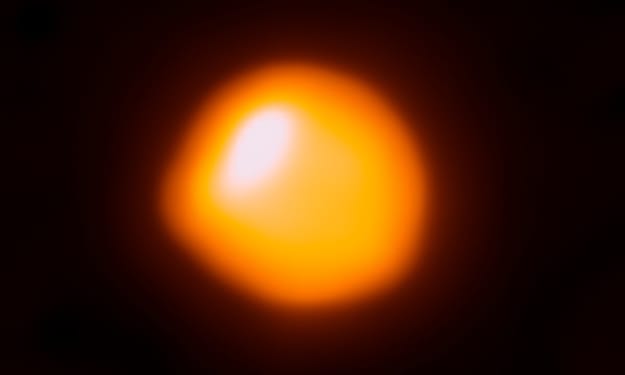
Astronomers Take New Highest-Resolution Image of Giant Star Betelgeuse
Betelgeuse is one of the largest stars known in our galaxy, a red supergiant, and now astronomers have taken the highest-resolution image ever so far. They used the Atacama Large Millimeter/submillimeter Array (ALMA) in Chile for their observations, and not only was it the first time that ALMA had observed this star, but it succeeded in producing the highest-resolution of Betelgeuse currently available.
By Paul Scott Anderson9 years ago in Futurism
Screen Reader Usage: Part 3
Welcome to another article in the series dealing with screen reader usage for the blind and visually impaired. This time, I would like to cover how someone who can't see can use a screen reader to browse the internet. When I was growing up, the process was far easier; we dialed in with a text browser and everything just worked. Links were numbered and we would simply press the number corresponding with the particular link we wanted to browse. With Windows, that whole system changed. That was the beginning of what we call browse mode or MSAA mode, which is now widely used. I would like to discuss how this works.
By Jared Rimer9 years ago in Futurism
A History of Gravitational Waves
14th September 2015. A 4 kilometer long arm forming part of the Laser Interferometer Gravitational-Wave Observatory (LIGO) changed its length by one ten-thousandth the width of a proton, due to a distortion in spacetime, disturbing a laser beam housed inside. Computers immediately detected the mind bendingly miniscule change, sending an automatically generated email containing the observed data to a postdoctoral researcher by the name of Marco Drago working in the Max Planck Institute for Gravitational Physics in Hannover, Germany. Marco’s job was to monitor LIGO readings examined the data to rule out any error or “dummy signal” used for testing purposes. Within a few days news of the detection had been leaked to the world astrophysics community and after the observation had been definitively confirmed an official press conference on the 11th of February 2016 revealed to the world the first observation of a gravitational wave on earth by LIGO.
By Devon Keogh9 years ago in Futurism
Chemical Mind
The brain is the most mysterious and highly complex device in the known universe, being composed of over 100 billion neurons, each with 10,000 or more possible connections, forming an astounding 100 trillion connections called synapses. Unlike other body cells, neurons never touch each other; instead, they are separated by gaps only 20-40 nanometers wide (to put this to scale, a piece of paper is roughly 100,000nm wide). Remember, these numbers don't include the neurons that exist within your body, some of which being as long as the distance from your head to your big toe!
By Justin Gignac9 years ago in Futurism
The Law of Attraction and Getting What You Want.
The universe we live in is made of energy. Everything we perceive is energy in some form or another, even our thoughts. All energy has a vibrational frequency, vibrating at a specific rate. We as beings transmit different frequencies of vibration into the universe. Our vibrations attract energies with the same vibrational frequency. This means that attitudes, emotions and even our thoughts that can raise or lower our vibrations that attract different energies to us, which in turn alters the physical world through its manifestation.
By Phillip Woodford9 years ago in Futurism
Are IQ Tests Valid Measurements of Human Intelligence?
According to britannica.com, human intelligence is a mental quality that consists of the abilities to learn from experience, adapt to new situations, understand and handle abstract concepts, and use knowledge to manipulate one’s environment. So, are IQ Tests valid measurements of human intelligence? And if not, then what is?
By Jeniah Clarke9 years ago in Futurism
Why We Should Stop Using the Word Race, It's Stupid.
I have a friend, not just any kind of friend but that special friend who looks at you and knows exactly what's up. The guy/girl you go to when you're in love, scared, confused. The brother from another mother. The sister you never had. That person we all have or should have.
By Milad Hussin9 years ago in Futurism
Philosophy: the Essential Analysis
Knowledge is the first principle. Man exists as mind. To found one’s principles upon any other axiom denies personal existence. The self-awareness of the individual provides the essential absolute necessary for any comprehension of the nature of existence. Mind is the knower. The nature of knowledge is the definition of cognitive awareness. Definition is founded upon the principles of reason. The binary nature of definition provides a framework for the comprehension of reality. Any given bit of knowledge must be either affirmed or denied, and it cannot exist simultaneously affirmed and denied. The affirmation or denial of any proposed idea is considered a single Knowledge. The accumulation of knowledges in the mind is the awareness of our existence. We live in a world of ideas, each an abstract conception in and of itself defined by logic into a coherent superstructure structure of consummate sentience. Experience, however, is ultimately subjective. Due to the self-defining nature of knowledge, this does not mean it is untrue, but that the very premise of true and false are contained in the mind as human conceptions. You may speak gibberish, and you may build a house of straw, but one will soon find that it is becoming to model one’s definitions after the objective reality instead of demanding nature to bow down to your dictionary. In that knowledge is a matter of subjective experience, knowledge has no basis in objective reality. One can assume a house to be made of oak, but if so, then this house of oak was swept away on a gentle breeze. The physical matter of which the house was composed has no name outside of the mind of the knower, but the principles of weight and tensile strength will remain objective. The external world is an unknowable postulate from the vantage point of the human mind. All active stimulus is but the sensation of the brain; the reality of this sensation can neither be affirmed nor denied; only accepted or rejected as a knowledge. Not even the brain can truly be affirmed nor denied as real, but that the thoughts of sensory awareness are manifest. Thought is the substance of the mind, and the basis of knowledge. Definition applied to thought is idea. The nature of our sensory existence is the foundation of our belief in an external reality. We see the world and we hear it and when we eat it we taste it and feel it going into our bodies—but then we wake up and it was actually quite a dream, and certainly that which is dreamed is not a reality. However, in that the faculties of sense continue to operate even in states of unreal consciousness, the senses alone cannot provide the evidence for an external reality. It becomes necessary for us to observe a moment of silence for all the dead solipsists.
By Eliander Black9 years ago in Futurism
The Consciousness Paradox . Top Story - June 2017.
Unlike any other species on this planet, humans develop extreme anxiety when thinking about the possibility of nothingness after death. With strong egos and attachment to the material world, ideas and theories of what comes after death and how humankind came to this land were developed. We found comfort in these thoughts, reassuring ourselves that our lives have purpose, meaning, and existence even beyond death. Humans find comfort in having purpose, for without it life seems almost meaningless... hopeless.
By Justin Gignac9 years ago in Futurism