space
Space: The Final Frontier. Exploring space developments and theorizing about how humans fit into the universe.
NASA Names Pluto Craters After Star Wars, Star Trek and Doctor Who
Pluto was downgraded from a Planet to a Dwarf Planet in 2005. Pluto's surface has always been unknown. But not now. On the 14th July 2015, New Horizons spacecraft was the first to get detailed and accurate measurements and also a load of observations of Pluto and its Moons.
By Lewis Jefferies8 years ago in Futurism
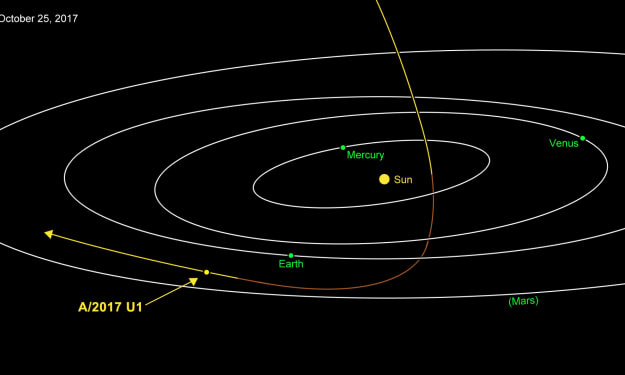
What Was the Solar System's Mysterious Interstellar Visitor Last Week?
Last week, something unusual was detected moving through the Solar System, a small object which didn't seem to behave like any known comets or asteroids. In fact, its behaviour suggested that it originated from outside of our Solar System. So what was this mystery interloper? While not 100 percent identified yet, it seems to be an interstellar asteroid or some similar rocky body.
By Paul Scott Anderson8 years ago in Futurism
Interstellar Object
One of the first sci-fi books I ever read was Rendevzous With Rama by Arthur C. Clarke. I was only about twelve years old, and it left a lasting impression. My imagination has been running overtime for the better part of twenty years because of it; after all, what would it be like to have an extraterrestrial object ploughing through our solar system? What would that mean for mankind?
By Simon Mcbride8 years ago in Futurism
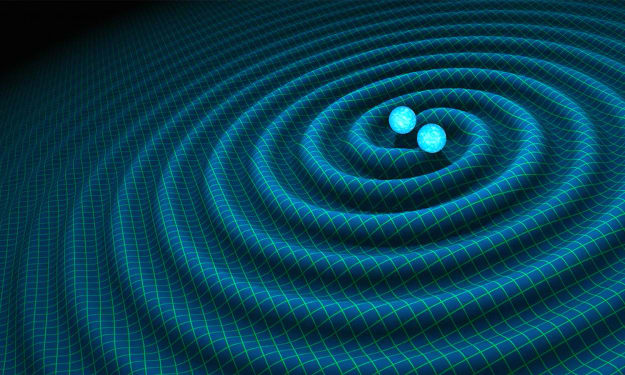
Astronomers Strike Gold (Literally) in the First Observations of Gravitational Waves Produced by Colliding Neutron Stars
There was some big astronomy news this week, as astronomers announced the first direct observation of gravitational waves produced by the collision, or merging, of two neutron stars. This collision even produced some heavy elements, such as gold. It sounds like science fiction, but is very real. Gravitational waves have been seen before, but those ones were caused by the collision of two black holes. This was also the first time that such an event (known as GW170817 in this case) had been detected in both visible light and gravitational waves.
By Paul Scott Anderson8 years ago in Futurism
NASA Says Good-Bye to the Cassini Saturn Orbiter
On September 15, 2017, the Cassini-Huygens mission to Saturn will culminate in a dramatic and fiery collision with the planet's upper atmosphere. NASA, the European Space Agency, and the Italian Space Agency teamed up for the groundbreaking mission that has changed what we know about planetary science and space travel itself.
By Anya Wassenberg8 years ago in Futurism
Astronomers Detect 15 New Enigmatic Radio Bursts from Distant Galaxy
In the search for extraterrestrial intelligence, astronomers have come across a variety of unusual phenomena in the universe; while natural explanations have been found for them, so far at least, some of these phenomena can be very bizarre. Fast Radio Bursts (FRBs) are one such example, and one for which an explanation has not yet been found—very brief (milliseconds), but powerful radio emissions from outside of our galaxy. Now, a new detection of 15 repeating radio bursts has been made by astronomers, adding a new piece to the puzzle and posing more questions.
By Paul Scott Anderson8 years ago in Futurism
Stuck in a Tin Can in Deep Space
One of the most iconic phrases in Science Fiction is Star Trek’s original opening line, “Space, the final frontier.” Space may be the final frontier, but first, we have to be able to survive the cold vacuum of vast open nothingness that makes up the unimaginable distance between our solar system and our nearest stellar neighbor. Or, even just make it to our nearest stellar neighbor that has a potentially habitable planet.
By C. A. Wilke8 years ago in Futurism
Beowulf's Commission
"Free trader Beowulf to Deimos flight control, I am beginning my final approach." Iritana didn’t wait for the reply and nudged the thruster controls forward. It was a breach of protocol not to wait for flight control to authorize the burn but Beowulf was on a docking path and Iritana’s adjustments would only alter the course slightly. Just enough to put the ship into the docking bays instead of smearing it across the rocky surface of the moon.
By andrew lucas8 years ago in Futurism
Cosmic Rain: NASA Launches New Experiment
NASA's Cosmic Ray Energetics And Mass for the International Space Station, aka ISS-CREAM, got underway August 14, 2017 by hitching a ride to the ISS with the SpaceX Dragon rocket in a successful launch. CREAM will be installed in Kibo, the Japanese Experiment Module Exposed Facility. The experiment is designed to probe the mysteries of cosmic rays, or cosmic rain.
By Anya Wassenberg8 years ago in Futurism
On-Demand Spaceship Parts from Pink Goop?
One of the most fascinating technologies to be birthed out of the turn of the millennium is additive, or 3D, printing. And like many other scientific discoveries and inventions, it doesn’t take a ton of imagination to see how something like that might be useful in space. In fact, I would argue that in order for something like a colony/generation ship to be successful, it would absolutely need to have the ability to manufacture new parts on the spot.
By C. A. Wilke9 years ago in Futurism